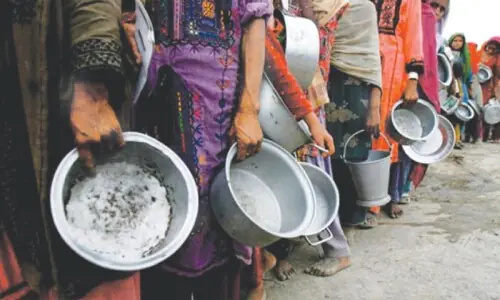
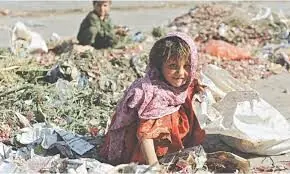
PAKISTAN’S poverty crisis is far deeper than official indicators suggest. While the government celebrates economic stabilisation, almost four in every 10 Pakistanis suffer from deprivation in health, education, and living standards.
The latest UNDP figures put multidimensional poverty at 38.3pc of the population against 19.3pc for South Asia. We are worse off than nearby countries — poverty affects 16.4pc of India’s and 14.9pc of Bangladesh’s population. These estimates are based on surveys from different years, however, and should not be treated as a strictly contemporaneous ranking. Still, the comparison is an indictment of our development priorities.
That Pakistan’s multidimensional poverty rate is almost twice the regional average is not simply a reflection of low incomes. The index captures deficiencies in nutrition, child health, schooling, sanitation, drinking water, electricity, housing, and other necessities. A family may earn enough to remain above an income-based poverty line and still lack access to these essentials. The intensity of deprivation for the multidimensionally poor is 51.7pc. Another 12.9pc of the population is vulnerable to such poverty.
This means millions more risk falling into acute deprivation when faced with illness, joblessness, rising food prices, or climate-related disasters. Our poor performance exposes the limits of an economic strategy focused primarily on containing inflation, accumulating foreign exchange reserves and meeting fiscal targets.
Though necessary, they cannot substitute for growth and development. An economy cannot sustain higher productivity when children miss school, malnutrition damages their development, and poor healthcare pushes households into financial distress. Economic stability should be judged by whether it improves people’s lives, not merely by whether the balance-of-payments holds or the budget deficit narrows.
Pakistan’s widening development gap with India and Bangladesh is a warning that stability without investment in people will leave poverty entrenched.
Published in Dawn, October 14th, 2026