“And what rough beast, its hour come round at last,
Slouches towards Bethlehem to be born?”
*— William Butler Yeats, The Second Coming*
OPENING NOTEWilliam Butler Yeats’ chilling 1920 poem had a backdrop: World War I, the flu pandemic, the Russian Revolution and a sense of impending doom, an inflection point. The gyre is widening and turning again.
As wars rage in Eastern Europe, the Middle East and West Asia, it is important to understand what’s happening and why. Questions abound. The answers are not easy to come by, given the unknowns. Here I intend to analyse how we have got here and what lies ahead. In the final section I also discuss how we theorise about war and why.
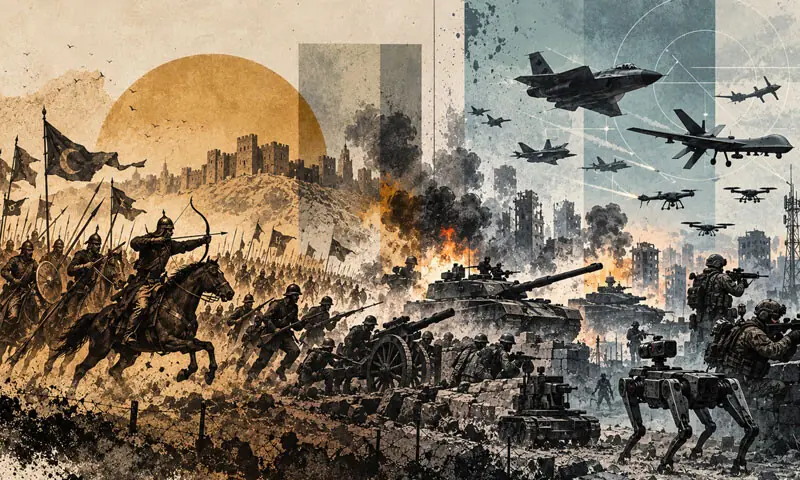
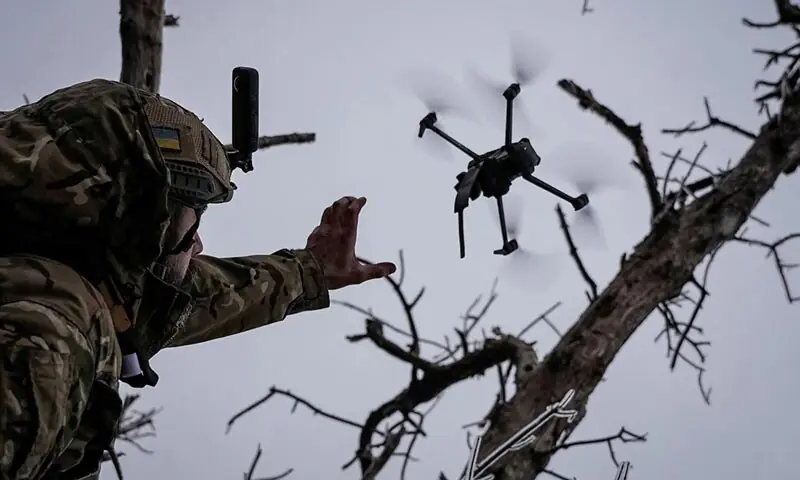
Wars bring death and destruction. Technology helps. In our era, the pace of technological innovation (the Ukraine frontline is an example) has put Moore’s law on steroids. As the ongoing wars show, sequestering digital tech (like states did with nuclear weapons) and denying it to the adversaries is becoming increasingly difficult. Physical interconnectedness means the effects of war will spread beyond the spaces in which it is being fought; digital is non-spatial. Result: conflicts are creating ever more complex second- and third-order effects. War has become compounded.
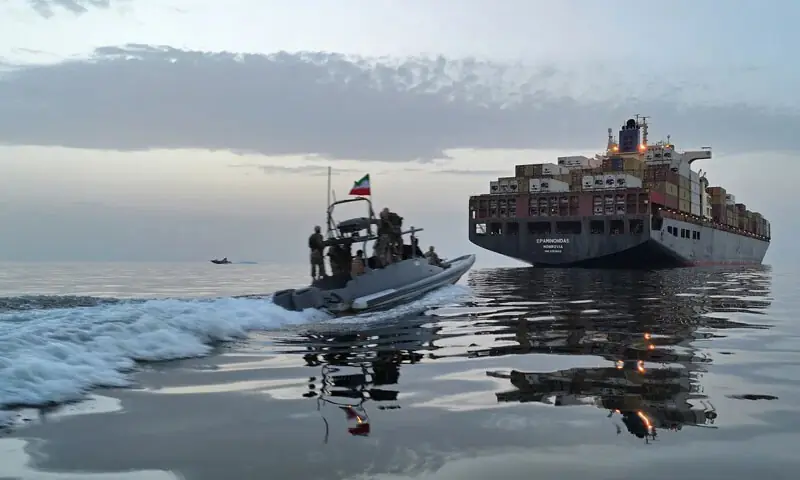
Commanders no longer stand on a knoll and cast Napoleon’s coup d’œil, the glance to judge the raging battle, and dispatch runners with new instructions. The closure of the Strait of Hormuz and its cascading effects is a case in point, as are strikes by Ukraine on Russia’s oil refineries that, in conjunction with the war against Iran, have created an oil refineries crisis, forcing US President Donald Trump to ask Kyiv to go easy on those targets.
Attacking Russia’s oil refineries is great targeting for Ukraine. Not so much for the rest of the world and energy markets. The war has also impacted US domestic politics and prices, not just the fuel price but also the bond market and its impact on mortgage payments.
From the wars in Eastern Europe, the Middle East and West Asia and the changing balance between the United States, China and Russia, contemporary conflicts are becoming longer, more interconnected and harder to resolve. Theories that once helped us understand war struggle to keep up. Attrition, technological disruption, economic warfare and geopolitical rivalry are producing conflicts with no obvious finish line and an international system increasingly incapable of containing them
Yet another problem is the finish line. X starts a war. Y fights back. Where in time and space does it end? Armies want decisive victories. Wars, increasingly, remain indecisive. Victory becomes contested. Iran against the US and Zionists; Ansar Allah against Saudi Arabia; Ukraine against Russia; the Taliban against Pakistan. This is not entirely new. Since World War II there have been many cases of tactical successes failing to achieve a war’s political objectives. That has now become a near-consistent menace for the stronger parties.
Allied with it is what I call the ‘arena problem’, a direct outcome of compounding. The clash percolates into ether (information war, influence operations, cyber-attacks), financial and commodities markets, shipping and insurance (resulting in energy volatility, food insecurity, shortages of raw materials in petrochemical industries, the list is long). The kinetic embracing the non-kinetic in a new dialectic.
The element of compounding and the absence of finish lines throw up another problem. War with its many battles is morphing into protracted conflicts that contain within them iterative wars and their battles, interspersed with pauses of uneasy, tenuous peace. As Nadia Schadlow, Trump’s former Deputy National Security Adviser for Strategy, has argued in a recent article for Foreign Affairs (‘America’s Attrition Trap’), belligerents increasingly have non-negotiable objectives. That leaves little room for compromise and makes conflicts intractable and wars within those conflicts attritional.
Gone are the days of short, decisive wars when “relatively small numbers of sophisticated and expensive weapons systems” could devastate the enemy. Conflicts are now long and grinding. The world has learnt that the US does not have the industrial base that can rapidly replace many of the sophisticated munitions it has expended attacking Iran. Worse, it doesn’t have a strategy to create the political conditions required for victory.
If attrition comes, can sustainment be far behind? No. Sustainment requires industrial assembly lines. The US won WWII because of its industrial output and innovation. It is now constrained by the inability to produce at scale. This isn’t a problem higher GDP can solve. As Schadlow notes, you can’t fire GDP from artillery tubes. That creates a gap “between nominal power and usable military capability.”
When a war is happening, military theorists study it even as events are unfolding. While studying an ongoing war is crucial, it is important to remain wary of applying its lessons to every case. This is not to say that every war is absolutely different in its conduct. Just that one has to be careful in selecting what could apply to one’s own context. The Zionist war against Hamas and Hezbollah is not the same as a war against Iran or Ansar Allah.
Sustainment and attrition are not new problems. The two great wars were all about attrition and sustainment. Attrition was taken for granted and it couldn’t be addressed without sustainment. Strategy incorporated both and industrial production responded to the challenge. That changed with the RMA (revolution in military affairs) in the 1980s. Lean became mean. Quality replaced mass in the field and scale on the factory floor. The wheel has turned again.
But before we proceed, a word is in order about the environment in which the present threats are emerging.
LIBERAL-INSTITUTIONALISM MAKES SHIP-WRECK
When the Soviet Union passed into history, liberal institutionalism declared victory. US political scientist Francis Fukuyama told us history had ended though, in fairness, he had borrowed the term from the German philosopher Georg Hegel, who had meant it in a teleological sense, ie history had achieved its ultimate purpose.
In his 2011 book, Canadian psychologist Steven Pinker came up with statistical abracadabra to tell us that violence had declined (Iraq and Afghanistan were happening). American political scientist Robert Keohane’s 1984 critique of hegemonic stability theory became the beacon for neoliberal policy. One-time US assistant secretary of defence Joseph Nye Jr gave us the soft power framework just before the demise of the Soviet Union. Power should attract and affect others to get the outcomes one wants. Culture and values played a crucial role, said Nye, as did foreign policy approaches that were grounded in legitimacy, cooperation and moral authority.
Nye has passed on and is beyond these concerns now. Keohane is witnessing the unravelling but has dug in (that’s a separate debate). But the point is that there was much rejoicing all round. It seemed the party was over for the Realists.
The Constructivists, a hybrid theoretical breed, were not to be left behind and found a backdoor to this victory ball. In any case, the long and the short of it was that, even without a world government, we were assured that we were close enough with the US as the benign unipole. Western and international institutions (the North Atlantic Treaty Organisation, the European Union, the United Nations, the World Trade Organisation) were no longer just tools to manage the Cold War, they were the architecture of a new, rules-based, “liberal international order.”
In an ideal world, perhaps — the hegemon establishing a just order and submitting to it before demanding that everyone else should too. Rules applying in equal measure to everyone. Except, the world got liberal hegemony. The hegemon sets the rules but wants to sit atop them, while coercing everyone else into submitting. That’s when the bondsman decides, in a Frantz Fanonian way, to fight back. That moment births consciousness, the value that asserts that there is a part of human nature, a baseline of human dignity and right, that none must be allowed to cross.
Let’s now take a quick look at the current geopolitical scene before we round off with how we theorise about war. I eschew details because every item on the list can be written about at great length.
BRAVE NEW WORLD
John Mearsheimer marks 2017 as the end of the unipole anomaly. It’s not a random year but a structural pivot. Trump comes to power in the US and drops the language of the liberal international order. China’s economic miracle begins to translate into fast-paced acquisition of military capabilities. Putin’s two decades of efforts to resurrect and reassert Russia are succeeding and the US’ liberal hegemonic foreign policy now has rivals.
International institutions and norms, never much comfort for the Global South, are unravelling, as are the legal standards and norms of international law (witness Trump’s recent tirade against the International Criminal Court). While many states, such as Japan, continue to support international institutions, they have to walk on eggshells, because the state that provides them security is the one taking its own edifice down brick by brick.
The global state of affairs for arms control and non-proliferation is at its most dangerous and fragile point since the Cold War. The New Strategic Arms Reduction Treaty between Russia and the US officially expired on February 5 this year without a successor agreement, which means there are no legally binding limits or mutual on-site inspections governing the strategic nuclear forces of the two. The 2026 Non-Proliferation Treaty Review Conference collapsed for a third time without achieving a consensus final document because of geopolitical gridlock. Meanwhile, the de facto global moratorium on nuclear explosive testing is under strain due to political rhetoric and modernisation efforts at test sites in the US, Russia and China (corollary: bilateral and multilateral nuclear guardrails are disappearing).
The UN security council is paralysed and diplomacy is giving way to raw military coercion. Since Trump’s first term in office, sanctions and protectionism have weaponised trade, critical supply chains and international financial systems. That threatens the concept of a unified global economy.
All of this is compounded by emerging tech (artificial intelligence or AI, robotics, lethal autonomous weapons). AI is already part of the kill chain while experts debate the moral, ethical and legal implications. Add to that hypersonic weapons as delivery systems, normalised rhetoric of nuclear brinkmanship (from Trump’s “a civilisation will be obliterated” to Putin’s threat on Kaliningrad) and the global architecture splitting into competing, militarised blocs, and we are watching the post-WWII order fray slowly and steadily.
Result: escalating probability of global conflict and the return of Realist principles of anarchy and hard power. Which of course brings us back to war.
WAR AND THEORIES
Human consciousness is defined by a fundamental paradox. The inordinate desire and the ability to create surplus requires understanding our environment. But our environment, whether our immediate physical world, the cosmos, or human affairs, is rarely linear. Causality is not easy to understand, especially when dealing with human societies. To understand the complex non-linearity, the mind must simplify, slice and label things and events.
Knowledge in this sense is reductive. We search for patterns and impose structures on the phenomena around us, to translate complexity into usable meaning. We build theories. There’s a slight problem, though. We want the theory to hold across time and space, to give us immutable principles and conquer temporality. It can’t, but we need boxes we can check.
Theorising about war is no different. Readers are generally aware of such names as Carl von Clausewitz and Sun Tzu. But there are many more and no less important. All have written about war’s nature and its character. While there’s a general acceptance that war’s nature doesn’t change and it remains a violent clash of opposing political wills, the problem is structural.
Three defining elements (and their sub-elements) form the basis of potential conflict. The first is anarchy, to be understood not as chaos but the absence of a central authority to which states can submit. This means that every state is ultimately responsible for its survival; it also means it has a security dilemma. By what means must it survive?
Laws and institutions can help but they can’t ensure survival. The dilemma is that intentions can’t be predicted, so capabilities must be watched closely and matched. For instance, in a triadic situation such as Pakistan, India and China, Pakistan cannot assign a lesser value to its security simply because China could bail it out because of Beijing’s friction with New Delhi. Similarly, when India says that China is its primary threat and its military modernisation is to keep pace with China, Pakistan cannot rest easy because, in a conflict, India will not set aside certain capabilities as essentially China-specific and therefore unusable against Pakistan.
The second element is power distribution. Its first sub-element is the return of more than one great power centre. In other words, the ‘tragedy’ of great power competition is back. The second element is the pressure generated by power transition. When the structural gap between a dominant superpower and a rising challenger narrows, the likelihood of inter-state conflict spikes.
The third element is history’s persistent geopolitical flashpoints. We don’t arrive at any point with a clean slate. The past is etched on the slate. Geography becomes zero-sum: borders, sea-lanes, choke points, territorial claims, resource scarcity (water, for instance) and competition (oil/minerals). Resources are now entwined with tech competition and vulnerabilities: energy, water, rare earth minerals.
With these elements taken as constants, we are left with the conduct of war. How to fight to win? Are there any principles involved? Can we figure out a non-spatial and non-temporal theory? In other words, can war be understood and even conducted on the basis of some theory across time and space?
Changing nature of war
Observing Napoleon keenly, Clausewitz insisted on total mobilisation and concentration of all forces towards crushing the enemy in battle. He even minimised the elements of surprise, deception and manoeuvre and believed that they might divert the commanders from advancing to battle as swiftly as possible. But he was in for a shock. After 20 years of developing his thought, he looked at France’s Spanish and Russian campaigns and realised that Napoleon’s adversaries had won against him by doing the opposite: avoiding battle, effecting deep withdrawals, using a scorched earth strategy, and, yes, guerrilla warfare.
In fairness, Clausewitz wasn’t the only one looking at Napoleon. Antoine Jomini, his contemporary, observed Napoleon even more closely. In fact, Jomini’s entire theoretical framework was an attempt to codify Napoleon’s genius into a replicable science. Napoleon himself was deeply influenced by Comte de Guibert, whose 1772 work General Essay on Tactics argued for a highly mobile war of movement, independent combined-arms divisions and living off the land rather than relying on slow supply wagons. Napoleon essentially took Guibert’s theoretical concepts and executed them on the ground. Unfortunately for him, the damn Russians kept burning everything right up to Moscow and then burnt Moscow itself!
Gen Giulio Douhet, the Italian air war strategist whose theories informed much of air war during World War II, argued that strategic airpower would be the decisive factor and conclude wars within hours or days. That hasn’t aged well, as we know from subsequent events and qualitative and quantitative analyses by various experts.
Alfred Mahan was a US naval officer and naval war theorist. His ideas about securing maritime supply networks, controlling global sea choke points and projecting power through logistics remain fundamental to modern naval war and trade doctrine. The British, Germans and French studied him avidly. And yet, he thought of naval war like Douhet thought of air war. He lost focus on developments like the railways and the shifting balance between sea and land transportation. Surprisingly, he also thought little of commerce raiding and focused on the great naval battles. The German U-boats in WWII put paid to that. In fact, Churchill considered German commercial raiding the biggest threat in the Atlantic.
It’s important to clarify that all these strategists distilled insightful ideas from actual wars. They were brilliant. In the case of Douhet, he understood the potential of war in the air, a new phenomenon. But the one flaw that underlay their theories was simple: they were looking for and tried to present a theory that was supposed to beat time and innovation. That’s generally a losing battle.
Before WWI, military art looked at two levels: strategy studied war, while tactics looked at combat engagement. During the inter-war period, Russian theorists Aleksander Svechin and Georgii Isserson studied WWI, its immense scale, mass mobilisation and its wide geography. In his 1926 work Strategy, Svechin argued that a modern campaign is not a single clash, but a series of disjointed tactical engagements over wide geographies. War required an intermediate level. He called it operational art, the skill required by a commander to direct and chain these individual tactical battles together towards a unified strategic goal across time and space. He also recognised that wars would be attritive and require sustainment.
Isserson turned the theoretical concept into practical methodology. In his influential 1936 book The Evolution of Operational Art, he laid out the blueprint for what he called Deep Battle — ie an offensive must strike the entire depth of the enemy’s deployment simultaneously. This was the seed that sprouted the concept of manoeuvre war.
Germans were concurrently developing their manoeuvre doctrine (bewegungskrieg — movement warfare) under Gen Hans von Seeckt. They were focused on achieving a rapid, mobile outcome with highly capable forces, before an enemy could fully mobilise. Isserson was codifying a Soviet version of “distributed, manoeuvre-focused operations.” Both systems rejected the static linear gridlock of World War I in favour of dynamic, motorised movement.
But here’s the thing. After the slaughter of infantry attacking lines in WWI, many argued that infantry had become passé. That was not to be. Tactical adjustments, fire and manoeuvre techniques, decentralisation of tactical command and mechanisation did not just keep infantry in play but it remains, to this day, the ultimate arbiter of victory, by holding and exploiting territory. Will it remain so, if and when robots and other lethal autonomous weapons are fielded, is unknown territory.
A similar thing is happening to the tank in relation to the threat of direct attack and loitering munitions, as also tandem-charge anti-tank projectiles. The Falklands war began a debate about the usefulness of larger naval ships. They are still here and so will be the tank. Its armour protection relative to its weight and movement has reached an optimal level. The focus now is on local protection (defensive systems and tactics in the tank’s surrounding, to protect it from close-range and precision threats) through identifying and neutralising threats. As for the future, nothing is certain.
I understand the desire to see into the future. But the point is simple: every theory must accept the limitations of time and space. Certain principles remain constant. Their application changes with technology.
This is where we get into another trap. When a war is happening, military theorists study it even as events are unfolding. While studying an ongoing war is crucial, it is important to remain wary of applying its lessons to every case. This is not to say that every war is absolutely different in its conduct. Just that one has to be careful in selecting what could apply to one’s own context.
The Zionist war against Hamas and Hezbollah is not the same as a war against Iran or Ansar Allah. The Russo-Ukraine war has two seemingly paradoxical trends: a static trenched frontline with conventional obstacles and another (with drones, counter-drones, satellite communications) where, to quote Schadlow again, the “feedback loop for learning [and innovation is running] directly from the battlefield to engineers and manufacturers and back again.”
We are fighting against Afghanistan. That war and its conduct is very different from the wars we have fought against India and will likely fight in the future. Attrition and sustainment acquire relatively different meanings, for instance, in the case of India and Pakistan than they currently do in the case of Russia and Ukraine. Planning and execution, therefore, have to keep these subtle and more obvious differences in mind.
Equally, certain developments will be shared across these different battlefields. Drones are one; missiles, another. On the defensive side, this means counter-drone tech (upgraded legacy anti-aircraft guns with radars and target-tracking sensors in close-in weapons systems against threats that have bypassed outer defensive layers) and anti-cruise and ballistic missile defences.
Drones already are and increasingly will be a ubiquitous menace even in the hands of non-state actors. Commodification of tech means a lot of cheap but effective tech will be available to non-state actors through 3D-printing and information and instructions acquired from AI (Yemen’s Ansar Allah reportedly used Claude recently to hone target tracking and acquisition).
Similar principles apply to force employment. For instance, Iran can afford to take defence in depth against ground incursions. Its land borders are sparsely populated and the terrain is formidable. It can allow an invading force to come in and give battle at a time and place of its choosing. Pakistan cannot. It lacks depth and the bulk of its urban infrastructure, lines of communication and population centres are in close proximity to Indian axes of advance. It has to ensure, in a contact war, to fight it on Indian soil.
CLOSING THOUGHTS
We need clarity. But clarity is very hard to come by. To offset the disadvantages of an approach that slices and dices, we introduced systems analysis and general systems thinking, borrowing the approach from biology, maths and engineering.
It came as a decision-making tool to the Pentagon during the Cold War and seeped into the social sciences. The problem is that human systems are complex, reflexive and volitional and have a bad habit of undermining predictive models. Hegel and Marx introduced dialectics. Holistic knowledge in this sense is the ability to hold two opposing realities in mind simultaneously and trace how they shape each other over time.
It sounds great but it too has limitations. Two opposing human forces is a game played by actors with free will, shifting emotions, and flawed information. In other words, dialectics can explain the nature of the struggle, but it cannot really map the outcome.
That’s where we stand both in terms of the current trajectory of geopolitics as well as the outcome of that trajectory. The reason is simple: we are on a foggy slope and we don’t know where the precipice is. There are no real answers to the questions we have. Let no one tell you otherwise.
The writer is a journalist interested in security and
foreign policies. X: @ejazhaider
Published in Dawn, EOS, October 11th, 2026