Growing up in Pakistan, introducing myself always required a disclaimer.
Because my surname is Khan, people instantly assume I speak Pashto and either hail from the north or belong to a specific tribal culture. Instead, I grew up in an Urdu-speaking household, shaped by the cultural traditions of Uttar Pradesh (UP) in undivided India. For my entire life, I have found myself having to justify my own surname.
In Islamabad, a bureaucratic city where almost everyone hails from somewhere else, two questions governed my 1990s school playground experience: “Tum loag kaun ho?” [Who are you people?] and “Tumhara gao’n kaun sa hai?” [Which village do you hail from?].
My classmates mapped their lives to specific ancestral villages across Punjab, Sindh or Khyber-Pakhtunkhwa. When they looked at me, a kid with the surname Khan who spoke meticulous and formal Urdu, the equation did not add up.
To the first question, I usually replied, “Urdu-speaking”. To the second, I offered a familiar routine: I pointed to Haripur, where my mother was born and which my father still considers his hometown, to account for my surname. Or I cited Karachi, where both my parents’ families later settled, to explain the way I spoke Urdu.
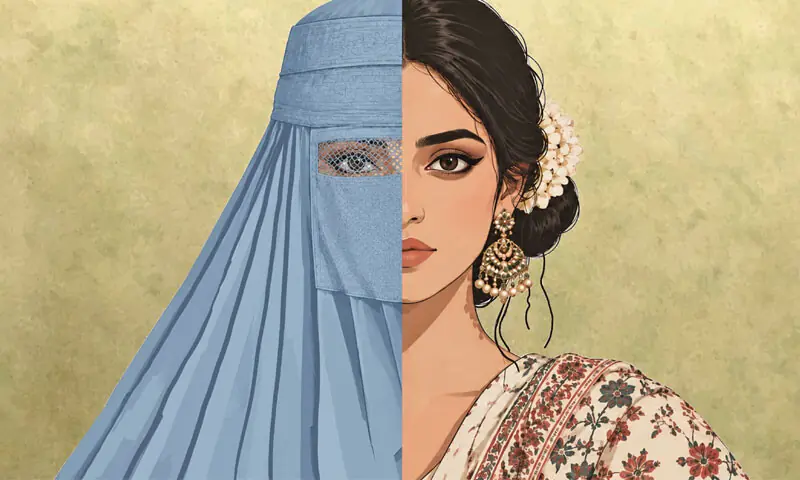
What happens when a family retains its ancestry but loses the language associated with it? For an Urdu-speaking Pakhtun family in Pakistan, the answer has meant generations explaining a surname that no longer fits neatly into the country’s ethnic categories
When I finally offered the truth, UP, it satisfied no one. For native Pakhtuns, a Khan without Pashto was an imposter. For Muhajirs — Urdu-speaking migrants and their descendants — my surname belonged to an entirely different ethnic universe.
I was trapped in a cultural blind spot: too much of a Khan for the south, too much of a Hindustani for the north. I was an Urdu-speaking ‘Pathan’ — an identity that made complete sense in the history of north India, but registers as a contradiction in modern Pakistan.
FROM the highlands TO AWADH
This contradiction has a very specific history. During the Awadh era (1722–1856), our ancestors brought their Pakhtun lineage from the Afghan highlands into Madhya Pradesh and, later, Uttar Pradesh. The migration was circular; when geopolitical storms made the north Indian plains unliveable, they retreated to the Afghan highlands, returning to the UP estates when the dust had settled.
There, the family became landed gentry, eventually managing a consolidated estate of 60 villages centred around Dudhara. Over generations in the plains, Pashto gradually gave way to Urdu, its nuances and ashrafia [ruling elite] etiquette, while the family retained “Khan” as an heirloom of ancestry.
But they carried it with a strict regional distinction. Locals pronounced it as a soft, nasalised Khaa(ñ), a title reserved by the society of eastern UP for noble, landed families. In the fluid history of the plains, it was a vocal marker of class that blurred the lines between the migrated Afghan gentry and the established elite who shared their status.
The true depth of our lineage was rarely a formal topic at the dinner table. It just slipped out in casual conversations. I still remember sitting in the corner of my paternal grandfather’s bedroom while my maternal aunt asked him about where we truly came from, making sure my siblings and I heard the story.
With the quiet indifference of an elder who understood the Subcontinent’s deep, fluid memory, he traced our line back to an ancestor named Laali Khan. It was a rustic Pakhtun name, matching the Pashto word for an affectionate brother or a precious gem. When speaking of our heritage, he bypassed the colloquial north Indian ‘Pathan’ altogether, referring to us simply as Afghan. It was perhaps a subtle adherence to classic ashrafia conventions, using the historic Persian ethnonym to emphasise a lineage rooted in the highlands.
It was a history far too layered and ancient to explain to acquaintances who demanded instant and one-word labels. When implored about my surname, I lacked the vocabulary for such vastness. So I gave protective, flattened answers, letting them believe I was just a walking contradiction of “Urdu-speaking Khan” or allowing them to dismiss me as a feudal relic.
It was easier to let them assume a convenient falsehood than to unpack a centuries-long migration that my own family was still slowly revealing to me.
THE COST OF KEEPING THE NAME
When Partition divided the Subcontinent in 1947, generational landholdings and local prominence shielded my family from the worst of the violence. Their property and position allowed them to delay their departure, migrating to Pakistan as Muhajirs only in 1951.
My paternal grandfather, an Aligarh-trained engineer, spent decades leading Pakistan’s Telephone and Telegraph Department, rising through postings in Haripur, Karachi, Peshawar and Islamabad. Yet, despite building the nation’s physical infrastructure, our place in its social landscape remained unmapped.
Today, a significant number of families among Sindh’s Urdu-speaking population share some version of this history, tracing paternal roots back to Pakhtun settlements in north India. Yet, in modern Pakistan, where state categories demand rigid ethnic lines, carrying a name that requires a history lesson at every introduction becomes exhausting.
The pressure eventually took its toll. Over the years, several of my paternal cousins in Karachi and along the northern borders quietly removed “Khan” from their legal documents. In Karachi, amidst historic political friction between Muhajir and Pakhtun communities, being an Urdu-speaking Khan meant constantly navigating mutual suspicions.
In areas bordering KP, opening your mouth to speak Urdu instead of Pashto meant failing a daily test of authenticity. For them, dropping the name was not an act of historical denial. It was a practical choice to make life easier.
For those of us in Islamabad, keeping the name was less perilous, but no less awkward. On Eid holidays and during summer vacations, my cousins and I would trade stories of the side-eyes we drew: resentment from native Pakhtuns who assumed we were British-era titleholders and scepticism from Muhajirs who viewed the name as foreign.
Today, as urban politics and state polarisation increasingly flatten regional nuance into rigid caricatures, the space for intermediate identities is shrinking faster than ever. Modern statecraft increasingly demands that you fit a precise cultural template. You are either a Pashto-speaking highlander or an Urdu-speaking Muhajir. Yet for those of us who kept the surname, retaining ‘Khan’ was never an act of identity crisis or historical denial. It was a silent refusal to disown a complex heritage for bureaucratic ease.
WHAT REMAINS
As the last generation with memory of pre-Partition Awadh gradually passes away, these oral histories risk slipping into total erasure. Living in the grey space between these categories has shifted from a personal quirk into a daily negotiation, a resolve to hold on to an ancestry that modern boundaries insist on levelling.
What remains when an identity loses its language but keeps its name? You inherit the ashrafia tehzeeb [elite etiquette] and Lakhnavi Nishist-o-Barkhaast [Lucknow’s social demeanour] of North Indian court culture alongside a quiet determination passed down from the mountains.
To be an Urdu-speaking ‘Pathan’ is to be tied to the refinement of UP and the enduring resolve of the highlands. It is to live in the space between national categories, a witness to a fluid and migratory South Asia that existed long before modern borders insisted on neat, singular boxes.
The writer is an Islamabad-based geopolitical researcher and editor.
X: @FarehaIqtidar
Published in Dawn, EOS, October 11th, 2026