HOCKEY: HOPE AND REALITY
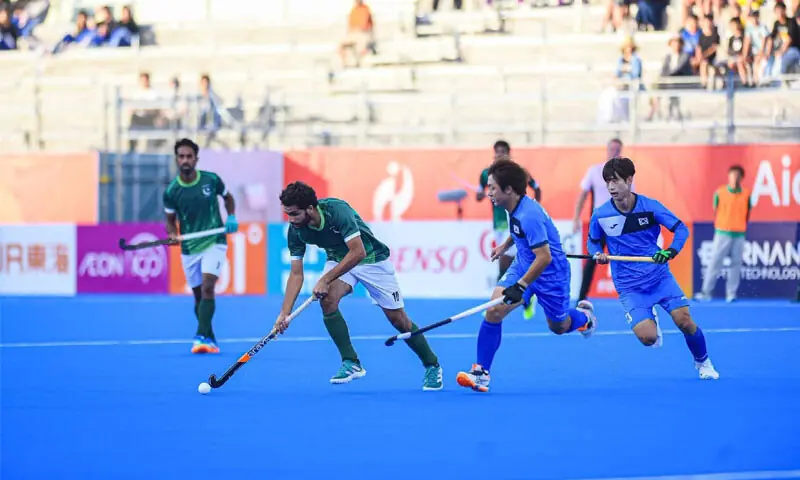
Pakistan’s hockey team won the bronze medal at the 2026 Asian Games. Is this satisfactory or unsatisfactory? The answer to this is not straightforward.
A medal is always welcome. Pakistan failed to win a medal at the previous two Asian Games. Yet, for a country with an enviable Asian Games record of eight gold medals — compared to India’s five — a bronze hardly represents a return to the top.
There is another, more important, way of looking at it. The Asian Games winner earns direct qualification for the 2028 Olympics. Pakistan has missed that opportunity and will now have to negotiate the Olympic qualifying process in early 2028. Sixteen teams will compete in two eight-team tournaments for four or five Olympic berths. That is a daunting prospect for a country that has failed to qualify for the last three Olympics.
So, purely in terms of results, there appears to have been little progress. But results alone do not tell the whole story.
Pakistan’s hockey team managed to snag a bronze at the recently concluded Asian Games. What does it tell us about the trajectory of Pakistan Hockey?
ASIAN GAMES ASSESSED
Pakistan began the Asian Games ranked third in Asia and 14th in the world, behind India, which is ranked eighth in the world and Malaysia, ranked 12th. In its pool games, Pakistan had a comfortable passage against the lower-ranked sides, beating Thailand 9-0, Uzbekistan 5-1, China 3-0 and Oman 7-2.
Malaysia was the only genuinely testing opponent. It was a pulsating contest, with the lead changing hands repeatedly. Pakistan led 4-3 with only four minutes remaining and, on the run of play, deserved to win. All four Pakistani goals came from penalty corners. Pakistan earned eight penalty corners; Malaysia had only three but converted all of them.
Malaysia created only four or five clear chances from open play and scored twice. Pakistan, meanwhile, dominated the third and fourth quarters — apart from the final four minutes — but squandered several opportunities, including some sitters. The contest eventually ended with Malaysia edging Pakistan 5-4.
That defeat forced Pakistan into a semi-final against India, the overwhelming favourites and the Pool B winners.
Pakistan have not beaten their traditional rivals for more than a decade, and recent encounters have frequently produced one-sided scorelines. Once India surged into a 3-0 lead, it seemed that history was about to repeat itself.
But then Pakistan came alive.
Captain Abu Bakar Mahmood reduced the deficit with a penalty-corner conversion at the stroke of half-time. The match was transformed in the 45th minute, when an electric move down the right flank ended with Abdul Hannan Shahid finding the net. Soon it was 3-3. Rana Waheed completed another superb attacking move from the right to take Pakistan level. What followed was a thrilling, end-to-end contest, with chances at both ends.
Then came the cruelest of endings. India’s winner arrived in the final minute, in bizarre circumstances. Abhishek’s attempted pass was deflected into the Pakistan goal by a Pakistani stick, turning what had seemed an amazing Pakistani recovery into another defeat.
The bronze-medal playoff provided another comeback. South Korea led 3-1, but Pakistan recovered to win 5-3.
There is a pattern here. Pakistan’s ability to fight back after falling behind has become one of the more encouraging features of the present team. As in the World Cup, the players repeatedly showed that they could recover from two or even three-goal deficits. Even when they could not turn those comebacks into victories or draws, they often transformed apparently lost contests into competitive matches.
But the frequency with which Pakistan has to recover from poor starts is also a serious weakness. Why does this team so often concede early goals? Is it tactical? Is it psychological? Is it a problem with game management? The questions require serious technical analysis.
But there are other positives.
Sufyan Khan is developing into a world-class drag-flicker. His 12 goals made him the joint leading scorer at the Asian Games. Yet Pakistan’s use of its penalty corners against India raises questions. The team earned seven penalty corners but converted only one. Against Oman, three of Pakistan’s penalty-corner goals had come through a two-touch variation. Curiously, that indirect option was not employed against India.
There is no shortage of individual talent. Hannan Shahid and Rana Waheed have established themselves as genuinely world-class forwards. Goalkeeper Ali Raza also produced an impressive performance. Captain Abu Bakar is a dependable defender who has the added value of scoring from penalty corners, and his recent signing for Melbourne Cobras in Hockey One — Australia’s premier domestic competition — is another indication of his growing stature.
Meanwhile, Abdul Rahman’s goal against Wales at the 2026 FIH World Cup won him the Poligrass Magic Skill Award, selected by fans for the moments that best captured the magic of hockey.
So, even during one of the darkest periods in Pakistan hockey’s history, individual talent remains available.
Pakistan’s great teams have traditionally possessed a potent weapon: attacks from the right wing. The opponent’s left side is generally regarded as the more vulnerable defensive flank, making the right-wing route particularly effective. Pakistan’s second-half fightback against India provided a vivid demonstration. Both goals that brought Pakistan level originated from superb attacking movements down the right. The lesson is obvious: strengths must be identified, developed and repeatedly exploited.
At the other end of the pitch, however, Pakistan continues to commit too many unforced errors. Mistimed tackles and poor clearances in deep defence gave away penalty corners and, on occasions, resulted in soft goals. The team management must address these deficiencies.
The broader picture is also worth considering. The Olympics, the World Cup, the Asian Games, the Asia Cup and the Commonwealth Games are the sport’s principal title tournaments. In these competitions, positions matter. Pakistan did not achieve the desired finish in either of the two title events of 2026 — the World Cup and the Asian Games.
Given Pakistan hockey’s decline over more than a decade, this was hardly unexpected. But what matters now is whether the current upward trend can be converted into sustained progress.
There is no title tournament before the 2028 Olympics. That should simplify Pakistan Hockey’s priorities. From now until the Olympic qualifiers, virtually every major effort should be directed towards building a team capable of qualifying for Los Angeles.
The performance graph does appear to be moving upwards. Pakistan went toe-to-toe with India despite the considerable difference in world rankings and a decade of adverse results. That should provide the players with a substantial psychological boost. But there is still a sizeable gap before Pakistan can seriously challenge the world’s top six.
One indication of that gap was the difference in tempo between the 2026 World Cup and the Asian Games. The World Cup’s final and semi-finals were played at a frantic pace. The intensity and tempo at the Asian Games were nowhere near that level. Pakistan must bridge that gap.
The next step should be extensive and meaningful international exposure. The PHF should seek matches against teams such as New Zealand, France and Ireland, ranked around ninth to 11th in the world. Matches against opponents of that calibre would provide a much more accurate measurement of Pakistan’s progress than victories over lower-ranked Asian sides.
The objective should not merely be to play more international hockey. It should be to play the right opponents, under demanding conditions, and to learn how to compete for 60 minutes at the highest tempo.
The bronze medal in the Asian Games is, therefore, neither a failure nor a triumph. Pakistan have demonstrated resilience, individual quality and flashes of the attacking hockey that once made them feared across the world. But they still concede too early, make too many defensive errors and struggle to maintain the intensity required against the very best teams.
The Olympic qualifiers will tell us whether Pakistan has actually moved forward. For now, the most urgent question remains unanswered: why does a team with the ability to come back from the brink so often put itself there in the first place?
The writer is a freelance sports journalist based in Lahore.
X: @IjazChaudhry1 Email: ijaz62@hotmail.com
Published in Dawn, EOS, October 11th, 2026