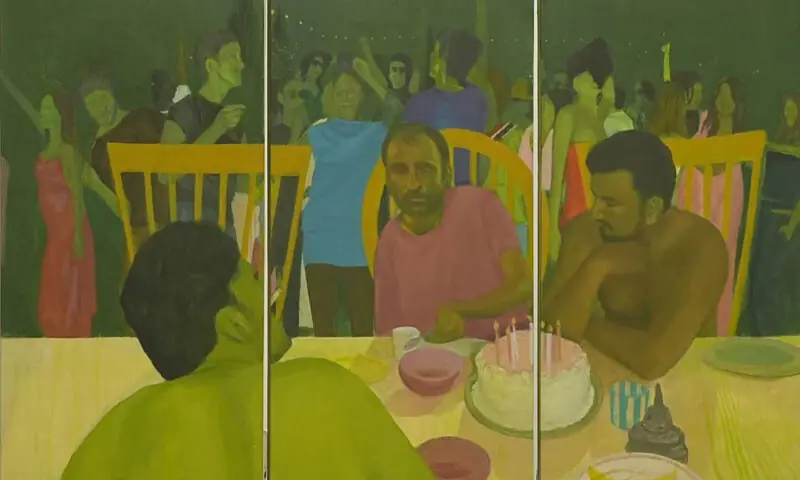
There are rooms full of people where silence can somehow feel louder than conversation. A birthday is being celebrated, a party is underway, bodies sit beside one another or disappear into a crowd, yet something remains strangely distant.
Usama Toru’s debut solo exhibition ‘Elsewhere’ at ZQ Gallery occupies this peculiar emotional space: one where people are physically present but seem to have already drifted somewhere else.
Born in Mardan and now based in Lahore, Toru is a graduate of the Pakhtunkhwa College of Art. His paintings move between everyday living rooms and imagined spaces, exploring what he describes as the tension between familiarity and strangeness, and between reality and memory. Yet, what makes ‘Elsewhere’ compelling is not simply this premise but the visual unease through which it is constructed.
Green dominates the exhibition. It settles on to faces and bodies until skin no longer feels entirely human, giving otherwise ordinary encounters an almost dreamlike quality. In Birthday Girl, an apparently cheerful moment becomes oddly detached. The party hat, glasses and badge suggest celebration, but the stillness of the figure resists it. Similarly, the artwork Goodfellas places us within a social interior, yet its figures seem emotionally separated, even while sharing the same room.
Through green-tinged interiors and isolated figures, Usama Toru’s artwork examines the loneliness that can exist in a crowd
This contradiction becomes one of the exhibition’s most interesting qualities. Toru paints crowds without necessarily painting togetherness. In The Distance Between Us and particularly in the large Elsewhere II, bodies accumulate across the canvas but intimacy remains elusive. Some faces are blurred, others reduced to darkened eyes or barely resolved features. Figures further away become almost ghost-like, as though memory has already begun erasing them. Even surrounded by people, one can almost feel the silence.
The roughness of Toru’s brushwork strengthens this instability. Certain passages appear unfinished or abruptly interrupted, refusing the polish one might expect from scenes so recognisable. Rather than weakening the images, these unresolved marks often make them feel closer to recollection — we rarely remember an entire room with equal clarity.
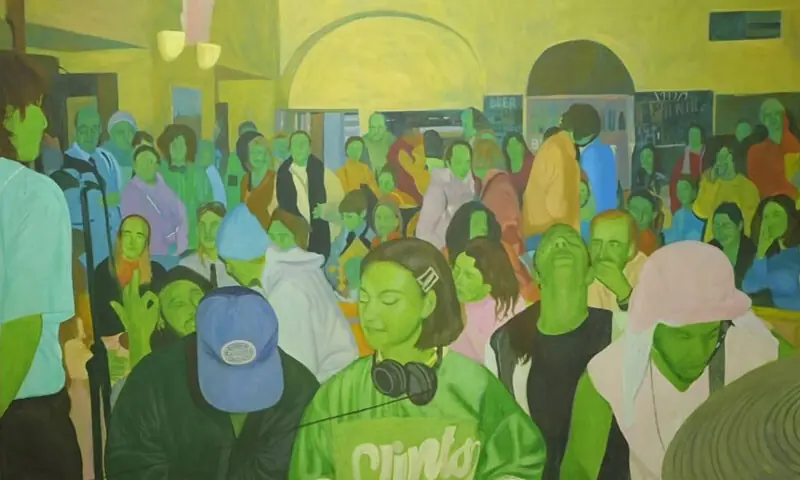
A face remains vivid while someone standing behind it disappears; a colour survives while the details around it dissolve. In Brief Encounter, the sharply present central figure contrasts with those receding behind her, turning an ordinary scene into something closer to a half-remembered encounter.
At times, however, the repeated green treatment risks becoming too consistent a device. Because it appears across so many bodies and scenes, its initial strangeness can gradually become familiar. The works are strongest when colour operates alongside shifts in focus, scale, gesture and incompleteness rather than carrying the psychological unease on its own.
Perhaps this is also where the title ‘Elsewhere’ begins to make sense. Toru’s figures are neither completely absent nor entirely present. They seem suspended between being inside a moment and remembering it from somewhere far away. There is loneliness here, but not necessarily the loneliness of being alone. It is the quieter kind that can exist between bodies occupying the same room, when physical closeness fails to close an invisible distance.
Toru does not explain where this ‘elsewhere’ is and, perhaps, he does not need to. It may simply be that strange place the mind retreats to while the body remains behind.
‘Elsewhere’ was on display at
ZQ Gallery in Lahore from
August 22-September 2, 2026
The writer is a Karachi-based visual
artist currently pursuing an MPhil in
Visual Arts at the National College
of Arts (NCA), Lahore
Published in Dawn, EOS, October 11th, 2026