KARACHI: Federal Minister for Finance Senator Muhammad Aurangzeb has identified population growth and climate change as two major challenges requiring sustained national attention.
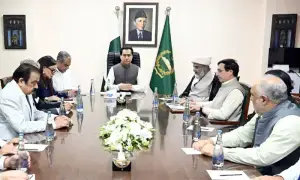
He said this while delivering an online keynote address as the chief guest at the National Sustainable Development Goals (SDGs) Investment Fair 2026, titled ‘Investing in Pakistan’s Sustainable Future’, organised by the United Nations Development Programme (UNDP) Pakistan here on Tuesday.
Senator Muhammad Aurangzeb also highlighted Pakistan’s participation in the COP31 Climate Implementation Bridge initiative, developed in partnership with UNDP to connect climate goals with financing through investment-ready projects.
He stressed the importance of capacity building and collaboration among federal and provincial governments and the private sector.
Finance minister highlights macroeconomic stability, investment confidence at SDGs Investment Fair 2026
Speaking on the occasion, the finance minister expressed his confidence in Pakistan’s potential to address the challenges of population and climate change.
He stressed the importance of capacity building and collaboration among federal and provincial governments and the private sector.
He also addressed the importance of macroeconomic stability, investor confidence and public-private partnerships in mobilising domestic and foreign investment for Pakistan’s sustainable development.
He commended the event as a timely platform for dialogue on strengthening the country’s investment climate.
“Macroeconomic stability is the basic hygiene factor for investment. Building confidence among domestic investors is essential to attracting foreign investment,” he said, emphasising the need for both local and foreign investors to finance development projects.
Senator Aurangzeb noted that Pakistan’s economy, which had been contracting three years ago, was now moving towards growth. While acknowledging inflation pressures arising from global conflicts, he stressed that maintaining macroeconomic stability remained a priority.
He also said that the privatisation of the Pakistan International Airlines demonstrated the capacity of domestic investors to collaborate and pursue large-scale opportunities.
He also highlighted the growing activity at the Pakistan Stock Exchange, including five upcoming initial public offerings (IPOs), as evidence of expanding investment opportunities.
On foreign investment, the minister highlighted interest from three Turkish companies in the privatisation of power distribution companies, urging investors to leverage platforms such as the SDGs Investment Fair to develop bankable projects and attract international financing.
Van Nguyen, Deputy Resident Representative Pakistan, UNDP, also spoke at the inaugural session.
SDGS must move beyond paper commitments: Sherry
Senior Pakistan Peoples Party leader Senator Sherry Rehman called for Pakistan’s SDGs agenda to move beyond being treated as a checklist of commitments and become a practical investment framework capable of delivering measurable improvements in people’s lives, warning that the country’s growing population, persistent poverty, education crisis, water insecurity and climate vulnerability leave little room for delay.
Addressing the event via a remote video link, she expressed gratitude to UNDP for creating an opportunity pipeline that brings potential investors and development projects together across jurisdictions.
She said the significance of the initiative went beyond mobilising money, because it could help create the institutional, regulatory and financial architecture required to turn development priorities into viable investments.
“When we talk about the SDGs or development, too often they are seen as a box to tick off. They sit on paper, but they do not always become a real commitment that begins where the population can actually experience change,” she said and stressed that Pakistan needed to build a sustainability lens into development planning rather than treating sustainability as an additional or peripheral consideration.
Senator Rehman said the public-private partnership model offers one of the most important pathways for taking development projects from the drawing board to implementation, particularly at a time when public resources are under enormous pressure.
She said the Sindh government’s initiative of bringing the public and private sectors together had been recognised and lauded by the finance minister, and stressed that such partnerships could help unlock investment while sharing risks and building projects that are financially and environmentally sustainable.
Referring to the Sindh government’s new wastewater treatment and reuse plant in Karachi, she said this was precisely the kind of investment Pakistan needed as its water challenges continued to intensify.
She said that the development gap was already visible in some of Pakistan’s most basic indicators.
“When you have 26 million children out of school, you cannot tell yourself that development is happening because a policy document exists. Development has to be experienced — in a school, in a hospital, through clean water, through jobs, through resilient infrastructure and through the ability of families to withstand shocks,” she said.
Senator Rehman stressed that the scale of Pakistan’s climate exposure makes this urgency even greater. Pakistan ranks among the world’s most climate-vulnerable countries and suffered approximately $30 billion in damages from the 2022 floods. She warned that climate change was creating conditions of increasing instability at precisely the moment when markets were seeking greater certainty.
“Markets run to stability. They run to risk-proof futures. Climate change creates conditions that do not automatically create stability, so governments — federal and provincial—have to create a level of certainty through policy, regulation, financial modelling and real commitments,” she said.
She said the success of the SDGs Investment Fair would ultimately depend on whether the projects showcased could acquire the institutional support, financial structures and political ownership required to survive beyond an announcement.
“If we invest in water, we protect health. If we invest in education, we build human capital. If we invest in women, we expand the economy. That is what the SDGs should mean in practice,” she said.
Published in Dawn, October 7th, 2026