‘Emerging island’ threatens Moria Loop Bund in Indus
• Experts fear large-scale inundation of agricultural land, villages and urban settlements
• Say river is shifting course from left bank to right bank
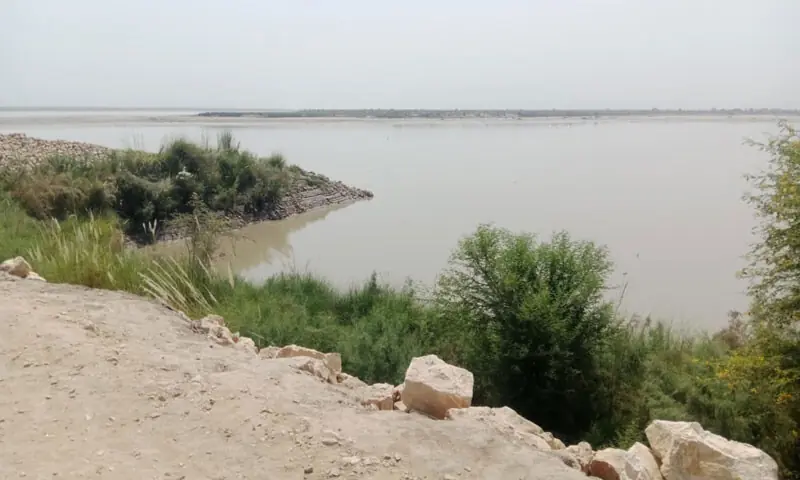
LARKANA: Standing at the junction of the Sukkur-Larkana (SL) and Moria embankments on the Right Bank of the River Indus, one can clearly see that the river’s recent strong flows and changing course have formed a large island very close to the embankments.
Pointing to the recent changes, Jamil Ahmed Sangi, superintending engineer of the North Dadu Division, said the island has grown bigger and it is feared it might threaten the embankment in its present condition.
He said that because of the change in flow, the department had hoped the river would cut through the island, but unfortunately it widened, creating a new obstruction on the flow during the peak flood season.
In irrigation terms, it is believed that receding water does more damage, and that is exactly what has happened here, where the Sukkur-Larkana embankment and the Moria Loop Bund meet.
Touring the site in the intense heat to assess the damage caused during the high flows and the receding period, Irrigation Assistant Engineer Nadeem Jafri said an earlier plan, recommended by experts, to build a hockey-shaped spur upstream of the Moria Loop Bund had failed because the force of the water and the shift in flow washed away the structure built there.
He said that instead of diverting the flow, the river struck this spot head-on and cut through the structure. “The plan was to build a hockey-shaped spur with a 200-foot shank and a 225-foot crown at an angle of 86 degrees, but the effort proved futile,” he added.
The superintending engineer said the Northern Dadu Division alone has to maintain 86 miles of embankments along the right bank of the Indus, along with a 60-mile second line of defence.
According to sources close to the chief engineer of Sukkur Barrage’s right bank, the Moria, Abad and Hakra embankments are extremely weak, and the Moria embankment is a chronic problem.
Public Accounts Committee chairman’s letter
Alarmed by the seriousness of the situation, Nisar Ahmed Khuhro, in his capacity as chairman of the Sindh Assembly’s Public Accounts Committee, wrote to the Sindh chief minister on Aug 17.
He had drawn his attention to the poor condition of the embankments on the right bank of the Indus in Larkana district and described them as weak.
These include the SL (Sukkur-Larkana) bund from mile 40/2 to 40/3, the Old Abad bund, and the LS (Larkana-Sehwan) bund from mile 15/0 to 16/1.
Dawn has seen the letter, in which Mr Khuhro, drawing the chief minister’s attention to the matter, described the condition of the first-line river embankments protecting the densely populated areas of Naudero and Larkana as “alarming”.
Based on reports received from the irrigation department, the senior PPP leader said sections of the SL bund from mile 40/2 to 40/3, the Old Abad bund and the LS bund from mile 15/0 to 16/1 had become extremely weak and were now under serious threat from the Indus.
The condition of these protective structures has badly deteriorated, and the sections are at immediate risk. The letter says any failure of these flood-protection structures could result in large-scale inundation of agricultural land, villages and urban settlements, especially in Naudero and Larkana and across the province, along with irreparable damage to public infrastructure and livelihoods.
There is no provision for these essential flood-protection works under the current Annual Development Programme (ADP) or any other funding mechanism, and the limited repair and maintenance (M&R) funds are said to be insufficient for works of such scale, especially since the interventions must be completed in very little time before the peak flood flows begin.
The letter also notes that during the flood emergencies of 2024 and 2025, the irrigation department carried out various emergency protections and preparedness works in the larger public interest under exceptional circumstances. However, despite the passage of considerable time, payments for these emergency works are still pending. The condition of the embankments is weak and alarming, and the lack of funds has created serious challenges for dealing effectively with any future flood emergency.
“In view of the exigency of the situation, kindly take up this matter on a priority basis and issue the necessary directions for the immediate allocation and release of the required funds so that these emergency protection works can be completed well before the peak flood season. Timely intervention at this stage will not only safeguard the lives and property of thousands of people but also prevent the huge financial losses that would result from any breach or failure of these vital protective structures. Your personal intervention in this matter would be greatly appreciated in the larger public interest,” Mr Khuhro said.
According to irrigation department sources, Rs900 million is still to be paid for the emergency works carried out in 2024 and 2025.
In response to Mr Khuhro’s letter, Sindh Chief Minister Murad Ali Shah marked it to the Sindh irrigation secretary on Aug 17, 2026, with the note: “Please process expeditiously and ensure no loss occurs.” The letter was sent under No. SO(VII)/CMS/Irri-18(1)254-2026/1583, Karachi, dated 18.08.2026.
The letter requests that “necessary action be taken in this matter in accordance with law, rules and policy, and this Secretariat be informed at the earliest,” according to the document seen by Dawn.
Irrigation Assistant Engineer Nadeem Jafri said the T-spur located at “mile 40/4 +560 on the Sukkur-Larkana bund” began to erode in 2023, when its upstream “T” collapsed.
In 2025, its downstream “T” also collapsed, and in 2026 the entire shank of the T-spur gave way.
He said the situation is now dangerous and the structure urgently needs repair or reconstruction. He added that the Indus has been continuously shifting its course from the left bank to the right bank, causing further damage to the embankments.
Realising the gravity of the situation, the chief engineer of Sukkur Barrage’s right bank exercised his authority under Para 8 of the Bund Manual and formed a sub-committee of the Indus River Commission (IRC) on July 6, 2026, headed by Chief Engineer Drainage Junaid Hashim.
Right Bank Chief Engineer Mukhtiar Abro and Superintending Engineer Northern Division Jamil Ahmed Sangi were its members. After studying the pros and cons of the situation, the IRC sub-committee visited the structures on July 8, 2026, and prepared a proposal calling for four studs, stone pitching and aprons on the SL bund from mile 40/2 to 40/3 +300 feet.
The SE Irrigation said the recommendations would soon be sent to the IRC for final approval. According to sources, the proposed work will cost an estimated Rs1,429 million. Irrigation officials were hopeful that, in light of the correspondence, the required work would begin soon. The sources also said the contractor who had won the contract for the hockey spur had abandoned the work, citing non-allocation of funds.
Published in Dawn, October 7th, 2026