
IT may not be inaccurate to say that Manmohan Singh created India’s middle class, and the middle class created Narendra Modi. Marxists call them/us the ‘vacillating class’.
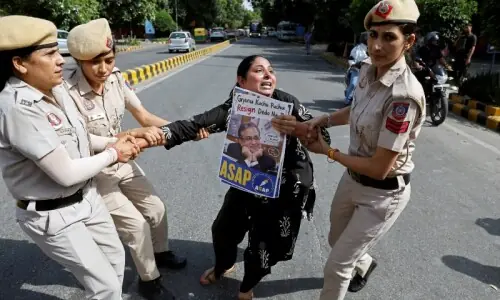
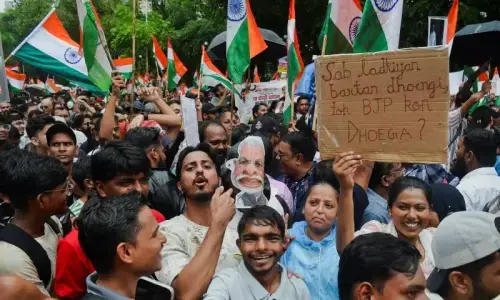
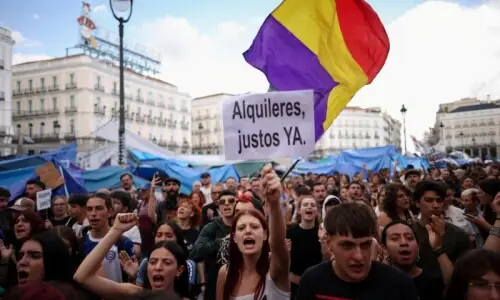
Janus-like, we are suspiciously double-faced and have a split identity. We look towards the capitalists with one face, wishing to join their ranks and protect property rights. And we look towards the working class with the other face, sharing their economic anxiety and fear of being ruined by big corporations. Given that powerful protests have mushroomed since July across India, mostly led by young students and unemployed youth, it could be signalling a significant disenchantment with the system that has wooed middle class support since 1991.
Before Manmohan Singh’s economic reforms as finance minister and his subsequent decade as prime minister (2004-2014), India’s middle class was miniscule, estimated at roughly 2.5 million people earning over $10,000 annually or representing a small, state-controlled bureaucratic and managerial stratum.
Following the 1991 liberalisation and the growth of the IT, services, and corporate sectors, the middle class expanded dramatically. By 2015, the number of Indians earning over $10,000 annually grew to 55m. Other estimates placed the middle class at roughly 142m people (about 12 per cent of the population) by the early 2010s, when they were entering various tiers of the middle or ‘neo-middle’ class depending on purchasing power parity of around $10-$50 per day.
After Singh left office in 2014, the expansion plateaued for many households due to rising living costs, stagnant real wages, and a K-shaped economic recovery, where wealth concentrated more heavily at the very top. The Modi-led alliance of big business and right-wing street thugs peaked during the Covid-19 episode when the government asked the people to bang their pots and pans to drive away the virus and the UN secretary-general warned that liberalising the exploitation of coal, which the government had announced bang in the middle of the crisis, was hardly the prescribed method to fight the deadly scourge sweeping India and the rest of the world.
The young protesters may have to engage with the fact that India’s growth has been consumer-led and K-shaped, with deepening inequality.
An Oxfam report in November 2021 said Indian billionaires increased their wealth by 35pc during the lockdown to three trillion, ranking India after the US, China, Germany, Russia, and France. Out of these, the rise in fortunes for the top 100 billionaires since the lockdown was estimated as enough to give every one of the 138m poorest Indian people a cheque for Indian rupees 94,045 each. Oxfam’s Inequality Virus Report was released at the remotely conducted World Economic Forum in Davos.
Should it interest the protesters that the wealth of just the top 11 billionaires during the pandemic could easily sustain the MGNREGS — the 2005 social welfare law guaranteeing rural employment — or the health ministry for the next 10 years? Instead, inequalities deepened during Covid-19 when the wealthiest escaped the worst impact of the pandemic and the poor faced joblessness, starvation, and death.
A tycoon who emerged as the richest man in India and Asia, earned INR900m an hour during the pandemic when around 24pc of the people in the country were earning under INR3,000 a month during the lockdown.
A reintroduction of the wealth tax was advised as a one-time Covid-19 cess of 4pc on taxable income of over a million Indian rupees to help the economy recover from the lockdown. The rejected tax on the nation’s 954 richest families could have raised the equivalent of 1pc of GDP.
Even as they seek to repair India’s broken democracy, which is a most crucial task, the young protesters may have to engage with the fact that India’s growth has been consumer-led and K-shaped, with deepening inequality. In comparison, China’s modern economic growth model has been state-led, investment-heavy, and steered by a policy of ‘common prosperity’.
India’s middle classes must relearn that China’s current economic strategy shares striking structural DNA with Jawaharlal Nehru’s original vision for India, albeit with a divergence in political execution. Both models share the foundational belief that a post-colonial nation cannot rely on the unbridled free market to achieve greatness or equity. Ergo, the state must control the ‘commanding heights’ of the economy to guide development.
Nehru, reviled by the Modi echo chamber, famously insisted that the state must control the core sectors of the economy (steel, power, heavy machinery, and infrastructure) through public sector undertakings. China achieved this exact goal through its massive state-owned enterprises and state-run banks, ensuring that private billionaires never overpower the national agenda.
Singh swore by Nehru but failed to appreciate that Nehru was deeply wary of the concentration of private wealth, fearing it would corrupt society and exploit the poor. China’s common prosperity drive — manifested in aggressive regulatory crackdowns on tech monopolies, tutoring companies, and real estate moguls — is driven by the same suspicion of oligarchic power.
Nehru viewed heavy industries as the “temples of modern India”. Beijing’s pursuit of “new productive forces” (semiconductors, green energy, EVs, and AI) represents a modern, high-tech version of Nehruvian import-substitution and state-directed scientific self-reliance.
Unlike Singh’s rely-on-services trajectory, China historically built a manufacturing-and-export juggernaut, which is currently transitioning into a paradigm-focused, state-mandated wealth redistribution. Indira Gandhi nationalised banks to pursue an equitable Nehruvian agenda to serve the masses. Singh, however, set the stage for opening the backdoor of state-owned banks to private plunderers that Modi turned into an art.
Singh saw Babri Masjid’s destruction as finance minister but concluded that the biggest internal threat to India came from Maoist tribespeople, exactly the opposite of Nehru’s assessment that it was the right-wing Hindu movement that posed a mortal challenge to Indian democracy, not communists. Would the protesters, overwhelmingly from the middle classes, heed the discussion — but only after winning their battle against the current right-wing government — and ask why 800m compatriots remain on food dole in one of the world’s largest economies built by Manmohan Singh?
The writer is Dawn’s correspondent in Delhi.
Published in Dawn, October 6th, 2026