Situationer: Can Afridi strike a balance between agitation & governance?

WHILE the PTI focuses on political mobilisation to secure Imran Khan’s release, the province it is charged with governing continues to face acute security pressures.
At present, Khyber Pakhtunkhwa remains the bastion of PTI’s political power. With the provincial government in its hands, the party enjoys a degree of security that allows it operational space and maneuverability.
In the ongoing political contest, KP provides PTI with a crucial fallback option; a platform from which it can continue to function and regroup.
But the province has also borne the brunt of terrorist attacks, mostly blamed on the proscribed Tehreek-i-Taliban Pakistan (TTP), who Islamabad accuses of using Afghan soil to stage their assaults.
Critics accuse the PTI-led KP govt of putting agitation ahead of administration, calling for governor’s rule if things don’t improve
Since the outfit renewed its attacks following the breakdown of a ‘ceasefire deal’ in Nov 2022, security forces have conducted several targeted intelligence-based operations along the north-western border, though the PTI-led provincial administration has opposed such actions at times.
Data from the Centre for Research and Security Studies’ (CRSS) Annual Security Report 2025 indicated a nationwide rise in fatalities from 2,555 in 2024 to 3,417 in 2025, a 34 per cent increase. KP alone accounted for 711 of these deaths, an 82pc share of the national rise.
“In light of these facts and figures, the question that comes to mind is why the majority of terror incidents take place in KP,” military spokesperson Lt Gen Ahmed Sharif Chaudhry asked at a recent press conference.
“The primary reason for this is the politically conducive environment provided [to terrorists], and the political-terror nexus that is flourishing in the province,” he had claimed at the time.
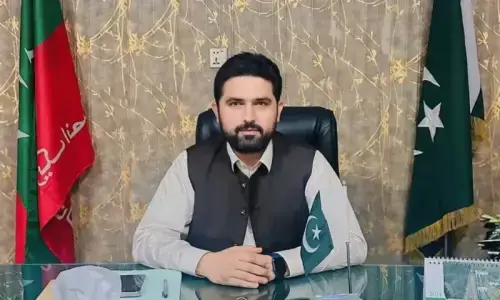
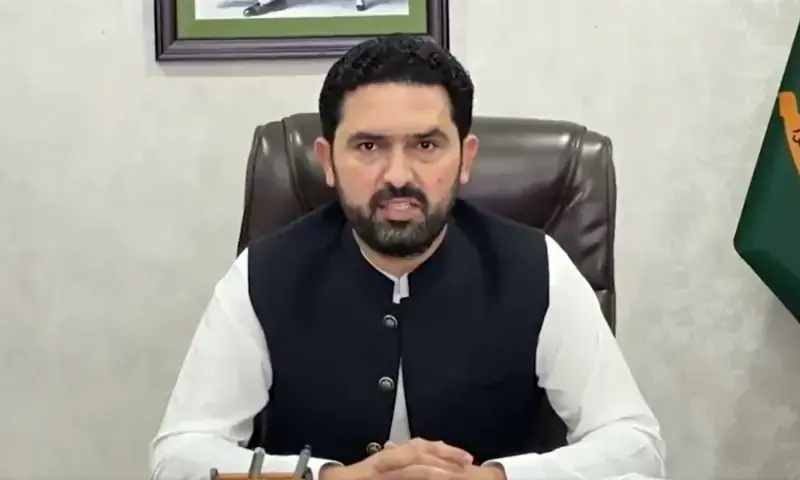
The province’s chief executive, Sohail Afridi, has been the focal point of such claims.
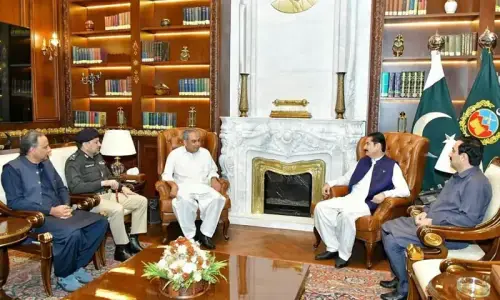
The federal government has repeatedly criticised the provincial administration over worsening law and order, and accused it of not coordinating with the Centre. For his part, CM Afridi has publicly criticised military operations against terrorist groups in KP, and indicated the party’s preference to negotiate with Afghanistan.
The chief minister claims the deteriorating security environment is the result of a failed foreign policy, pursued over the last 22 years.
“If a policy is not delivering results and is continuously failing, there is a need to change it,” he said during a recent visit to Kohat, in the wake of a suicide bombing that claimed the lives of several security personnel.
Agitator-in-chief
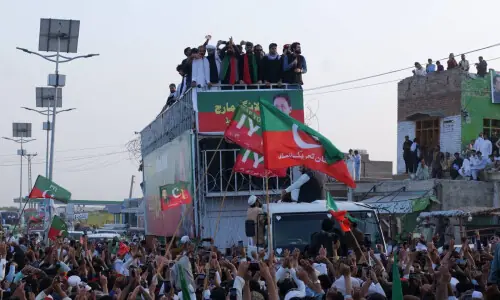
Simultaneously, Afridi has been charged with spearheading the protest movement by none other than Imran Khan himself, and has made multiple trips to Islamabad to meet the incarcerated PTI founder, albeit without much success.
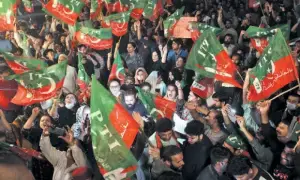
He has also taken the lead in coordinating the party’s nationwide “street movement”, efforts that culminated in the present protest, following a series of delays and postponements.
Professor Faizullah Jan, a journalism professor at the University of Peshawar, said, “I think Afridi has been selected because he is hard-headed like Murad Saeed, indebted to Imran for everything, and being ‘anti-establishment.’ Because of his young age and a lack of experience (in governance and politics), he is unlikely to be a threat to party leadership, unlike Pervez Khattak, Mehmood Khan, and Gandapur.”
Critics argue that his focus on agitation, especially at a time when the province faces escalating security threats and growing political pressure, has intensified questions about the PTI-led government’s ability to govern effectively.
Coming to mainstream politics from the Insaf Students Federation (ISF), Afridi maintains a natural connection with the youth and claims to operate on the same wavelength as them. As a former special assistant for communication and works to his predecessor, Ali Amin Gandapur, he had previously demonstrated his abilities as a firebrand speaker, effectively articulating the party’s narrative.
His approach to political mobilisation is, therefore, inseparable from the broader PTI strategy, which is central to understanding the province’s current state of unrest.
For his administration, the challenge is not merely resisting pressure from the Centre, but demonstrating that governance can proceed even amid political mobilisation.
“Despite the KP chief minister’s combative mood, they (provincial government) want a working relationship [with the federal government],” Ahmed Bilal Mehboob of the Pakistan Institute of Legislative Development and Transparency (Pildat) told Dawn.
“Imposing governor’s rule will cause more agitation,” he added. “Both the KP and federal governments need to coexist.”
Precarious balance
His detractors would have you believe that this is not possible.
Describing the PTI’s rule, KP Governor Faisal Karim Kundi says the party has been unable to balance political agitation with its administrative responsibilities, and has neglected issues such as terrorism, corruption and problems faced by medical staff and university faculty, among other issues.
“They don’t pay attention to these provincial issues; they only care about agitation and the march to Islamabad and what people are saying about them on social media, so they can one-up each other,” the governor says. “There are three or four groups within them (the PTI) which do not agree with each other.”
Mr Kundi said that whenever he speaks with the president, prime minister or interior minister, he informs them that the provincial government “is not seriously monitoring the law and order situation”.
“They do not attend the funerals of army officers and personnel and these people want to go off to Islamabad. There are a lot of issues,” he says.
But how does the PPP leader - whose own party has spearheaded protests against the Centre in recent months - justify his criticism when another party opts for a similar course of action?
Giving examples of PPP and Jamaat-i-Islami protests in recent months, Mr Kundi notes that this political agitation was largely peaceful.
“We marched from Karachi to Islamabad with Bilawal sahib without incident,” he recalled. “But when the PTI protests, they spread chaos. You can see it even now; the CM is making statements about what he will do when he gets to Islamabad. He wants chaos.”
But even Mr Kundi, who has been making a case for imposing governor’s rule in the province for quite some time now, does not believe that this option can be exercised lightly.
In his view, governor’s rule is a “constitutional option”, which should only be treated as “a last resort” for when the situation in the province severely deteriorates.
“The president and prime minister sit down with institutions and assess the situation. If they find that it is necessary to use governor’s rule to resolve the situation in the province, they can impose it,” he explained, recalling that the option had been used in the past as well.
Militancy in the mix
So, what is really at stake here? According to Riccardo Valle, a research analyst tracking militancy across South and Central Asia and co-founder of The Khorasan Diary, local grievances, the absence of the state and poor governance were detrimental to the broader security environment where counter-terrorism policy is enacted, limiting its effectiveness.
On the other hand, he noted that constant pressure from militants against security forces poses a major hindrance to any comprehensive effort by the government to address social and economic issues, as security issues prevent the solving of the matter.
When asked what policies the KP government could implement to counter terrorists, Mr Valle noted that it “cannot become the sole issue or responsibility of a single province”.
Friction between the provincial administration and the Centre could “ultimately benefit militant groups, who can exploit confusion and disagreement both from a narrative-building perspective as well as by increasing pressure on security forces,” he said.
Asked about why the KP government is so opposed to military operations, he noted that operations brought mixed results, citing the 2009 Operation Rah-i-Nijat and 2014’s Operation Zarb-i-Azb.
“While these operations displaced militants and led to effective control of territories, they also caused collateral damage, internal displacement and profound social [and] economic issues,” Valle explained.
“Today, the asymmetric warfare adopted by militant organisations in KP further complicates the efficacy of any such military operation, possibly exacerbating the conflict and alienating local communities,” he added.
Nadir Guramani in Islamabad, and Ismail Khan and Manzoor Ali in Peshawar also contributed to this report
Published in Dawn, October 5th, 2026