Teenage stars shine as Asian Games face scrutiny over conditions

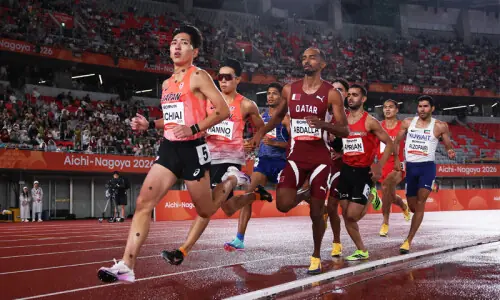
NAGOYA: Teenage prodigies and a Thai sprint sensation provided the highlights on Sunday as the Asian Games entered their eighth day, but the sporting spectacle in Aichi-Nagoya continued to face scrutiny over accommodation, transport, sparse crowds and a doping case.
China strengthened its position at the top of the medal table, reaching 119 golds by the end of the day, well clear of Japan on 37 and South Korea on 20.
The day’s standout performance came from China’s 18-year-old Yan Ziyi, who needed just one throw to win the women’s javelin and shatter the Asian Games record.
Yan sent the spear 70.46 metres on her opening attempt, surpassing the previous Games record of 66.09m set by compatriot Liu Shiying in 2018. Japan’s Olympic champion Haruka Kitaguchi had to settle for silver with 62.70m.
The throw was the sixth longest in history and underlined the remarkable progress of Yan, who threw 71.74m in May, the second-best mark ever recorded.
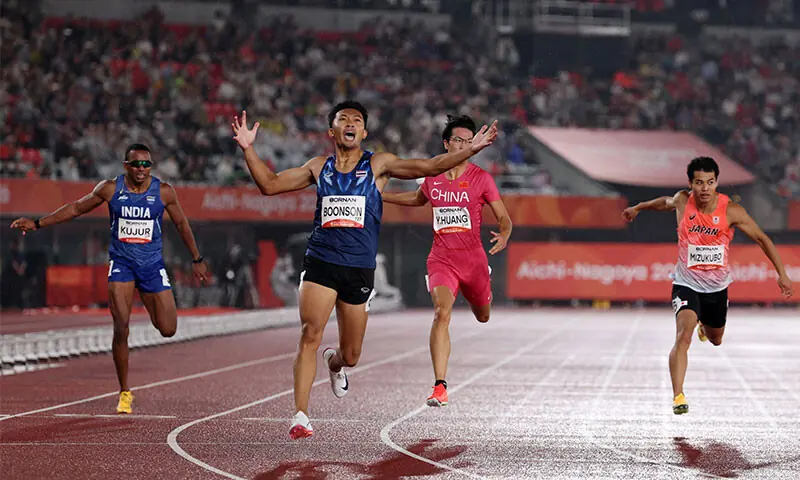
Thailand’s Puripol Boonson was another young star to make his mark, completing the men’s 100m and 200m sprint double.
The 20-year-old followed his 100m victory in 9.90 seconds with a 19.88 in the 200m, becoming the first Thai sprinter to break 20 seconds in the event. His time equalled the seven-year-old Asian record held by China’s Xie Zhenye.
Puripol, who won by more than half a second, said he was targeting further improvement.
There was another Chinese success in athletics when Bahrain’s Olympic champion Winfred Yavi won the women’s 3,000m steeplechase in 9:04.36, adding to her 10,000m gold.
Singapore’s Shanti Pereira successfully defended her women’s 200m title in 22.78 seconds. Having lost the 100m to China’s 17-year-old Chen Yujie, Pereira denied the teenager in the longer sprint by 0.15 seconds.
Former Olympic champion Mutaz Barshim was absent from the men’s high jump after withdrawing with an injury. Taiwan’s Fu Chao-hsuan won the title with a 2.25m clearance.
In squash, Malaysia claimed both singles gold medals. Ng Eain Yow won the men’s title while Sivasangari Subramaniam prevailed in the women’s competition. Their victories also secured the first quota berths awarded for squash’s Olympic debut at Los Angeles 2028.
Subramaniam, who survived a near-fatal crash in 2022, said her ambitions now extended to the biggest prize in the sport.
South Korea retained its dominance over hosts Japan in baseball, beating the home side 3-1 in the men’s final.
The day began with controversy in the race walks. India’s Priyanka Goswami, a Commonwealth Games runner-up, was disqualified from the women’s event after accumulating too many red cards. Kazakhstan’s Yasmina Toxanbayeva won the gold.
Japan took the men’s title through 35-year-old Hayato Katsuki, who won in 3 hours, 3 minutes and 36 seconds. China’s Zhou Yingcheng was a distant runner-up.
Away from the competition venues, the Games continued to attract criticism over the experience offered to athletes.
Unlike the traditional athletes’ village used at many major multi-sport events, Aichi-Nagoya organisers opted to accommodate competitors and officials in hotels, temporary wooden units and a cruise ship in an effort to reduce costs.
India’s decorated badminton player H.S. Prannoy, who won a team bronze, described the experience as disappointing.
“It was sad,” the 34-year-old said in a video published by the Badminton Association of India. “It never felt like we were playing in an Asian Games, to be honest.”
Organisers have already faced complaints over a shortage of rooms, long airport delays and transport problems. An official acknowledged that some athletes had found their accommodation “rather cramped”.
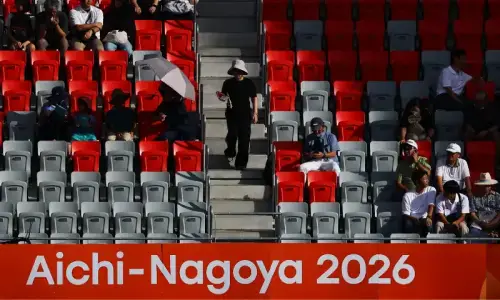
Rain also contributed to sparse crowds at venues, reviving concerns about spectator interest after the Games had already faced criticism over empty seats.
The organisers had previously acknowledged that ticket sales were slow and apologised for transport and accommodation problems.
The Games also recorded their first doping case involving a medallist. Uzbekistan’s Nodirbek Shavkatov, who won bronze in mixed martial arts, was provisionally suspended after testing positive for meldonium in an out-of-competition test, according to the International Testing Agency.
Meldonium is a prescription heart medication that has been prohibited in sport.
Published in Dawn, September 28th, 2026