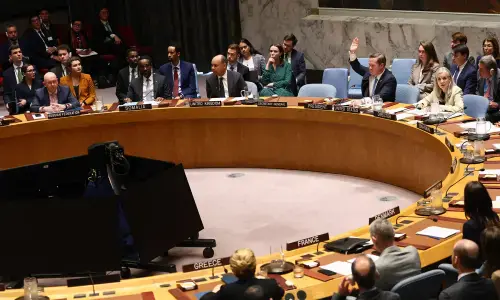
UNITED NATIONS: Pakistan abstained on Thursday when the United Nations Security Council (UNSC) voted on a US-sponsored resolution to extend the mandate of the Panel of Experts assisting the council’s Iran sanctions committee.
The resolution was rejected after China and Russia, two of the Security Council’s five permanent members, voted against it, effectively vetoing the measure. Eleven of the 15 Council members, including the United States, Britain and France, voted in favour, while two, including Pakistan, abstained.
The negotiations on the draft resolution reflected the deep divisions within the council over the Iran nuclear issue, particularly the dispute over the triggering of the “snapback” mechanism to reimpose UN sanctions on Iran that had been suspended under the Joint Comprehensive Plan of Action (JCPOA) and Security Council Resolution 2231 of 2015.
China and Russia reiterated their longstanding opposition to the legal and procedural validity of the snapback mechanism. Both permanent members were expected to vote against the draft, which would block its adoption even if it secured nine or more votes in favour.
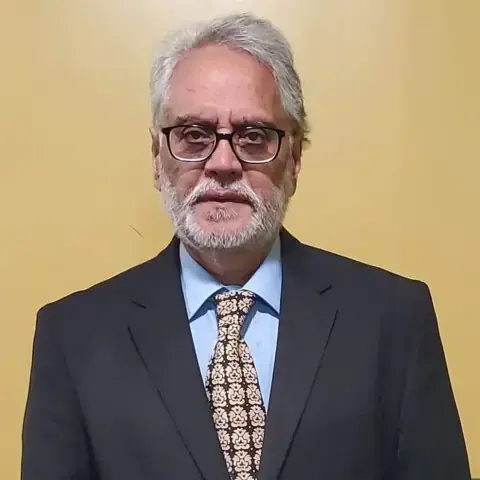
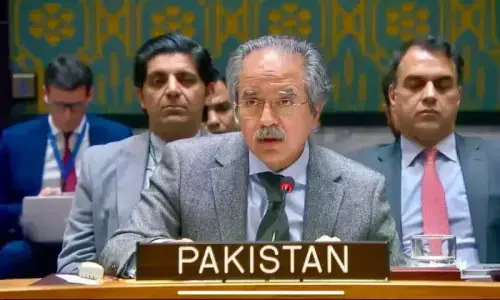
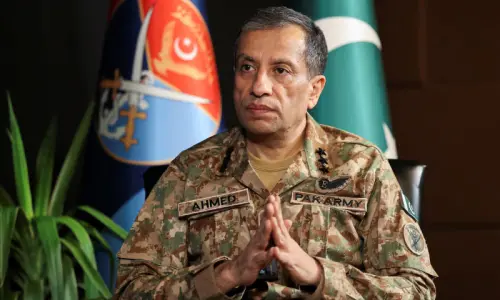
Pakistan’s abstention was explained by its permanent representative, Ambassador Asim Iftikhar Ahmad, who said Islamabad remained concerned that the Iran nuclear issue had become increasingly complicated and that the council had moved away from the spirit of cooperation and peaceful settlement that had accompanied the adoption of Resolution 2231 in 2015.
“Diplomacy and dialogue remain the guiding principle” for resolving outstanding issues concerning Iran’s nuclear programme, Ambassador Ahmad told the council.
The US draft extends the experts’ mandate until September 2027 and asks the panel to provide recommendations on updating sanctions-related measures, quarterly reports on its work and an annual report to the UNSC.
The panel, established under UNSC Resolution 1929 of 2010, monitors implementation of measures imposed on Iran and provides the council with assessments and recommendations. Its mandate was due to expire on Sept 26.
The dispute over the panel is part of a wider disagreement over the status of the UN sanctions regime following the invocation of the snapback mechanism by Britain, France and Germany in 2025.
Pakistan has consistently argued that the nuclear issue should be resolved through negotiations rather than confrontation.
In his statement on Thursday, Ambassador Ahmad recalled that Pakistan had urged the council last year to provide additional time for diplomacy through a technical extension of Resolution 2231. He said Islamabad had warned that a non-confrontational and cooperative approach would have provided greater space for a lasting settlement.
“The Iran nuclear issue should be addressed through peaceful means,” he said, stressing that the rights, obligations and responsibilities of the parties concerned must be respected.
Pakistan also reaffirmed its support for the International Atomic Energy Agency (IAEA), describing it as the technical body responsible for implementing safeguards agreements.
“The IAEA should ensure this important work as per its mandate, independently and without political interference,” Ambassador Ahmad said.
He called for renewed diplomatic engagement and urged the parties to return to negotiations.
Pakistan also referred to the Islamabad Memorandum of Understanding, calling on the parties to implement their commitments under the agreement and return to the negotiating table.