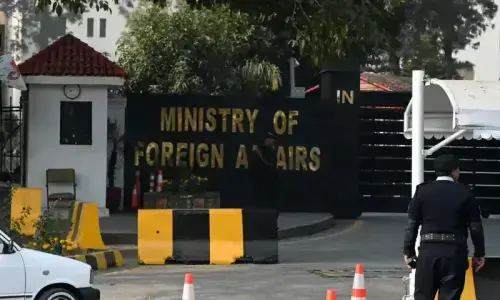
Pakistan on Wednesday summoned the Charge d’Affaires of the Indian High Commission and lodged a “strong protest” over a “highly provocative and unacceptable” action by an Indian Navy vessel in Pakistan’s Exclusive Economic Zone (EEZ) on Sept 15, the Foreign Office (FO) said.
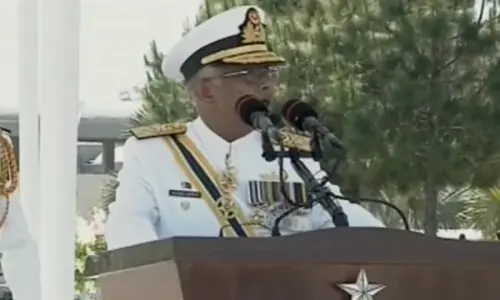
According to the FO, the incident occurred while the Pakistan Navy was conducting its biennial exercise, SEASPARK-26.
The FO said that the Indian vessel carried out “aggressive manoeuvres” in dangerously close proximity to a Pakistani naval ship, resulting in contact between the two vessels.
The ministry termed the incident a “serious violation of international law” as well as the 1991 bilateral agreement on Advance Notice on Military Exercises, Manoeuvres and Troop Movements.
It said the incident also risked escalating tensions in the region.
The Indian diplomat was asked to convey to New Delhi that Pakistan “strongly rejects” the “belligerent Indian action” and urged India to strictly adhere to international law and bilateral agreements, particularly those intended to prevent incidents at sea.
The FO added that Pakistan’s Charge d’Affaires in New Delhi would lodge a similar demarche with India’s Ministry of External Affairs.
Pakistan also called on the international community to urge India to refrain from what it described as “irresponsible actions” that could further destabilise South Asia.
“The region can ill-afford to remain perpetually hostage to India’s reckless pursuit of conflict and instability,” the ministry said.
India’s Ministry of External Affairs also summoned Pakistan’s envoy in New Delhi earlier today and issued a demarche over the incident.
In May 2025, a four-day conflict between Pakistan and India was sparked by an attack on tourists in occupied Kashmir’s Pahalgam, which New Delhi, without evidence, linked to Pakistan. Islamabad strongly denied responsibility while calling for a neutral investigation.
After New Delhi launched deadly air strikes in Punjab and Azad Kashmir on May 7, Pakistan said it downed six Indian planes in air-to-air combat, later raising the tally to eight. After tit-for-tat strikes on each other’s airbases, it took American intervention on May 10 for both sides to finally reach a ceasefire.
In April, on the first anniversary of the Pahalgam attack, Pakistan had rejected a renewed Indian propaganda campaign linking it to the attack, deploring that the neighbouring country was focusing on “weaponising its false narrative” in the midst of a regional crisis sparked by the US-Israel war on Iran.