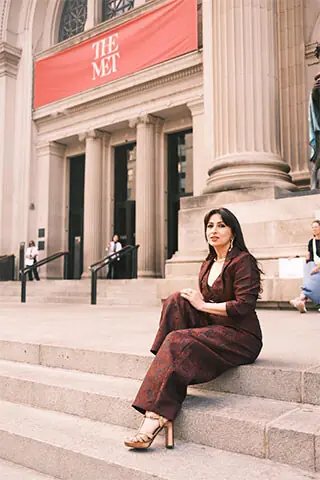
An email arriving around Christmas last year took Saba Qizilbash by surprise. The Pakistani diaspora artist, who lives and practises in Oxford, England, initially struggled to believe what she was reading. Repatriation of Tipu’s Tiger (2022), one of her large-scale drawings, had been selected for ‘Musical Bodies’ at the Metropolitan Museum of Art (The Met) in New York.
On view until September 27, 2026, ‘Musical Bodies’ brings together around 130 objects, spanning 4,000 years. Organised by Bradley Strauchen-Scherer, curator at The Met’s Department of Musical Instruments, the exhibition explores the relationship between musical instruments and the human body across cultures and centuries.
Once Qizilbash had spoken with the curator, surprise gave way to research. She began looking closely at the remarkable company her drawing would keep. Among the works is an Irish harp made by John Egan around 1821, alongside African instruments, including an Akan/Ashanti breasted drum. Elsewhere, objects ranging from ancient instruments to the singer Prince’s “Love Symbol” guitar extend the exhibition’s conversation across histories and geographies.
For Qizilbash, whose practice examines borders, routes, migration and displacement, these neighbours matter. Her drawing enters a conversation between objects whose histories have themselves been shaped by movement.
At New York’s Metropolitan Museum of Art, Saba Qizilbash’s drawing of Tipu’s Tiger becomes part of a wider conversation about objects, music, migration and the contested journeys of history
Executed in graphite, water-soluble graphite and suminagashi ink on Mylar, Repatriation of Tipu’s Tiger comes from the collection of Yasser and Mariam Mahmud in Pennsylvania. Its subject is the extraordinary 18th century mechanical tiger made for Tipu Sultan, ruler of Mysore. The near life-size automaton depicts a tiger mauling an East India Company (EIC) soldier, while a concealed organ turns this violent encounter into sound. Following Tipu’s killing during the British assault on Seringapatam in 1799, the tiger was taken to Britain. Today, it is held by the Victoria and Albert Museum in London.
Qizilbash does not simply redraw the object. She imagines its repatriation, reversing its historical journey towards the landscape from which it was removed. Yet, she complicates the apparent simplicity of return. What happens afterwards? Who becomes responsible for its survival? Would it receive the same level of conservation? More provocatively, should every historical object necessarily be preserved at all costs?
These questions make the drawing particularly resonant within ‘Musical Bodies.’ The original tiger is itself a strange musical body: sculpture, automaton and organ combined. Around Qizilbash’s drawing, instruments from Ireland, Africa and elsewhere reveal other relationships between bodies, sound, identity and power.
Living and practising in Oxford has also placed Qizilbash close to British museums and archives containing colonial collections connected to South Asia. Her meticulously researched drawings often resemble maps or archival documents, yet their apparent certainty is deceptive. Geography shifts, histories overlap and journeys prevented by politics become possible on paper.
Her inclusion at The Met therefore matters beyond institutional prestige. Qizilbash enters an encyclopaedic museum not by presenting a fixed image of Pakistani identity but by asking how histories travel, who possesses them and who determines their destination.
Qizilbash’s imagined return also raises a question beyond the drawing itself: if Tipu’s Tiger were returned today, where exactly would it go? Mysore is now in India, making India its geographical home. But Tipu Sultan died in 1799, almost 150 years before India and Pakistan emerged from Partition. The object may belong geographically to India, while the history it embodies belongs to a much older undivided Subcontinent.
Perhaps the tiger can be returned to a country, but its history cannot be contained by one.
‘Musical Bodies’ is on display at the Metropolitan Museum of Art, New York, from June 7-September 27, 2026
The writer is an art critic, curator and educator who spends his time between Birmingham and Lahore. He can be reached at aarish.sardar@gmail.com
Published in Dawn, EOS, September 13th, 2026