PM Shehbaz discusses need for ML-1 railway project's early groundbreaking in meeting with ADB official
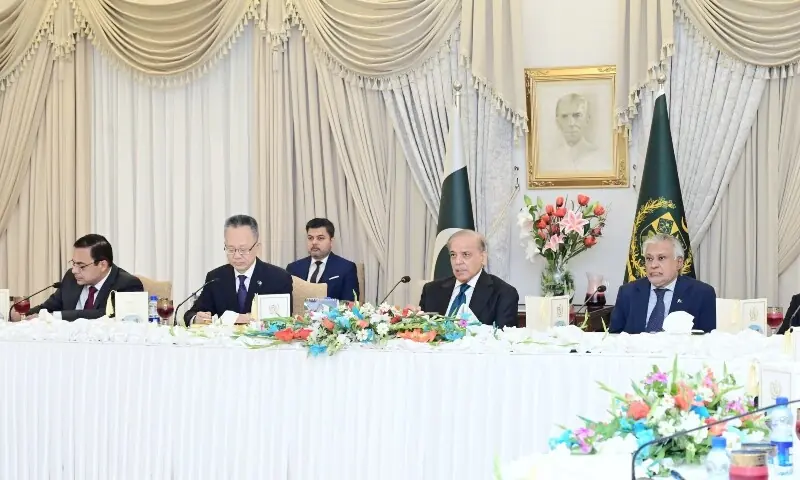
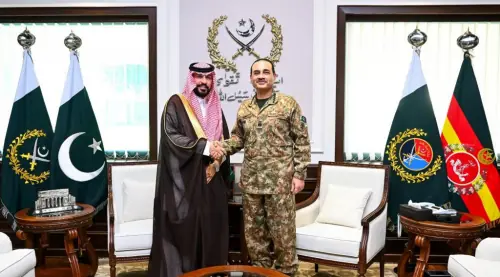
Prime Minister Shehbaz Sharif discussed the need for Karachi-Peshawar Main Railway Line’s (ML-1) early groundbreaking with Asian Development Bank (ADB) South, Central, and West Asia Vice President Yingming Yang on Friday.
The premier and the visiting ADB official held a meeting in Islamabad, the Prime Minister’s Office (PMO) said in a statement, adding that a central focus of the discussion was the modernisation of ML-1.
The long-delayed project was a “vital national infrastructure priority”, the statement said.
During the meeting, PM Shehbaz stressed that upgrading the project was essential for modernising freight logistics, strengthening regional trade connectivity and supporting major industrial initiatives, it said.
Moreover, the “meeting discussed the need for the early groundbreaking of ML-1, being vital for infrastructure development and modernising the connectivity”, it added.
The $10 billion ML-1 project is among the public-private partnership initiatives for which Pakistan is seeking ADB’s scaled-up financing.
Pakistan has already secured $2bn in financing from the Manila-based lending agency for the Karachi-Rohri section of the 1670-km ML-1 project, which is under implementation.
In July, Planning Minister Ahsan Iqbal told the media that the groundbreaking of the first phase of the project, part of the China-Pakistan Economic Corridor (CPEC), was to take place early next year.
Asked if the ADB loan for the project was acquired after China declined to take up the scheme, as it used to be the preferred financier under the CPEC, the minister did not agree, saying all three modes, including local, Chinese and multilateral financing, were part of the plan under the CPEC framework agreement for ML-1. “It was agreed with China under the CPEC framework that ML-1 would be financed jointly through Chinese, Pakistani and multilateral sources,” he said.
However, given the ongoing annual rollovers of existing Chinese loans, it was considered prudent to start the project with ADB financing in the initial phase, and it was done with China’s consent.
Previously, Pakistan had been requesting the Chinese side to depute technical teams for technical and financial terms and conditions for well over two years after the project size was scaled back for cost-cutting.
Country Partnership Strategy discussed
In Friday’s meeting, PM Shehbaz also lauded ADB’s “consistent professionalism and responsiveness in delivering transformative urban infrastructure, transport, and public service projects in Pakistan”, the PMO statement said.
It added that he and Yang also reviewed the multi-decade development partnership and charted priority interventions under the new Country Partnership Strategy (CPS) 2026–2030, the PMO statement said.
Yang is leading an ADB delegation, which is in Islamabad as part of a follow-up to the $10bn CPS, approved in March this year.
In March, ADB announced the five-year CPS, under which it would extend about $10 billion in financing to Pakistan.
The CPS sets out “a roadmap to support the country’s transition to sustainable and inclusive growth through private sector-led development”, the Manila-based lending agency said at the time.
PM Shehbaz told the ADB official that Pakistan has “successfully navigated a difficult economic turnaround through rigorous fiscal, structural, and governance reforms”.
These corrective actions had restored macroeconomic stability, reinforced investor confidence and earned stable outlook upgrades from major international credit rating agencies including Fitch, Moody’s, and S&P, he said.
Reaffirming his government’s “steadfast commitment to long-term economic transformation”, the PM said administrative bottlenecks were being actively dismantled through dedicated execution task forces, the PMO statement said.
It added that the two also discussed expanding cooperation in different sectors, exploring “collaborative avenues in support of the private sector, energy security, food security, export competitiveness, artificial intelligence and information technology”.
“The meeting concluded with a mutual pledge to translate the strategic priorities of the CPS 2026–2030 into concrete, high-impact results that drive sustainable growth and visibly enhance the standard of living for the people of Pakistan,” the statement said.
The PM also welcomed Yang on his first official visit to Pakistan as the ADB vice president for South, Central, and West Asia.