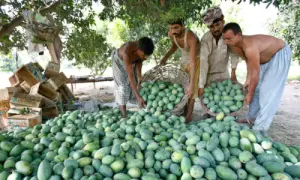
THE Committee on Genetically Modified Corn has approved GM maize cultivation alongside hybrid and organic varieties. The decision itself is not the problem. But the lack of transparency around it and the framework for conducting open-field trials of new technology to test its behaviour in the local environment are problematic. While the committee’s statement cites a “practical, well-defined framework” and stakeholder consultations, it says little about independent field trials for Pakistani soil and climatic conditions, as distinct from controlled environments. International protocol for GMO food crops exists because laboratory performance and open-field behaviour diverge, and the contamination risk to neighbouring crops is real. Both stages of testing need to happen before commercialisation. The results should be published so that farmers and the public can make an informed decision.
Coexistence with existing varieties, endorsed in principle, needs more than a promise. It needs a mandated buffer distance between GM and non-GM plots, and separate harvesting, transport and packaging for GM maize. Pollen drift and seed mixing in transport are the two main routes of contamination. If the state wants to protect the non-GM seed base, these details must be worked out. There is also the question of timing. Maize, by the committee’s own account, is a thriving crop in Pakistan on hybrid seed alone. The push for commercialisation has apparently come from the US administration and from American firms holding trial licences, not from a domestic productivity crisis. That doesn’t make the technology bad. It does, however, mean the government owes the public an account of what GM maize solves that hybrid seed does not. If GM maize proves suitable for local conditions after proper testing, the companies bringing it to the market should compete with hybrid and organic varieties on the same footing as any other seed technology. No government guarantees, no subsidised entry, no regulatory shortcuts should be allowed. Farmers need training on cultivation requirements before GM seed reaches the market. Also, consumers need transparent labelling. Most countries that allow GM crops into the food supply mandate it so that buyers can choose. Pakistan should not leave GM and non-GM maize indistinguishable on the shelf.
Published in Dawn, September 4th, 2026