Govt eyes petrol deregulation by June next year

• High-speed diesel to be deregulated at a later stage
• Ogra may be empowered to adjust diesel pricing without repeated cabinet approvals
• Petroleum price stabilisation fund unlikely to be operationalised
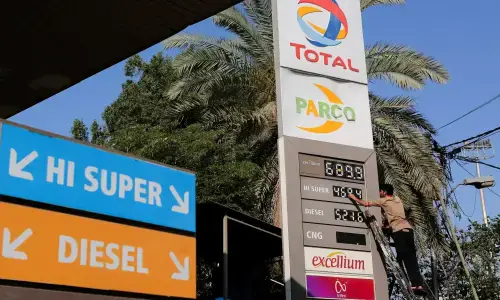
ISLAMABAD: The government is unlikely to operationalise the recently created Petroleum Prices Stabilisation Fund (PPSF) and instead plans more changes to the pricing mechanism, including complete deregulation of petrol by June 2027, with high-speed diesel to follow at a later stage.
A meeting of the committee on petroleum pricing, led by Petroleum Minister Ali Pervaiz Malik, also agreed in principle to empower the Oil and Gas Regulatory Authority (Ogra) to switch diesel pricing to crude-based calculations in case of an unusual rise in the diesel crack spread without seeking repeated approvals from the federal cabinet.
The cabinet had last month temporarily capped the HSD crack spread — the gap between international diesel and crude oil prices — at $41.89 per barrel after it averaged above $60, resulting in windfall gains for local refineries and sharp increases in their profitability and share prices.
Once approved, Ogra would be able to adjust the HSD crack spread within a prescribed floor-and-cap mechanism.
“For diesel pricing, the committee approved the guiding principles for possible rules-based intervention in case of an emergency situation, with clearly defined price-shock triggers and possible corrective measures,” the petroleum division said in a statement.
Informed sources said the committee agreed that, despite usual hue and cry, daily price adjustments had worked well and generally helped stabilise the market by avoiding the larger shocks associated with longer pricing intervals in the past.
They said this had reduced the need for a price stabilisation fund, which would otherwise require additional taxation for financing.
Sources said a consultancy working on the subject had advised the government that maintaining adequate fuel stocks generally worked better for price stability than intervention through stabilisation funds, which could create price and market distortions.
Therefore, the government intends to proceed in phases, starting with the complete deregulation of petrol pricing — similar to high-octane products such as 97 RON HOBC and 95 RON — with daily adjustments by June 2027.
For consumers, deregulation could mean more frequent changes in petrol prices and, eventually, different prices across oil marketing companies as they compete in the market. It could offer cheaper options in some cases but would also expose consumers more directly to movements in international oil prices and the exchange rate.
In a subsequent phase, diesel pricing would also be considered for complete deregulation, allowing oil marketing companies (OMCs) to adjust prices in a competitive environment.
The petroleum division said the committee had agreed on a set of recommendations to strengthen the existing pricing mechanism and would submit its final report to the prime minister for consideration and approval.
Informed sources said some additional technical input was still required and the process was expected to be concluded in another two or three committee meetings.
The committee also reviewed recommendations on the petrol pricing formula and set a likely June 2027 target for deregulation, with the aim of ensuring a gradual transition towards competitive, market-based pricing while protecting consumers from excessive price volatility.
The meeting reviewed the existing Inland Freight Equalisation Margin (IFEM) mechanism, which is used to maintain uniform depot-stage petroleum prices across the country, and agreed on a revised methodology for calculating it.
Ogra assured the committee that the IFEM audit for FY26 would be completed by the end of calendar year 2026.
The committee also directed Ogra to submit written recommendations on consolidation and performance of existing oil marketing companies, especially in terms of adoption of best practices and latest technologies.
Informed sources said a major player associated with a leading OMC was already absconding after allegedly being found involved in unfair business practices, while the petroleum division wanted its foreign partner to play a greater role in operating retail outlets.
The committee reviewed reports of subcommittees on the proposed price stabilisation fund, benchmarked against various successful and unsuccessful international models, and directed the subgroup to further refine its proposals.
“The committee, however, observed that in view of the ultimate deregulation of the market, maintaining adequate fuel reserves would be more appropriate than establishing a stabilisation fund,” the petroleum division said.
The committee believed the proposed changes would improve predictability and transparency in petroleum pricing, enhance market efficiency and safeguard consumers from abrupt price movements while facilitating a gradual transition towards deregulation.
A subcommittee headed by NetSol’s Naeem Ghauri was also advised to meet Federal Board of Revenue (FBR) Chairman Rashid Langrial to assess whether the taxation regime needed to be reviewed in light of changing market conditions.
The government had notified the establishment of a petroleum price stabilisation fund in June amid sharp price fluctuations following US attacks on Iran. However, the fund currently holds no deposits, although the Ministry of Finance has already created special heads of account for it.
Published in Dawn, September 4th, 2026