SOCIETY: A KARACHI THAT BELONGS TO NO ONE
In Karachi, I stopped at red lights and Karachi found this unreasonable.
The horns would begin within seconds — long, aggrieved blasts from motorcycles and cars that could see the signal as plainly as I could. Around me, vehicles slid past the stop line and settled on to the zebra crossing, then into the intersection itself, packed together with nowhere to go, waiting for a green light they had already declined to honour.
Nobody looked embarrassed. The embarrassment, such as it was, belonged to me: the man obstructing traffic by obeying it.
I had come to the city midway through a 16-day road journey: Lahore to Rahim Yar Khan, on to Hyderabad and Karachi, before heading home along the Indus Highway.
A long drive is a peculiar instrument. It shows you a country at ground level, without the anaesthetic of airports and hotel lobbies. You stop reading the place through headlines and begin reading it through its roads, shopfronts, pavements and walls. Mile after mile, one question kept returning: how people behave in the spaces they hold in common. Nowhere did that question press harder than in Karachi.
What connects impatient car horns at a red light, a gleaming signboard on a grimy building and open sewage beside the beach is a single missing conviction: that the city belongs to the people in it
The city must first be given its due. Karachi is furiously alive. It works the way a great port city works: goods move, markets churn, restaurants fill, towers rise, and millions of people get up every morning and go out to earn. Its commercial vitality has no rival in Pakistan; its coastline, food, layered architecture and diversity would be the envy of the region. Nothing that follows is written by someone immune to any of this.
But somewhere along the way, Karachi appears to have settled for functioning at the minimum level required for survival, and to have made everything above that level negotiable. The city moves — whether it moves with order is negotiable. Commerce thrives — whether it thrives amid filth is negotiable.
The evidence is cumulative. Broken pavements stay broken for years. Manholes go uncovered until pedestrians learn their positions by heart. Garbage gathers wherever gravity and habit deposit it. Construction material lies across footpaths long after the project it belonged to has stalled, so that rubble and ordinary life coexist without friction.
Whole stretches of the city manage to look under construction and abandoned at the same time — a strange trick, since building implies a future and neglect implies the future has been called off.
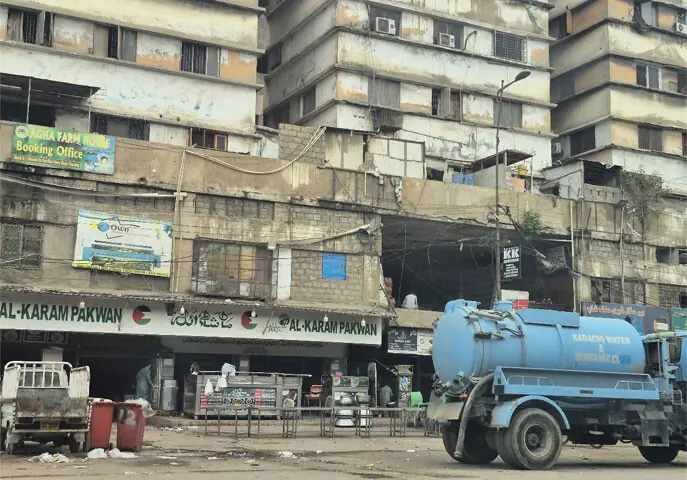
The buildings say it most plainly. Across the city, residential and commercial facades stand unwashed and unpainted, sometimes for decades: peeling paint, stained concrete, balconies furred with grime, wiring strung across frontages like an improvised nervous system.
This is hardly confined to the poorest neighbourhoods, where the explanation would at least be obvious. I passed businesses that had spent handsomely on illuminated signboards bolted on to buildings nobody had cleaned in years — money for the advertisement, none for the thing advertised. Even corporate towers, where resources plainly exist, have glass that clearly has not been washed in months and frontages that have not even been swept.
It is tempting to file all of this under poverty, and dishonest to do so. Poverty prevents people from doing what they might otherwise do. But not all neglect can be explained by poverty. A man who cannot afford paint is poor; a prosperous trader operating out of a soiled building beneath a gleaming signboard reflects a different type of failure: a condition that becomes so normal that it no longer demands attention.
The state’s failure is real, and I do not discount it. Karachi has been governed badly, and often barely, for decades; its municipal systems were outrun long ago by its own growth, and its people have every right to their grievance.
But institutional failure, endured long enough, stops being a circumstance and becomes a teacher. People adapt to it; the adaptation hardens into habit, the habit into culture and, in time, the culture reproduces the failure faster than any government could. A red light that requires a policeman beside it to mean anything has already ceased to be a red light. It is a suggestion with electricity.
Sea View supplied the image I have not been able to shake. On one of the city’s best-loved waterfronts, an open channel of sewage ran across the sand towards the sea — dark, foul-smelling, in plain sight of families out for the evening and a McDonald’s doing brisk trade a few yards away.
Nothing about the scene was hidden and nothing about it was treated as scandalous. Children played on one side of the discharge; the Arabian Sea received it on the other. Karachi has reached a point where both facts can coexist indefinitely, with no one in particular answerable for the arrangement.
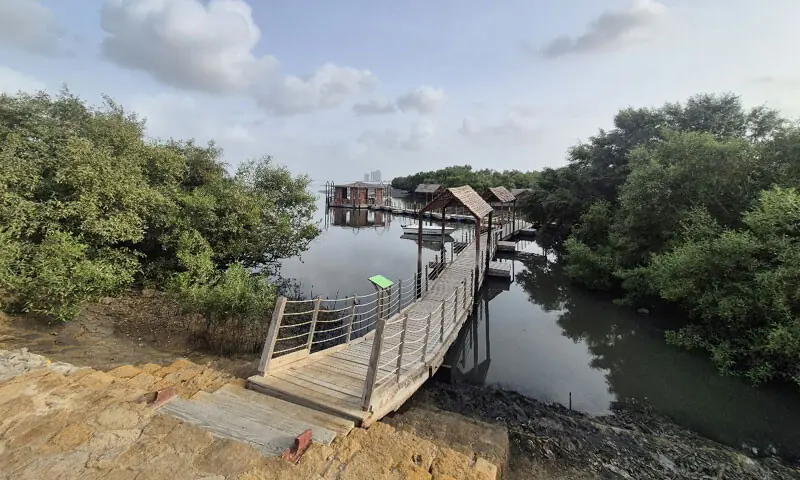
A few days later, at a mangrove biodiversity park, I found the same arrangement in more decorated form. The mangroves were dense and improbably green, and the wooden boardwalk winding through them was handsome. The water beneath was another matter: grey-black and oily, carrying what appeared to be sewage and industrial waste into the roots of the very ecosystem the park exists to celebrate.
We had raised a monument to biodiversity over the slow poisoning of it. The trees, for now, survive. The water asks how long a city can keep congratulating itself on things it is simultaneously destroying.
The easy verdict — dirty city, failed city — is also the lazy one, and it misses what makes Karachi’s condition genuinely painful. A building does not need to become a museum to possess dignity; often it needs only to be cleaned and painted. A shopfront needs no streetscape scheme, only an owner willing to sweep the few metres outside his own door. Watching so much of this go uncared for is harder to bear than outright ruin would be, because ruin at least has the decency to be finished.
What connects the horns at the red light, the signboard on the filthy building and the gutter beside the beach is a single missing conviction: that the city belongs to the people in it.
Belonging is the hinge on which everything else turns. A man who feels some responsibility for the street outside his shop is more likely to sweep it without being ordered to. A man who believes that the street belongs to the government, or to no one, may step over its garbage for years without feeling responsible for it.
And when a society lives with disorder long enough, the eye retires from it. The missing manhole becomes normal, as does the blackened façade. The same is true of the sewage reaching the beach. Chaos, at least, announces itself as an event; Karachi has drifted past it into something quieter — chaos as climate, permanent, ambient and attributable to no one.
I do not believe the remedy begins with another grand project. Karachi has seen master plans before and will see more; the sewage has outlived most of them.
Cities are made of millions of small behaviours repeated every day, and they are unmade the same way. The rebuilding of this one, if it comes, will start smaller than any plan: a shopkeeper sweeping his own frontage, a driver holding behind the stop line with no policeman in sight, a resident looking up at the building he lives in and deciding it deserves paint — anyone looking at the city around them and thinking: this belongs to me too.
The writer is an essayist concerned with
power, politics and culture. He can be
contacted at suhaib.ayaz@gmail.com
Published in Dawn, EOS, August 30th, 2026