ISLAMABAD: The government on Tuesday claimed progress towards resolving the goods transporters’ strike after two days of negotiations, but transporters rejected the official account and vowed to keep heavy vehicles off the roads until their demands were accepted, as textile exporters warned that continued disruption was putting orders worth millions of dollars at risk.
A statement issued by Communications Minister Abdul Aleem Khan, convener of the committee constituted by the prime minister to negotiate with the transporters, said consensus decisions had been reached with the All Pakistan Goods Transporters Ittehad after two days of talks.
The statement said it had been decided to establish a joint monitoring committee comprising Customs authorities and representatives of goods transporters.
On the axle-load issue, transporters expressed support for the communications minister’s proposal that overloading should be controlled at source through a uniform policy, according to the statement.
The meeting also discussed short- and long-term measures to address problems faced by transporters in dealing with Customs authorities.
Mr Khan directed the authorities to promptly address complaints regarding weigh stations and said state-of-the-art facilities with minimal human intervention would be established on all motorways.
The five-hour meeting included detailed discussions between officials of the petroleum ministry and representatives of the All Pakistan Goods Transporters Ittehad, which represents edible oil tankers, petroleum tankers, container trailers, truckers and intercity goods carriers.
However, representatives of the Ittehad rejected the government’s claim of progress and said the talks had ended without a breakthrough.
They announced that the nationwide wheel-jam strike would continue until their demands were accepted.
Ittehad spokesman Muhammad Owais Chaudhry said transporters would not withdraw their “legitimate demands”.
“We are ready to continue negotiations with the government, but the nationwide wheel-jam strike will continue until our demands are practically accepted,” he said. “Now we have decided to move to our main protest camp in Karachi. The minister and other authorities will have to come to Karachi to talk to us,” Mr Chaudhry told Dawn.
“We do not want to play the traditional bureaucratic game of ‘committee, committee’. If they want to accept anything, they should. If not, they should clearly tell us to stop doing business,” he added.
Export orders at risk
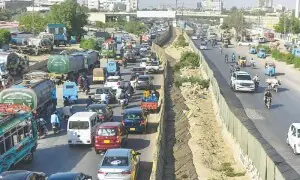
Meanwhile, the textile export industry expressed serious concern over the suspension of cargo movement, warning that the countrywide strike had brought export-related logistics to a virtual standstill and put millions of dollars’ worth of orders at risk.
Pakistan Textile Exporters Association (PTEA) Chairman Sohail Pasha said the continued suspension of goods transportation was severely disrupting the movement of export cargo, raw materials and other essential supplies.
“We are really worried about the situation, as the continued suspension of goods transportation is severely disrupting the movement of export cargo, raw materials and other essential supplies,” he told reporters.
Mr Pasha said the situation was particularly alarming for the textile industry, which operates on strict production and shipment schedules linked to international buyers and shipping lines.
Khalid Hasnain in Lahore also contributed to this report
Published in Dawn, August 12th, 2026