2.4 million girls affected by Taliban ban on schooling, says Unesco
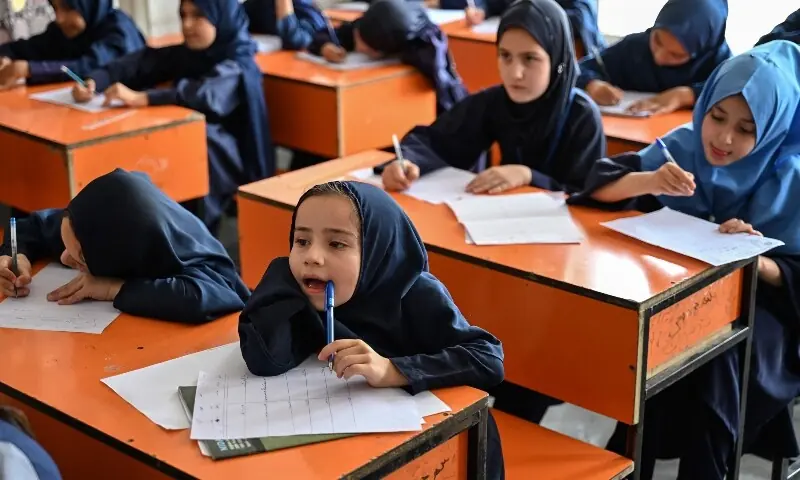
PARIS: Around 2.4 million girls in Afghanistan have been denied access to secondary education since the Taliban returned to power in 2021, the United Nations said on Tuesday, urging an end to such “discrimination”.
The Taliban administration, recognised solely by Russia, has imposed a series of restrictions under which girls cannot study beyond primary school.
The number of girls denied access to secondary school has risen by 200,000 since last year and could reach nearly four million by 2030 if the ban persists, said the UN’s cultural and educational agency Unesco.
The UN agency called for the immediate restoration of their right to education and condemned the “discrimination against women and girls”.
The Taliban government, which promised a softer rule after retaking power in Aug 2021, has imposed sweeping restrictions on women, banning them from universities, parks, gyms and beauty salons.
Girls were barred from secondary schools in March 2022, with universities closed to young women later that year. “These restrictions are reversing two decades of progress in expanding access to education: while access to schooling for girls was severely limited in 2001, by 2021 nearly one million girls were enrolled in secondary education,” Unesco said. “Afghan girls and women have the right to learn, that’s a basic human right,” said Hoda Jaberian, Unesco’s programme coordinator for education in emergencies.
“They have the right to work. They should have the freedom of movement.”
The schooling ban also carries a significant economic cost, with the restriction on women and girls estimated to cost Afghanistan $9.6 billion by 2066, the UN agency said.
Afghanistan’s wider education sector is in crisis, with more than half of primary school-age children completely out of school.
More than 90pc of 10-year-olds are unable to read a simple text, according to Unesco. A lack of drinking water, sanitation facilities and heating in schools has compounded the crisis, as have natural disasters, including earthquakes that have repeatedly struck the country in recent years.
Published in Dawn, August 12th, 2026