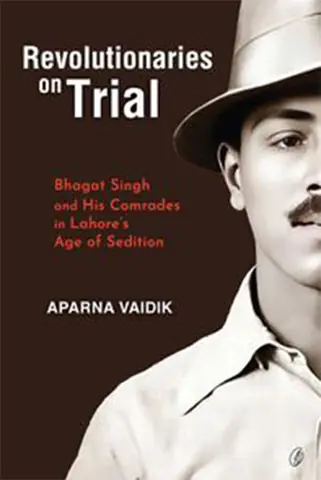
Revolutionaries on Trial — Bhagat Singh and His Comrades in Lahore’s Age of Sedition
By Aparna Vaidik
ILQA Publications
ISBN: 978-969-640-332-6
532+pp.
Aparna Vaidik spent over a decade and made three visits to Pakistan from India to write her scholarly, extensively researched book, Revolutionaries on Trial — Bhagat Singh and His Comrades in Lahore’s Age of Sedition.
Besides thoroughly documenting the trial of the Lahore Conspiracy Case (1929-30), the author has effectively addressed the prevailing myth that the people of the Subcontinent are submissive and lack the DNA to rise against oppressive rulers.
The joint struggle and sacrifices of the people of the Subcontinent against British colonial rule still remain underrated, ignored or demeaned all over the Subcontinent. The resistance and actions against the brutal British oppression, though mostly dispersed geographically, nevertheless existed widely across this entire region. It was backed by all religious segments and ideological divides in pre-Partition India. Ironically, the so-called ‘good legacies’ and contributions of the colonisers have attained more currency than their misdeeds, even today.
“So, why does militant nationalism not gain as much political traction in the Indian Subcontinent as in Russia and Latin America?” the author asks. She answers that, “A large part of the answer, as this book shows, lies in the history of armed resistance and militant political dissent having been written out of Indian history, despite its abundance, and non-violence being written in as the nation’s civilisational essence.”
A deeply researched study examines the trial in Lahore of revolutionary icon Bhagat Singh and his comrades, exposing how colonial law, courtroom procedure and public opinion were manipulated to write militant resistance out of the history of the Subcontinent
The author adds: “Even the young revolutionaries received their knowledge about the history of militant groups who preceded them through the voluminous reports and books written by British officers. The Sedition Committee Report (1918), for instance, was an essential read for all the young revolutionaries, and it continues to be a significant reference text for contemporary writers and historians… It claimed that all the revolutionary conspiracies had been ‘successfully encountered with the support of Indian loyalty’.”
The Hindustan Socialist Republican Association (HSRA), founded in 1928 in Delhi, was a radical Indian freedom fighter organisation formed to overthrow British colonial rule and to strive for an independent socialist state. It evolved from the Hindustan Republican Association (HRA), founded in 1924 in Kanpur. Ram Prasad Bismil, Ashfaqulla Khan, Sachindra Nath Bakshi, Sachindranath Sanyal, and Jogesh Chandra Chatterjee were the foundational leaders of the HRA, and were dedicated to overthrowing British colonial rule through an armed uprising.
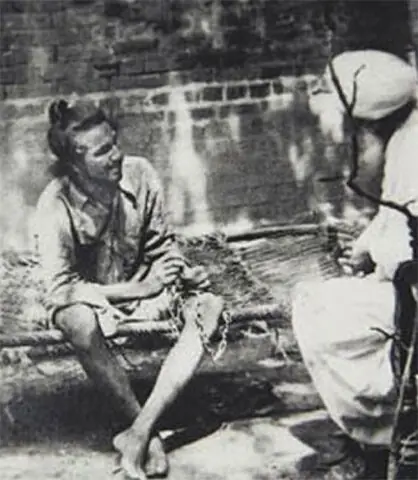
Key revolutionaries of the HSRA included Chandra Shekhar Azad, the commander-in-chief and brilliant strategist who masterminded the organisation’s armed resistance. Bhagat Singh and Shivaram Rajguru assassinated British police officer J.P. Saunders in 1928 to avenge the fatal lathi-charge on Indian nationalist leader Lala Lajpat Rai. Bhagat Singh and Batukeshwar Dutt then symbolically bombed the Central Legislative Assembly in 1929 to protest oppressive public safety and trade dispute bills, courting arrest to spread their message.
HSRA also included Sukhdev Thapar, a chief organiser and ideological leader who managed bomb factories and coordinated underground resistance, and Jatin Das, who staged a historic 64-day hunger strike in Lahore Central Jail to demand better conditions for political prisoners, eventually losing his life.
In 1929, the HSRA had set up bomb factories in Lahore and Saharanpur. On April 15, 1929, the Lahore bomb factory was discovered by the police. Following the Assembly bombing and the Saunders assassination, the British government cracked down heavily in the Lahore Conspiracy Case. The execution of Bhagat Singh, Sukhdev and Rajguru on March 23, 1931, was followed closely by the combat death of Chandra Shekhar Azad, effectively marking the end of the organisation.
The decline of the HSRA began with the arrest of key leaders such as Bhagat Singh, Sukhdev and Rajguru. Like the 1857 War of Independence, which was labelled as a ‘mutiny’ by the colonisers, these freedom fighters were similarly publicly portrayed as traitors and terrorists by the British Raj. Vaidik painstakingly details how facts, laws, administration and public perceptions were manipulated by the government to achieve its objective of crushing and undermining the indigenous resistance and defaming the revolutionaries.
Detailed crime investigation procedures of this case are reproduced by the author. They read like detective novels. The original post-mortem sketch of Saunders’ body, the approach to Saunders’ assassination site, the escape route of the assassins, the scene of the incident, a copy of the FIR and newspaper clippings of The Tribune and Hindustan Times of that period are also among the illustrations in the book.
Legal explanations, definitions and arguments abound, including the legislation to curb the revolutionary, anti-government struggle, trade unions and labour strikes/protests. Prosecution and defence arguments, as well as questions and answers, are reproduced. Interrogation details and court proceedings in the sedition trials are also elaborated in the book.
The fear of communism, which threatened the British at the time, was also a driving force and a pretext behind many policies and actions of suppression.
“The press in England was firmly of the view that the bombing of the assembly was part of the wider Bolshevik conspiracy to destabilise the British Empire,” Vaidik writes. “They believed Bhagat Singh and Batukeshwar Dutt were ‘two communists’, and their style resembled that of the Third International, slightly modified to suit the Indian surroundings.”
Jawaharlal Nehru later reminisced about Bhagat Singh’s death in his autobiography: “He [Bhagat Singh] became a symbol; the act was forgotten, the symbol remained and, within a few months, each town and village of Punjab, and to a lesser extent in the rest of northern India, resounded with his name. Innumerable songs grew up about him, and the popularity the man achieved was amazing.”
After March 1931, the revolutionary fervour, nevertheless, continued to surge in different parts of the Subcontinent. There were a high number of revolutionary actions the government records show, but they did not become public the way this trial had. Since Saunders’ assassination, the attacks on British officials increased considerably, with about “a dozen incidents a year in 1930 and 1932.”
Vaidik asserts in the concluding chapter that “revolutionary activities did not achieve the effervescence of the late 1920s until Subhash Chandra Bose rose as the brightest star of the armed struggle during World War II, when he formed the Indian National Army (INA) in Singapore. His activities remained underground and beyond public view until the beginning of the trial of the INA officers in 1945-46…
“Hereafter, militant resistance was either written out or craftily subsumed within the acceptable colonial and national narratives, as it threatened to expose and challenge the hidden structural violence.”
Against the backdrop of the Lahore Conspiracy Case of Bhagat Singh and his comrades, Revolutionaries on Trial highlights the political, cultural, legal and administrative factors as well as the people’s resistance that preceded the expulsion of the British colonisers. Consequently, the book offers an illuminating historical account of the war of freedom for all the subjugated countries of today’s Subcontinent.
The reviewer is a freelance writer and translator. He can be reached at mehwer@yahoo.com
Published in Dawn, Books & Authors, August 9th, 2026