SC grants bail to woman’s Afghan husband


• Executive delays in determining legal status cannot justify punitive incarceration, Justice Kakar observes
• Court notes no allegation of illegal entry was made in FIR
ISLAMABAD: Realising the plight of a foreign national married to a Pakistani woman, the Supreme Court on Thursday regretted that his ordeal had turned into punitive incarceration simply because administrative delays had prevented the determination of his legal status despite explicit judicial directions.
“Ignoring judicial directions and penalising a foreign husband while his application for determination of his legal status remains pending before administrative authorities converts executive processing delays into punitive incarceration,” observed Justice Muhammad Hashim Khan Kakar.
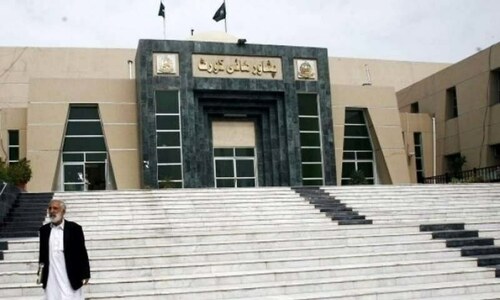
Headed by Justice Kakar, a two-judge Supreme Court bench had taken up a criminal petition challenging the May 11, 2026, order of the Peshawar High Court (PHC), which had rejected the post-arrest bail plea of the petitioner, Jalat Khan, an Afghan national by origin.
Setting aside the PHC order, the SC granted post-arrest bail to the petitioner, who had been residing within the jurisdiction of Police Station Nawagai in Bajaur district without a valid visa or residence permit. He had been arrested under Section 14 of the Foreigners Act, 1946.
According to the record, the petitioner had contracted a valid marriage with a Pakistani woman, Tasleem Bibi, through a registered nikahnama on May 1, 1994.
Following the marriage, the petitioner applied for a Pakistan Origin Card (POC). He also filed a constitutional petition before the PHC, seeking the issuance of a domicile certificate and a National Identity Card for Overseas Pakistanis (NICOP), or, alternatively, registration as a citizen of Pakistan under Section 10 of the Pakistan Citizenship Act, 1951.
Appearing on behalf of the petitioner before the SC, Advocate Jalaluddin argued that the petitioner’s continued stay in Pakistan while awaiting the federal government’s decision on his legal status could not be treated as an offence attracting penal consequences under the Foreigners Act.
On the other hand, Additional Advocate General Khyber Pakhtunkhwa Bashar Naveed contended that marriage to a Pakistani woman did not ipso facto confer Pakistani citizenship or exempt a foreign national from the regulatory framework of the Foreigners Act.
He argued that the offence under Section 14 of the Act continued to apply as long as the petitioner remained in Pakistan without lawful authority.
While deciding the matter, Justice Kakar observed that the first information report (FIR) contained no allegation that the petitioner had entered Pakistan illegally.
“The case against him rests entirely upon his continued presence following administrative changes regarding Proof of Registration (PoR) cards and subsequent executive notifications,” the judgement noted.
Justice Kakar further observed that Section 10 of the Pakistan Citizenship Act, 1951, historically provided a statutory route to citizenship for foreign women marrying Pakistani men but did not extend the same benefit to foreign men marrying Pakistani women.
The judgement recalled that this gender-based disparity had been addressed by the Federal Shariat Court (FSC) in a suo motu case, in which it held that Section 10 was discriminatory, violated the principle of gender equality, contravened Articles 2A and 25 of the Constitution, conflicted with Pakistan’s international commitments, and, most importantly, was repugnant to the injunctions of the Holy Quran and Sunnah.
Referring to the facts of the present case, Justice Kakar observed that the petitioner was a foreign husband married to Ms Tasleem Bibi, a Pakistani citizen by birth, through a registered nikahnama.
Concluding the matter, the SC set aside the PHC order and granted post-arrest bail to the petitioner, subject to his furnishing bail bonds of Rs20,000 along with two sureties in the like amount to the satisfaction of the trial court.
Published in Dawn, August 7th, 2026