IHC moved over delay in presidential nod for judicial appointments
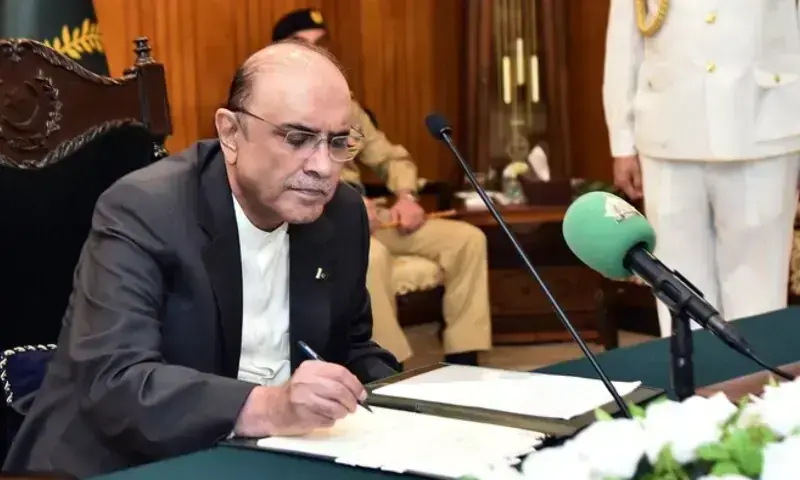


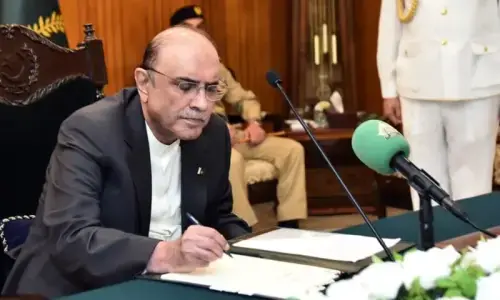
ISLAMABAD: A writ petition was filed in the Islamabad High Court (IHC) on Wednesday, challenging President Asif Ali Zardari’s delay in assenting to a summary forwarded by Prime Minister Shehbaz Sharif for the appointment and confirmation of judges to various high courts.
The petition, filed by advocate Luqman Zafar Chaudhary through his counsel Zahid Asif Chaudhry, urged the court to direct the president to approve the summary forwarded by the prime minister for the appointment of 19 additional judges and the confirmation of five judges to the Islamabad, Lahore, Sindh, Balochistan and Peshawar high courts.
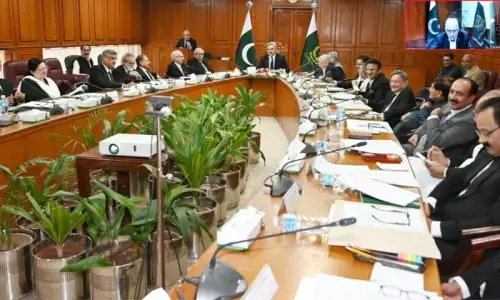
The JCP, headed by Chief Justice of Pakistan Yahya Afridi, recommended the names during meetings held on July 20 and 21 after following the procedure laid down under Article 175A of the Constitution. The summary was subsequently forwarded by the prime minister to the president for assent under Article 48 of the Constitution.
According to the petitioner, the oath-taking ceremony for the newly recommended judges was scheduled for July 27 but was indefinitely postponed after the president neither granted assent to the summary nor returned it, allegedly holding it “without any legal justification”.
The petition contended that the president’s inaction violated the mandatory provisions of Article 48(1) of the Constitution, which stipulates that the president “shall act on and in accordance with the advice of the Cabinet or the prime minister”.
“The only qualification available to the president is contained in the proviso that within fifteen days the president may require the cabinet or, as the case may be, the prime minister to reconsider such advice, whereafter the president shall, within ten days, act in accordance with the advice tendered after such reconsideration,” the petition stated.
Citing earlier judicial precedents, the petitioner argued that the president was required to act “strictly within the four corners of the Constitution” and cannot allow extraneous considerations to influence or delay the exercise of his constitutional functions.
The petition also cited the Munir Hussain Bhatti Advocate v Federation of Pakistan case, arguing that once the JCP had finalised its recommendations and they were endorsed through the prescribed constitutional process, the executive’s role was “narrow, time-bound and essentially formal” and could not be turned into “a power of veto or indefinite deferral”.
The petitioner argued that the continuing shortage of judges was “crippling the administration of justice, delaying the disposal of cases, and directly infringing the fundamental right of access to justice and a fair trial under Articles 9, 10A and 25 of the Constitution”.
According to the petition, the legal fraternity and the public at large had “grave apprehensions”, based on media reports, that the delay “is not attributable to any bona fide constitutional exercise but is being occasioned by extraneous political considerations unconnected with the constitutional scheme of Article 175A”.
Anticipating objections over presidential immunity, the petition argued that the protection available to the president under Article 248 did not apply in the present case, as he had been impleaded “in his constitutional/official capacity only, and not in his personal capacity”.
The petitioner urged the court to direct the president to assent to the summary forthwith, along with a declaration that the continued failure to act beyond the constitutionally prescribed 15-day period is “illegal, without lawful authority, and of no legal effect”.
The delay in presidential assent to judicial appointments has begun to affect the functioning of the superior judiciary, with the term of an additional judge of the Sindh High Court (SHC) having already expired and four additional judges of the Peshawar High Court (PHC) facing a similar situation within days, despite recommendations by the JCP for the continuation of their services.
Pakistan Bar Council Vice Chairman Pir Masood Chishti earlier told Dawn that an additional judge whose notification had not been issued by the president could not continue to perform judicial functions after the expiry of his or her tenure.
“Once the president grants approval and the Law Ministry issues the notification, the judges can resume office,” he said.