Death toll in rain-related incidents rises to 12 as four more drown in ponds
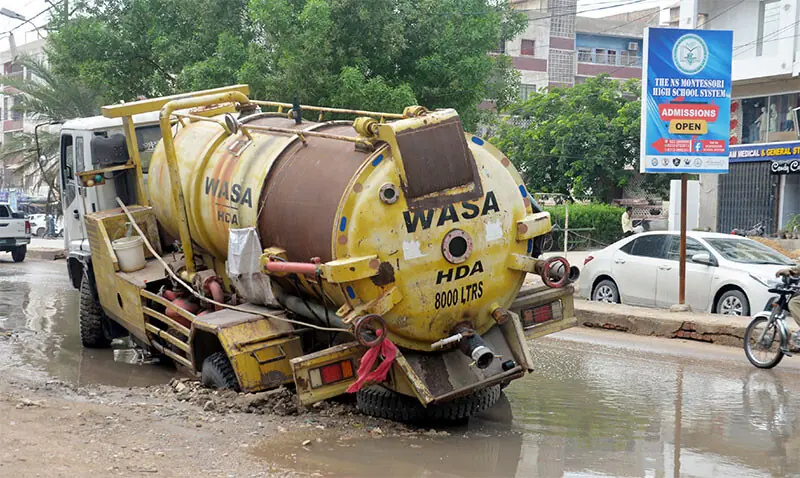


MITHI/KARACHI: With four more persons reported to have drowned in rainwater ponds in Tharparkar district following two days of downpour in the region, the overall death in rain-related incidents across Sindh has risen to 12.
Rescuers and locals said that four bodies were handed over to the heirs after they were fished out from ponds of rainwater in different villages of Tharparkar district. The deceased were two minor children and two young men, they said.
Their identities would not be ascertained due to badly damaged telecommunication and electricity networks during thunderstorm and downpour on Saturday and Sunday.
Roads and streets in most areas of the region still remained flooded and without telecommunication links and power supplies.
Urban, rural areas equally affected by flooding in rain-hit districts
On Monday, Chief Secretary Asif Hyder Shah presided over a high-level meeting to review the prevailing situation and the preparedness of provincial departments, district administrations, municipal bodies and rescue agencies for the remaining monsoon period.
He directed all the concerned institutions to maintain full operational readiness throughout August and until the middle of September.
He said that preparations should not remain limited to the provincial or district level but must be visible and effective at the town and union council levels.
The meeting was physically attended by the additional chief secretary local government, secretaries of the livestock, irrigation, rehabilitation, health and information departments, DGS of PDMA Sindh and Rescue-1122 and secretary Local Government Board.
All divisional commissioners, deputy commissioners along with district health officers, DG health, mayors and representatives of Hesco and Sepco participated in the meeting through video link.
Briefing the meeting, PDMA Sindh reported that five people had lost their lives in rain-related incidents during the last 24 hours. Three children and a man drowned in Tharparkar, while another man died after the roof of a house collapsed in Badin. The meeting was further informed that since the beginning of the current spell of rains on July 3, a total of 10 people, including five children, had died in different incidents, while eight others had sustained injuries.
The highest rainfall during the last 24 hours was recorded in Kot Ghulam Mohammad Taluka of Mirpurkhas, where 112mm rain was reported.
The chief secretary directed Hesco and Sepco to improve their response mechanism during rainfall, particularly at drainage disposal and pumping stations. He observed that prolonged power outages directly affected dewatering operations and caused rainwater to accumulate in residential and commercial areas. Both the utilities were asked to maintain close coordination with district administrations, mayors and municipal bodies and to accord priority to the restoration of electricity at pumping and disposal stations.
The Mayor of Hyderabad informed the meeting that drains had been cleaned and dewatering machinery was available. He said Hyderabad had 128 pumping stations and around 50 generators, while additional generators could be hired during an emergency. He, however, pointed out that generators had capacity and efficiency limitations and, therefore, a reliable electricity supply remained essential for effective drainage. The Mayor of Sukkur reported that the situation was under control and all relevant departments were prepared. The Mayor of Shaheed Benazirabad also briefed the meeting about the arrangements and highlighted the requirement for additional generators. The Mayor of Mirpurkhas informed the meeting that dewatering pumps had been deployed and rainwater had been drained from major roads and markets. The Mayor of Larkana stated that monsoon preparations had been completed at the union council level and teams had been assigned their respective responsibilities.
The Health Department briefed the meeting that its monsoon contingency plan covered both preventive and curative measures. PPHI had also prepared a separate contingency plan, while government dispensaries and health facilities had been placed on standby to respond to emergencies arising from heavy rains or flooding.
The meeting was informed that anti-snake venom was available at every Taluka & district headquarters hospital. The Chief Secretary directed the Health Department to continuously monitor the availability of essential medicines, anti-snake venom and emergency staff, particularly in rural and vulnerable areas. The Livestock Department informed the meeting that monsoon standard operating procedures had been activated and an animal vaccination campaign was under way. The Chief Secretary directed the department to ensure vaccination of livestock in vulnerable areas and maintain preparedness to protect animals from diseases during rains and flooding.
He further directed that, if required, relief camps should be established in a structured and organised manner with proper arrangements for health, sanitation, drinking water and other essential facilities. Rescue 1122 informed the meeting that district rescue teams had been deployed and were prepared to respond to any emergency.
Concluding the meeting, Chief Secretary Sindh Asif Hyder Shah stressed that the required resources were available and that the focus must now remain on their timely mobilisation and effective use. “Resources are available. What is required is clear communication, timely availability of those resources and close coordination among provincial departments, district administrations, municipal bodies, power utilities and rescue agencies,” he said.
Published in Dawn, August 4th, 2026