

THE Modi regime’s one-off defeat at the hands of the Cockroach Janta Party (CJP) in India has got the Pakistani commentariat asking: why has there been no ‘Gen Z’ uprising in our own country? My response would be: have you been living under a rock?
True, there has been no youth-led movement in Pakistan that looks exactly like the ones that have made waves since July 2024 in Bangladesh, Nepal and now India. But there is much that has taken place before and after that must be put on the record.
One does not have to agree with the PTI’s politics to acknowledge that it was the first mainstream political party to explicitly mobilise tech-savvy young people. From digitised membership to the systematic use of social media, the PTI made ‘youth’ a bona fide political demographic.
Of course, the decision-makers were initially keen for ‘youth’ to join the PTI’s ranks, evidently supporting troll armies under the guise of waging ‘fifth generation warfare’. Then the online networks turned critical of these powers, clarifying that, for all of its might, Pakistan’s ruling class has never enjoyed unhindered mass consent of the kind that it craves.
Significant numbers of young people have spoken truth to power.
This was made clear in February 2024, when the PTI’s unmatched online capacities translated into votes on the ground. The party doesn’t have sufficient offline ideological cadres to withstand the current incarnation of Pakistan’s ‘hard state’, but it continues to speak to the political aspirations of many young people.
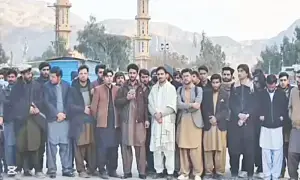
From around 2018, when the PTI still enjoyed the establishment’s good graces, many other youth-led movements erupted, especially in the country’s neglected peripheries. Pakhtun youth, whose historical abodes are today again subject to targeted killings and bomb blasts, organised as PTM against the totalitarian logics of the ‘war on terror’. This was no small matter and inspired many across Pakistan’s diverse ethno-national landscape. Much has taken place since, and PTM is now banned, but its impact on a generation of young people was profound.
The BYC has had similarly widespread effects, especially given the preponderance of young women in its leadership, a reflection both of the brutalisation of Baloch society since the Musharraf dictatorship and the changing character of nationalist politics. Its criminalisation by the state suggests that the organisation, too, was garnering too much visibility and support from metropolitan youth.
What is unfolding right now in Azad Kashmir is also largely an articulation of youth politics. Smaller but no less significant mobilisations led by young people have taken place over the past few years in Gilgit-Baltistan. The massive social movement against the proposed six-canal project in Sindh last year may not have been limited to youth, but young lawyers and students were its beating heart. When the regime went on a rampage against katchi abadis and historic villages in Islamabad earlier this year, progressive youth organised resistance. Aurat March was a coming-of-age movement for young, tech-savvy women and girls. Prominent scholars have theorised it as the fourth wave of Pakistani feminism.
It is telling that all of these organic political movements have been vilified by pro-state elements and suppressed by a coercive apparatus. Many of them have limitations, including overreliance on digital mobilisation and a tendency to engage in a competition of oppressions — insisting that the interests of their particular group supersede those of others. But the point remains that significant segments of young people in Pakistan have spoken and continue to speak, truth to power. And all this despite the absence of institutionalised forms of politics like student unions, which have been central to mobilisations in neighbouring cou-ntries. It is also important not to romanticise what has happened in Nepal or Bangladesh, where regimes may have been toppled but the nexus of state and capital stands reinforced.
The CJP has dented the BJP’s aura of invincibility, but its longer-term impact is yet to be determined. The overall effects of digitalisation on young people’s politics are not necessarily progressive, with organisation-building usually a casualty of the desire for virality.
Here in Pakistan, we remain in search of an ideological politics that can bring together diverse ethnic-national groups whilst speaking to shared class interests. The primary contradiction of political life is between the mass of the people and a militarised ruling class. We must learn lessons from progressive eras like the 1960s and 1970s as well as the recent past to give ourselves the best chance of changing an establishment-centric system.
The writer teaches at Quaid-i-Azam University, Islamabad.
Published in Dawn, July 31st, 2026