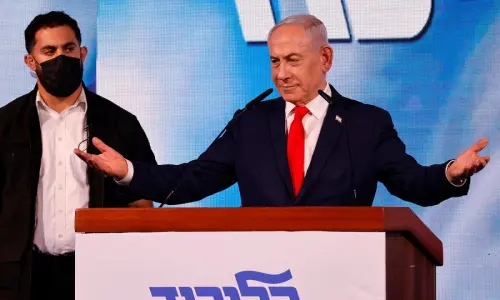
Netanyahu orders new settler posts in occupied West Bank

• Israeli settlers kill 4 Palestinians, hurt 5, torch olive groves in deadly West Bank raids
• Village council head says occupation forces shielded the violent mob
• Israeli military announces ‘extensive’ operation on Palestinian sites
• Settlements remain illegal under international law
JERUSALEM: Israeli Prime Minister Benjamin Netanyahu announced on Friday his government would establish new settler outposts in the occupied West Bank and legalise more existing ones, a move that followed a deadly raid by armed Israeli settlers who stormed West Bank villages and killed four Palestinians.
Netanyahu and Israeli Defence Minister Israel Katz announced “a series of steps” targeting Palestinians. These include military raids on Palestinian villages and “accelerating the legalisation of farm outposts and establishment of new ones”.
Under international law, all Israeli settlements in the occupied territories are illegal.
Netanyahu vowed in a statement to “act with full force”, adding he would convene a meeting of security officials.
Friday’s deadly violence erupted near the Palestinian village of Tell and the settler outpost of Havat Gilad in the West Bank, territory Israel has illegally occupied since 1967. Excluding East Jerusalem, more than 500,000 Israelis live in these settlements alongside roughly 3 million Palestinians.
Walid Zidan, head of the Tell village council, said the violence began when a mob of about 20 Israeli settlers invaded the Palestinian community.
“Villagers came out to defend their homes and property. Clashes and physical altercations broke out between the residents and the settlers,” Zidan said. “Israeli soldiers were present and, together with the settlers, began opening fire. ... It was the settlers who stormed the village, with the intention of killing, vandalising and setting property on fire.”
The Palestinian Health Ministry confirmed four Palestinians were killed and four others wounded. Grieving Palestinian families gathered at hospitals in the nearby city of Nablus, where the victims’ bodies were taken.
Israel also claimed that two Israelis died during the violence. The Israeli military characterised the attack as a “violent confrontation” between Palestinians and Israeli civilians.
A military official stated an emergency response team from Havat Gilad arrived with soldiers, resulting in one security team member killed and others injured.
Israel’s Magen David Adom emergency service said a man in his 30s was pronounced dead, and two others in their 20s were evacuated by helicopter with gunshot wounds.
Following the deadly settler raid, the Israeli military announced it was preparing an “extensive” operation in the occupied territory. The army postponed soldiers’ leave, deployed additional forces and set up roadblocks, severely restricting movement and preventing journalists from accessing the site.
Hours later, Israeli settlers launched a separate attack on the nearby Palestinian village of Farata. Abdel Moneim Shanneh, head of the local council, said settlers set fire to Palestinian olive groves.
“The army prevented young men from the village from extinguishing fires and opened fire on them,” Shanneh said, adding that five Palestinian men were injured.
Violence against Palestinians in the West Bank has intensified dramatically since the Gaza war began. According to data from the Palestinian Health Ministry, Israeli soldiers and settlers have killed at least 1,094 Palestinians over the same period. Israeli figures show 47 Israelis have been killed.
Published in Dawn, July 25th, 2026