AJK election commissioner says polls to be held in three phases beginning July 27
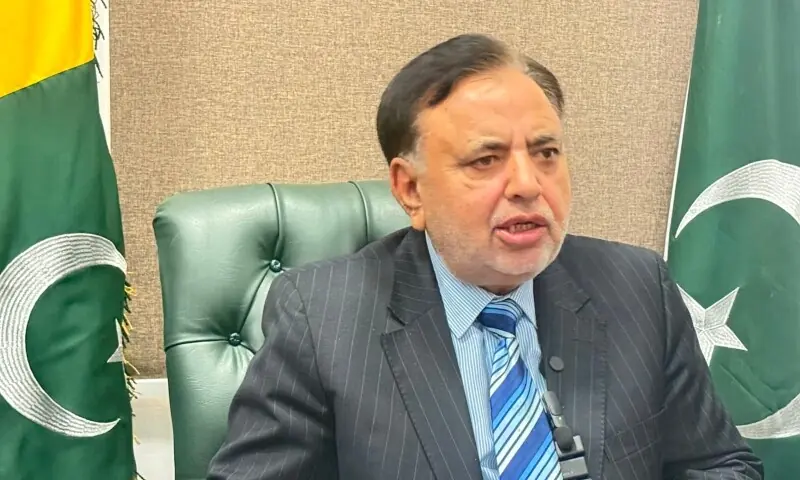
MUZAFFARABAD: The Azad Jammu and Kashmir (AJK) Election Commission on Tuesday announced that elections in the region, which were originally slated for July 27, would now be held in three phases ending on August 10.
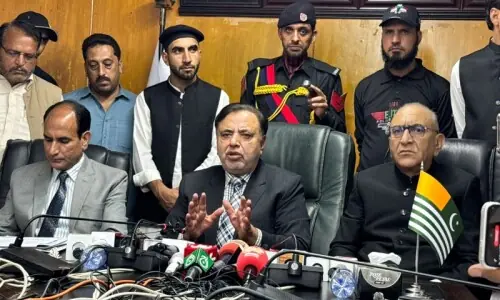
AJK Chief Election Commissioner (CEC) Justice (retd) Ghulam Mustafa Mughal made the announcement at a press conference, citing the need to ensure the availability of army personnel for security duties at the insistence of participating political parties.
The election commissioner said that polls will be held in three phases:
- July 27: 13 constituencies of Mirpur division
- August 2: nine constituencies of Muzaffarabad division and all 12 refugee constituencies
- August 10: 11 constituencies of Poonch division
CEC Mughal explained that the decision was made so that contingents of the army could be “available in all divisions in sufficient numbers” to ensure peaceful polling amid the ongoing situation in AJK, parts of which have been gripped with protests in recent weeks.
“You are aware of the overall situation in Pakistan. The army is engaged at various places, but we are grateful to all stakeholders who, at our request, made arrangements to provide an adequate number of troops. Their movement will begin over the next couple of days,” he said.
The CEC claimed that political parties were not satisfied with elections being held without the army being deployed.
“You know the conditions in Balochistan, KP and other places where incidents take place, and where our army is on duty,” he said, referring to the fragile security situation in these provinces.
CEC Mughal said that after polling is completed in Mirpur on July 27, the “same army will move to Muzaffarabad” for the August 2 voting.
He stressed that the changes have been made so that a “free and fair election” can be held under stringent security provided by the army and other paramilitary forces.
Mughal further stated that the stage-wise polling schedule has been decided after consulting with all political parties.
Although no formal meeting could be convened because election material for Mirpur division had already been dispatched, all parties were consulted over the phone and supported the amendment, he added.
Responding to a question, the CEC said he believed the stage-wise process would not have a “major effect” on the results of areas where polling is held later on.
He contended that people usually were “committed to their parties”, regardless of who wins in a particular division.
Replying to a query, Mughal said there was a chance that the official notifications for winning candidates would be issued once the entire electoral process had concluded across all AJK divisions.
The Election Commission, he said, was considering whether formal notifications would be issued division-wise or after receiving results from all constituencies.
However, the CEC noted that presiding officers would provide polling agents with Forms-24 at the close of polling, enabling them to know the unofficial results the same day.
When asked if the stage-wise polling could raise questions over the elections’ transparency, Mughal replied that the new schedule was rather aimed at making the elections more transparent.
Moreover, he rejected the idea that the Poonch division, where protesters and law enforcers clashed as recently as last week, could be excluded from the electoral process.
“Hopefully, the situation will improve. Even if it does not, we are constitutionally bound to hold the elections,” he said.
The CEC asserted that even if the situation “does not return to normal, elections have to be conducted” as they were a constitutional requirement.
Rejecting suggestions that the situation in AJK had become too volatile for elections, Mughal pointed to the enthusiastic participation in advance polling by government employees.
“The doubts were that elections might not be held at all or could be postponed. By adopting phased polling, we are reinforcing the electoral process so that elections remain peaceful, transparent, and voters can freely exercise their right to vote,” he said.
Asked about internet shutdowns hampering the transmission of reporting from journalists, the CEC said, “We have tried to ensure that you do not face internet shutdowns on election day and can freely share results.
“Beyond that, it is not the Election Commission’s job to decide how the state is run. Our responsibility is to conduct the elections,” he added.
Replying to another question, Mughal said the Election Commission had extended an open invitation to domestic and international election observers when the election schedule was first announced and was reiterating that invitation.
“Our doors remain open to all observers, including those coming from Pakistan,” he said.
The CEC was flanked by Senior Member Khawaja Muhammad Ahsan, Member Syed Nazeerul Hassan Gillani, and Secretary Raja Muhammad Shakeel.
Later, speaking to Dawn, CEC Mughal said the amendment to the election schedule had been made under Section 37 of the Jammu and Kashmir Elections Act, 2020.
Section 37 empowers the Election Commission to alter the election programme, after the issuance of the election notification, if it considers such changes necessary.
Election campaigns
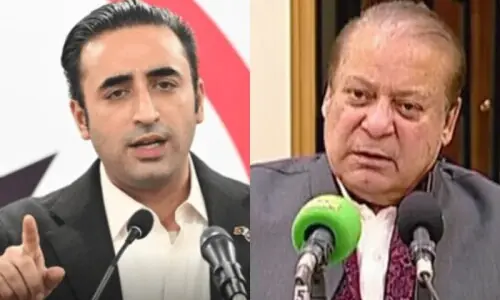
PML-N and PPP have stepped up their election campaigns recently, with their top leadership taking charge of the election campaign to galvanise their support base.
Observers see this election as PPP vs PML-N — with some claiming that the election campaign will be trickier for the PML-N because of resentment against the political party over its purported role in the crackdown on protests led by the banned JAAC.
The PPP has allied with the Jamiat Ulema-i-Islam—Fazl (JUI-F) to jointly contest the polls.
Last month, the PPP finalised its candidates for 35 of the 45 AJK assembly seats, while withholding decisions on eight constituencies and allocating two seats to its electoral ally JUI-F.
The regional administration and the JAAC have been at odds over various issues, most notably the committee’s demand to abolish the 12 seats in the region’s Legislative Assembly that are reserved for refugees from Indian-occupied Jammu and Kashmir who settled in mainland Pakistan after 1947.
Following the JAAC’s call for widespread protests on June 9 demanding the abolition of the 12 seats, it was declared a proscribed organisation on June 5. JAAC protests and the administration’s response have repeatedly turned violent over the past few weeks.
PPP’s Raja Pervez Ashraf has said that the issue of refugee seats is constitutional in nature and would be decided by the upcoming AJK Legislative Assembly.