0
0

 FODDER crop is essential for the promotion and development of livestock. In Pakistan, there are two types of livestock production practices i.e., rural household and large herds kept in rangelands. More than half of animal feed comes from fodder and crop residues, one-third from grazing the rangelands, wastelands, canal banks, road sides and other crops and their by-products.
The research and development sector has made significant improvement but the supply of nutritious fodder is inadequate. The livestock population is about 134 million, out of which 49.3 millions are buffaloes and cattle which provide dietary requirements like milk, butter, cheese, meat, etc.
The forage production is deficient by 25.6 million tons in total digestible nutrients and 1.58 million tons in digestible protein. Major fodders grown in the Rabi and Kharif seasons cover only 16 to 19 per cent of the total cropped area. The area under fodder corps has decreased from 2.7 to 2.5 million hectare in 1986-87 to 2003-04, respectively, but the forage yield per unit area has increased from 20 tons ha-1 to 22.8 tons ha-1.
However, regular supply of good quality fodder round the year to a rapidly growing livestock population is a basic problem.
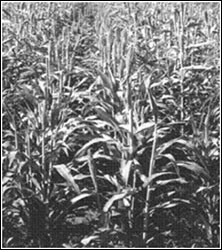
Fodder is the cheapest form of animal feed but does not meet the requirements resulting in under-nourishing. Among summer forages, sorghum (charri or jowar) is an important one that possesses a wide range of adaptability because of its xerophytic characteristic. It is widely grown by subsistence growers for feed and fodder in rain-fed, as well as irrigated regions. It is fed to livestock and is also used as hay or silage.
However, sorghum is low yielder and poor in quality due to low protein content and presence of hydrocyanic acid. The national average forage yield ha-1 of sorghum is low. Its forage yield, quality and nutritive value may be increased by adopting improved cultural practices like sowing techniques/patterns and by growing it in association with different forage legume crops.
The area under fodder corps cannot be increased at the cost of food and fibre corps. Therefore, increase in the yield per unit area by developing new techniques and methods is the way out in terms of quantity and quality. Inter-cropping is an exceptional technique for boosting not only the forage production per unit area but also its quality and palatability.
A field study was undertaken for two years at the University of Agriculture, Faisalabad to develop economically viable, highly productive and sustainable forage sorghum-based inter-cropping system, suitable for small growers and also for improving the health of livestock and soil. The results lead to the following conclusions and recommendations.
The increase in mixed forage yield (sorghum + intercrop) because of mungbean, clusterbean, cowpea and sesbania inter-cropping was recorded at 19.3, 22.0, 54.7 and 23.3 t ha-1, respectively, over sole sorghum forage yield.
Similarly, the crude protein level of mixed forage was raised to 19.3, 18.3, 18.3 and 21.9 per cent due to mung bean, cluster bean, cowpea and ses bania inter-cropping, respectively, over mono-cropped sorghum forage.
The increase in yield was due to increased plant height, stem thickness and leaf canopy, which contributed collectively to the increased forage yield while for good health of livestock a balanced ration is the prerequisite. Hence the nutritive value of the forage is another consideration for successful livestock programme. Legumes being the prime source of protein resulted in an increase in the crude protein concentration of the mixed forage.
As regard the planting patterns, the sorghum inter-cropped with forage legumes produced highest green mixed forage yield than sorghum grown alone. However, the highest mixed forage yield of 98.8 and 107.7 t ha-1 from the sorghum grown in 45cm spaced paired rows and inter-cropped with cowpea was obtained during both the years of study, respectively. Therefore, by adopting sorghum-based forage legume inter-cropping, we can get an extra forage inter-crop from the sources utilized for growing sorghum alone.
Furthermore, the residual soil nitrogen and organic matter was also increased in all the inter-cropping systems. However, the maximum increase in soil nitrogen was observed for forage sorghum + sesbania inter-cropping system followed by sorghum + cowpea. In contrast, phosphorous and potassium showed the depleted trend in all the inter-cropping systems in both the years.
On the basis of these findings, adoption of inter-cropping forage sorghum with forage legumes, preferably cowpea and sesbania, in the pattern of 45cm spaced two-row strips with 15cm inter row space (15/45cm) is recommended for the purpose of getting higher yield of palatable, nutritious and high quality forage sorghum under the agro-ecological conditions of Faisalabad.