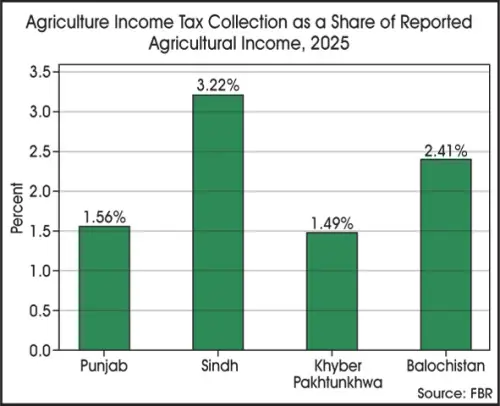
THE first year of Pakistan’s unified agriculture income tax regime has produced an outcome that should surprise no one. Despite sweeping legislation introduced under the IMF programme, provincial governments collected barely Rs5.62bn, or less than 2pc of the Rs306bn declared by taxpayers in agricultural income. Clearly, legislation alone cannot overcome entrenched political interests.
For decades, agricultural income has been one of the most glaring anomalies in our tax system. While salaried workers and documented businesses shoulder an increasing tax burden, one of Pakistan’s largest economic sectors has largely remained beyond effective taxation. The recent reforms sought to change that by harmonising AIT laws across provinces. Instead, they have merely exposed the gaps between policy commitments and political reality. Provinces adopted the reform with varying degrees of enthusiasm, and each implemented it differently, reflecting a deeper reluctance to confront powerful rural elites.
That reluctance is not accidental. Agricultural taxation lies at the centre of Pakistan’s political economy. The provinces are heavily influenced by landed interests, making meaningful enforcement politically costly. Asking them to rigorously tax agricultural income means asking governing parties, especially in Punjab and Sindh, to tax their own political base. Not even the IMF could compel the provincial governments to challenge constituencies that continue to dominate electoral politics.
Weak land records, outdated revenue administration, incomplete crop data and a persisting patwari system undoubtedly undermine tax collection. But these institutional weaknesses have survived because successive governments have had little incentive to correct them. Technology — whether digitised land records or online filing systems — can improve compliance only if authorities act against influential defaulters.
Provincial data reinforces this view. Punjab collected only a fraction of its potential revenue and was forced to slash even its modest collection target. Sindh has invested in a relatively stronger tax administration, but compliance remains weak. Since the 18th Amendment, provinces have demanded greater fiscal autonomy and a larger share of national resources. Autonomy, however, entails responsibility. Constitutionally assigned taxes such as agriculture income tax are meant to strengthen provincial finances and reduce dependence on federal transfers.
Failure to mobilise these revenues weakens the case for greater resources while affluent landowners continue to enjoy privileges unavailable to taxpayers in virtually every other sector of the economy. Unless the provinces develop both institutional capacity and political resolve to enforce the law effectively, agricultural income will remain outside the tax system.
Our chronic revenue crisis will persist not because Pakistan is short of taxable income but because it continues to exempt those with the greatest political influence from contributing their fair share.
Published in Dawn, July 4th, 2026