Indus commissioner says he wrote to Indian counterpart 4 times over Chenab fluctuations, but no reply so far
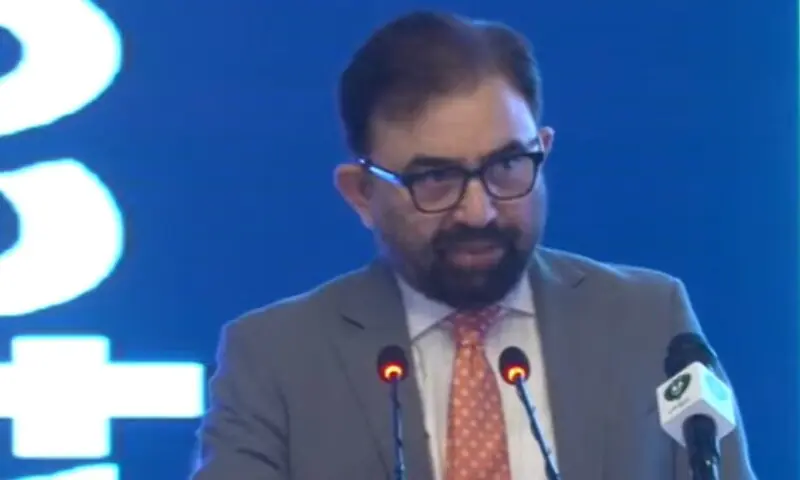



Pakistan Commissioner for Indus Waters Syed Muhammad Mehar Ali Shah said on Tuesday that he had written to his Indian counterpart regarding fluctuations in the flow of the Chenab River four times since last April — when New Delhi unilaterally decided to hold the Indus Waters Treaty in abeyance — but there had been no response thus far.
Speaking at a seminar held in Islamabad to highlight the legal and constitutional framework of the IWT, he said he last wrote to his Indian counterpart last night over “significant fluctuations” in the flow of the River Chenab.
The IWT allocates the eastern rivers — Ravi, Beas and Sutlej — to India, while the western rivers — Indus, Jhelum and Chenab — are largely allocated to Pakistan. The 1960 water-sharing agreement has also established mechanisms for data-sharing and dispute resolution.
The Indus Waters commissioner said the fluctuation in the Chenab was not a “technical inconvenience, but rather a strategic hazard”.
“There is no brainer in understanding that data-sharing is the line between natural risk and manufactured vulnerability,” he said, adding that India should answer for the fluctuations in the Chenab flows.
“I will state this carefully and without overclaiming causation. These events required explanation and operational data, and we have been asking India through treaty channels, but there is no response from the Indian side, and no response creates a risk,” he said.
He said that no “responsible” downstream commissioner would look at the fluctuation as “routine and move on”.
“These are precisely the events the Indus Water Commission exists to examine,” he added.
He further said that Pakistan, in the past year, had tried to keep the channel of communication and data-sharing under the IWT active despite India holding the treaty in abeyance.
“Pakistan continued to provide the required data, sent correspondents, requested meetings, inspections, project information and [held] Article 9 consultations,” he said; however, he added that Pakistan received no response from the Indian side.
He said that the Indian side followed a similar pattern before the 2025 abeyance, recalling that the last commission meeting was held in May 2022.
“No general or special tour of inspection, corresponding monthly data has remained outstanding after August 2023 and multiple core treaty communications have received no response,” he added.
“This is precisely what increases the risk of avoidable escalation,” he warned, adding that “hydrological information is not a diplomatic courtesy” but rather an “operational necessity”.
“Without data, the downstream state is forced to guess whether it faces nature or the upstream operation,” he explained.
Multiple instances of variations in the flow of the Chenab River have been reported since India announced last year that it was placing its IWT obligations in abeyance.
The announcement followed an attack on tourists in occupied Kashmir’s Pahalgam that killed 26 tourists — an incident New Delhi blamed on Islamabad without evidence. Pakistan has strongly denied the allegations and called for a neutral investigation.
The treaty and its status remain a point of contention between the two sides since then, with an Indian minister recently saying that they were working to stop the flow of water into Pakistan.
Pakistan has also asked India to refrain from any unilateral manipulation of the river flow and fulfil its obligations under the IWT — which also sets out guidelines for the construction of projects on Indus waterways.
Shah said on Tuesday that the way forward for the IWT was not “abeyance, but performance”, calling for an immediate commission meeting, full restoration of data sharing, and resumption of general and special tours and inspections.
“No unilateral abeyance, no data blackout, no diversion, no fait accompli,” he said, emphasising that “IWT is a life and the commission must therefore be allowed to work”.
Pakistan not opposed to ‘lawful hydropower’
Pakistan has opposed the construction of various such projects by India, terming them a violation of the IWT. Earlier this month, Deputy Prime Minister and Foreign Minister Ishaq Dar assailed 17 projects, including hydropower facilities, by India on Indus waterways as “tools for hydro-hegemony”.
In his address at the Islamabad seminar, Shah said the core issue for Pakistan was not “hydropower” but “accumulated upstream control without the treaty discipline”.
Pakistan did not object to “lawful hydropower”, but the “unlawful control, excessive discretion and opaque operations are a problem”, he said.
“Starting from the Marala Barrage, India has started reopening its low-level outlets, and what would happen in simple terms is that by way of so doing, India will have control by way of emptying the reservoirs and refilling and repeating these manipulations just to the detriment of Pakistan,” he warned.
Shah also took note of India’s plans to develop the Chenab-Beas link project, which he said would divert 1.9 million acre-feet of water from the Chenab.
He raised concern that “one project may be a question in terms of Article 9 [of the treaty] but a cluster of accelerated works with no data, no inspection and no commission engagement, that becomes a strategic pattern, no longer a question”.
On the Chenab-Beas project, Shah held that Pakistan’s legal position on the matter remained clear and stemmed from Article 3 of the treaty, which dealt with the governance of the three western rivers.
Shah said Article 3 contained “no free-standing category of the surplus western river waters available for diversion by India into an eastern river basin”, warning that diversion changed the character of the bargain at the core of the treaty.
On the issue of India’s Salal Dam on the Chenab, Shah recalled that Pakistan had signed a bilateral agreement with India in 1978 which required that the “outlet works be permanently plugged”.
If unplugging them was claimed to be necessary for a safety emergency, the agreement required immediate information, consultation, and site inspection, he noted.
Court of Arbitration rulings
Talking about Article 9 of the treaty, Shah said it provided an “elaborate dispute resolution mechanism” that began at the bilateral level and, if that failed, the process “without any paralysis” moved on to a third-party forum.
“The sequence is deliberate: institutional settlement first and third-party determination where necessary but no paralysis,” he added.
On the arbitration mechanism outlined in the treaty, Shah said that the Court of Arbitration had “reactivated the treaty” and addressed any legal uncertainty around the issue.
He recalled that India began work on projects planned for western rivers of the Indus system in 2000, and there had always been discord between the two parties.
“In 2016, Pakistan decided that now it’s time to have the general interpretation of the IWT, particularly the provisions which govern the development by India on the western rivers,” he said, recalling that Pakistan received two awards from the Court of Arbitration — one in 2025 and another in May, 2026.
Shah said the court confirmed “four essential” points in its rulings: “First, India’s non-appearance before the court does not paralyse the proceedings. Second, the abeyance posture does not deprive the court of competence. Third, the award is final, binding and controlling. And India must let the western rivers flow with treaty exceptions applied strictly.”
He asserted that it was not merely “political rhetoric” or Pakistan’s stance but the “treaty speaking through its own court”.
‘IWT a matter of national security’
Earlier in his speech, Shah said that for Pakistan, the IWT was not just a matter of hydrology but national security.
“When the lives and livelihoods of more than 240 million are tied to the Indus basin, when more than 80 per cent of the arable land depends on these waters […], when agriculture contributes almost a quarter of GDP and almost one-third of employment, water uncertainty becomes national uncertainty,” he explained.
The commissioner remarked, “Flow prediction is not a luxury of planning but part of the survival architecture of the state.”
He said the IWT was a “conflict prevention system” and that “Pakistan’s restraint has been deliberate”.
“But water, food, livelihood, and social stability are not negotiable abstractions; that is why Pakistan has publicly defined the strategic threshold for any attempt to stop and divert the treaty water belonging to Pakistan,” he explained.
‘Not a favour, but a binding settlement’
The commissioner for Indus Waters said the IWT had converted a “territorial water system” into a legal structure by fixing rights and obligations each party owed to the other.
“The eastern rivers were allocated to India, and the western were placed under Pakistan, with India’s use confined to carefully defined exceptions,” he recalled. “Pakistan accepted that bargain, rebuilt its irrigation life around that bargain and planned its national water economy around the assurance that the western rivers would be let flow.”
“The bargain remains a bargain,” he said, stressing that the agreement was “not a favour, but a binding settlement”.
The commissioner reiterated that the treaty functioned as a “conflict prevention design” and was engineered for “peace”.
He said the treaty worked because of four elements operating together — allocation, cooperation, the institution and dispute control, the Indus Water Commission in this case.
Shah further explained, “Allocation tells each side what it may use, what it may not; cooperation provides data, notice and inspection, and commission gives a regular channel of communication,” he said, warning that removing any of these elements would lead to the peace function failing.
“Therefore, abeyance is not a diplomatic slogan but an attempt to disable the stabilising architecture of the treaty,” he said.
Mentioning Article 8 of the IWT, which pertains to the Indus Water Commission, he said the operating mechanism kept “water out of conflict”.
The Indus Waters commissioner also spoke of Pakistan’s diplomatic efforts within the context of the IWT, stating, “We are taking the matter to the world not to internationalise a quarrel but to prevent a treaty breakdown from becoming a security crisis”.
Shah further said that Pakistan was on a “national journey to protect every drop, measure every flow and produce more value from the water we lawfully receive, with the guiding principle being that the stronger Pakistan becomes at home, the clearer its message becomes abroad: we protect every drop we receive, and we will not accept coercion for any drop we are entitled to receive”.
‘Inalienable right’
The seminar began with an opening speech by Information Minister Attaullah Tarar, who said the 240 million people of Pakistan had an “inalienable right” to water from the Indus River System.
“When we say that Indus is our lifeline and our people, the 240m people of Pakistan, have an inalienable right to the water of Indus, we mean it, from the core of our hearts,” he said.
He also described the IWT as “an instrument of peace and regional stability”.
“Today, we are not merely discussing the treaty. We are discussing the lifeline of nearly 240 million people of Pakistan,” he said.
He added, “When we identify ourselves as Pakistanis, we ask a question as to who we are. And if you go back into history, the Indus water [sic] civilisation defines us as a people.
“Whenever I go abroad, I always tell my counterparts that we are the people of the Indus Valley civilisation. Our identification is that we are people based on the banks and tributaries of the mighty Indus River.”
The minister said water was life, and the “Indus has given life to Pakistan”.
For Pakistan, he went on to say, water was simply not a resource but a matter of life itself.
Tarar said the Indus River system had nurtured one of the world’s oldest civilisations for thousands of years. “From the towering peaks of Gilgit-Baltistan to the fertile plains of Punjab and Sindh, these waters have connected our people across geography and history.”
He added that the story of Pakistan was, in many ways, the story of the Indus. It was for this reason that the Indus Waters Treaty of 1960 occupied such a “unique place in international relations”, he said.
He recalled that the treaty was signed under the auspices of the World Bank and had endured wars, political upheavals and prolonged periods of tension.
“Its resilience, for more than six decades, demonstrates an enduring truth that cooperation, dialogue and adherence to international commitments remain the only sustainable path to peace,” Tarar said.
The minister said the IWT stood as a “remarkable example” of the rule-based international order. “It embodies the principle of good faith — pacta sunt servanda — the sanctity of agreements and peaceful dispute resolutions. These are not merely legal concepts, but foundations upon which trust is built.”
Then, turning his attention to tensions between India and Pakistan over the IWT, he asserted that Pakistan’s civilian and military leadership had made it clear that the people of Pakistan had a right to the water of the Indus and the treaty could not be amended, revoked, suspended or held in abeyance unilaterally.
In contestation of the Indian decision to unilaterally hold the treaty in abeyance, Tarar pointed out that the treaty came into being after mutual consensus between Pakistan and India and could only be amended or revised with the mutual consensus of the two sides.
“India’s failed attempt at unilaterally holding this treaty in abeyance has led to international embarrassment for India at various forums, including legal forums,” he said.
Moreover, he contended that the “moral, social and legal foundations” of any one-sided attempt to hold the IWT in abeyance. “And any structure which has weak foundations will fall flat on its face,” he remarked.
The minister stressed the need to protect the IWT, especially at a time when climate change was accelerating, glaciers were melting at an unprecedented rate and water scarcity was becoming the defining challenge of the present times.
Tarar said South Asia was home to nearly a quarter of humanity, adding that “our collective future depends upon transforming water from a source of contention into a catalyst for cooperation”.
“History teaches us that rivers do not divide civilisations; they connect them. Rivers transcend borders, politics and generations. They remind us that nature recognises no boundaries, and that humanity’s shared challenges demand shared solutions,” he added.
Any attempt to block or stop water, he said, would always fail because water would always find a way.
“The weaponisation of water or attempts to unilaterally alter established arrangements undermine not only regional peace and stability but also the broader framework of international law. International agreements, as I said, cannot be suspended or disregarded at convenience.
“Respect for treaties is indispensable for maintaining confidence among nations and preserving the global order,” he emphasised.
He said Pakistan had consistently demonstrated its commitment to peaceful engagement and constructive dialogue and the faithful implementation of the treaty. But, he warned, if an attempt was made to stop the water of Pakistan, the country’s leadership stood resolved to respond effectively to restore the water for the people of Pakistan.
Concluding his address, he said: “Let us reaffirm today that we will, by all means, not only protect the sanctity of this treaty, but we will do all that we can to protect the inalienable right of the 240m people of Pakistan to the water of the Indus River.
“The waters of the Indus have flowed for millennia. They have witnessed transformations. Yet, they continue to sustain life with unwavering generosity. It is our collective responsibility to ensure that these waters remain a symbol of peace and shared prosperity for generations to come. […] We collectively resolve today that we will do all that we can at all international forums, legally and otherwise, to ensure that the right to water of the Pakistani people is not only protected, but the world gets to see the illegal attempts being made by India to alter or change this treaty, which it cannot do.”
Pakistan, he said, stood firm in its determination to protect the lives and livelihoods of its people, which are linked to the Indus River.
Bilawal draws Hormuz-Indus parallel
Former foreign minister and PPP Chairman Bilawal Bhutto-Zardari also addressed the seminar, saying that “we meet at a grave hour. We meet at a time when the world is reminded that a waterway is not merely geography. It is power. It is commerce. It is food. It is fuel. It is life.”
“The world saw the Strait of Hormuz become the centre of confrontation between Iran and the US,” he said, terming the closing of Hormuz the “weaponisation of a waterway”.
With the waterway now opened, Bilawal said no peace or ceasefire between the US and Iran could be achieved with the Strait of Hormuz closed.
“Similarly, how can any ceasefire between India and Pakistan hold without the Indus Waters Treaty being restored. From Hormuz, we must turn to the Indus because what is true of the Strait of Hormuz is true, with greater intimacy and greater cruelty, of the Indus basin. A strait may carry the oil of nations; the Indus carries the life of nations”.
He recalled that India had announced the unilateral decision to hold the treaty in abeyance last year, describing the move as part of New Delhi’s “unjustified assault on Pakistan”.
Bilawal spoke about the May 2025 conflict between India and Pakistan, describing it as a “David vs Goliath scale conflict” from which he said Pakistan emerged victorious.
The brief war had ended with a US-brokered ceasefire.
Bilawal said that while Pakistan had stuck to the terms of the ceasefire, India had not. Under the ceasefire terms, he said, both sides were to return to status ante while the two sides engaged in negotiations to address friction points.
Returning to the status ante included India returning to its obligations under the IWT, he said, noting that the neighbouring country had not done so.
“Just as one could not imagine warring parties agreeing to a ceasefire let alone peace without free-flowing Hormuz, how can Pakistan be expected to sustain a ceasefire when India continues to pose an existential threat?
“Let there be no ambiguity in Islamabad, in New Delhi, in Washington, in Beijing, in London and at the United Nations, this is not a technical dispute […] This is the weaponisation of water,” he said.
Bilawal continued, “The Indus Waters Treaty was not a favour given to Pakistan. It was a solemn international settlement. It was brokered in the shadow of Partition because the rivers of Punjab and Sindh could not be left to the mercy of anger.”
He said when India says it is holding the treaty in abeyance, it is not merely suspending meetings but striking at an international pact.
Highlighting the significance of the Indus for Pakistan, he said: “It is our bread. It is our cotton. It is our wheat. It is our fields of Sindh, our orchards of Punjab, our waters of Khyber Pakhtunkhwa, our channels of Balochistan.”
He said blocking the flows of the Indus was not a measure to pressure a government but an act of threatening people.
Bilawal emphasised that Pakistan must treat every step towards the “strangulation of its waters as a national security assault”.
He clarified that Pakistan did not seek war. However, he added, “Peace is not surrender, restraint is not paralysis, diplomacy is not silence and patience is not permission.”
“If India wants the world to take its threat seriously, Pakistan must compel the world to take our survival seriously. Our message must be clear: any move to block, divert, manipulate or potentially politically control Pakistan’s rightful water will not be treated as routine engineering,” he asserted.
He called for a whole-of-the-state response, including military response, to such threats and acts.
He added, “What are we doing in terms of military preparedness as India continues to pursue its stated path?”
Bilawal went on to say that Pakistan must not make a single move that “concedes India’s illegal position”.
“We must not behave as though India’s decision is fait accompli. We must not build policy on the assumption the treaty is dead. We must not rush to create downstream substitute dams in a way that tells the world India has succeeded and now Pakistan is adjusting. Or give the impression that we were victorious on the battlefield that we were victorious on the battlefield but surrendered on the banks of the river,” he said.
He stressed that Pakistan’s position must remain “immovable”.
“The treaty lives; India’s obligations are live; Pakistan’s rights live,” he added.
Bilawal emphasised that projects and dams already approved before India announced the unilateral abeyance of the IWT should continue on their own merit.
“We must strengthen our dams, reservoirs, barrages, canals and flood management system because Pakistan needs water security regardless of India’s aggression,” he said.
Bilawal further said, “We must move on a war footing for water conservation. […] We must make every drop count, not because India has a right to steal our water but because Pakistan has a duty to respect its own future”.
For this, he continued, sources outside the treaty should also be explored.
As for the IWT, he said it should be defended at every forum. “Pakistan must internationalise the principle, not merely the grievance,” he said, highlighting the need for a new international convention against the weaponisation of waterways.
Addressing New Delhi, he said, “You cannot build greatness on the thirst of another people. You cannot call yourself a civilisation while threatening another civilisation’s river. You cannot speak of democracy while placing millions under hydro-siege. You cannot invoke development while turning water into a weapon.
“The Indus is older than both our flags. It has seen empires come and go, it has seen kings, colonisers, conquerors, generals, viceroys, prime ministers and presidents. They all passed. The river remained, and Pakistan will remain.”
Saying that today, the life of the nation was being targeted, he called for unity.
“Let us rise above party, above province, above factions, above petty quarrels that have so often weakened us. […] Let there be unity in Parliament, let there be clarity at GHQ, let there be resolve in the Foreign Office, let there be urgency across government, let there be science in our university, let there be sacrifice in our politics and let there be discipline in our people,” he said.
He said Pakistan must say to the world that the Indus could not be held hostage and the IWT could not be suspended by “arrogance”.
Moreover, he said, Pakistan must tell India that “do not mistake our divisions for weakness, do not mistake our restraint for fear, do not mistake our appeal to law for lack of resolve”.
‘Water transcends critical boundaries’
Deputy Prime Minister and Foreign Minister Ishaq Dar warned India against sowing the seeds of war, saying Pakistan had consistently sought to resolve all issues through diplomacy and dialogue.
In his address, FM Dar said: “Water transcends critical boundaries; it sustains life, saves civilisations, and its governance has profound implications for peace, security and sustainable development.”
“Water is not merely a natural resource,” he said. “It is the foundation of human dignity, economic prosperity, food security and environmental sustainability.”
The foreign minister said transboundary rivers should bring nations closer through cooperation rather than divide them through confrontation.
“This principle is fundamentally embedded in international law and has guided water-sharing arrangements across the globe.”
FM Dar said it was “deeply regrettable” that this landmark treaty was now facing its “gravest challenge”.
“India’s unilateral decision to put the treaty in abeyance has no basis in the treaty itself or in international law.”
“Equally concerning has been the suspension of cooperation through the institutional mechanisms that have long served both countries under the treaty,” he said.
The foreign minister emphasised that Pakistan’s position was “very, very clear”.
“We reject India’s unilateral and illegal announcement to suspend the treaty. The Indus Waters Treaty (IWT) remains valid, binding, and fully operative. No party can unilaterally suspend or terminate its obligations under a treaty that contains no such provision,” he stated.
“This is not merely Pakistan’s interpretation; it reflects a fundamental principle of international law.”
FM Dar stressed that if international agreements can be disregarded whenever they become politically inconvenient, confidence in the international legal order is inevitably weakened.
Since April 2025, he said Pakistan had observed a pattern that raised “serious concerns”, including abrupt variations in the flow of the Chenab and Jhelum rivers and “continued efforts to expand infrastructure capable of regulating water allocated to Pakistan under the treaty”.
“Such actions undermine the cooperative framework that has preserved regional stability for more than six decades.”
He said India’s present course of conduct ran contrary to the fundamental rules governing treaty relations and the Vienna Convention.
“Responsible nations respect international law and implement international treaties as a moral and legal obligation.”
“We are convinced that binding international commitments cannot be changed,” the foreign minister said, adding: “We must be aware of the cost of derailing an international treaty on transboundary rivers, choosing confrontation by weaponising water, breaching international law and binding treaties.”
“Such transgressions in international relations set dangerous precedents,” he warned. “Such actions erode the rules-based order on which international peace and security rest.”
“Water is the lifeline of more than 250 million people in Pakistan; agriculture, energy, security and economic development depend on it.”
He added that protecting water was a matter of vital national interest.
“We sincerely advise India against sowing the seeds of war and jeopardising peace and security in our region,” the foreign minister said.
“Pakistan has consistently sought to resolve all issues through diplomacy and dialogue and through treaty-based mechanisms agreed by both parties.”
He emphasised that lasting peace could only be built on “mutual respect, sovereign equality and faithful implementation of international obligations”.
“There should be no misunderstanding,” he declared, adding: “Any attempt to deprive Pakistan of its waters, rightfully allocated under the IWT, would have profound consequences for regional peace and security.”
“Such actions serve no country but undermine the shared interests of 2 billion people of South Asia.”
The foreign minister maintained that Pakistan remained committed to peace, dialogue and good-neighbourly relations.
“We seek neither confrontation nor conflict; we seek respect for international law and faithful implementation of treaty obligations.”
He said Pakistan would not allow its rightful water share to be “misappropriated” and would safeguard its rights and interests under international law.