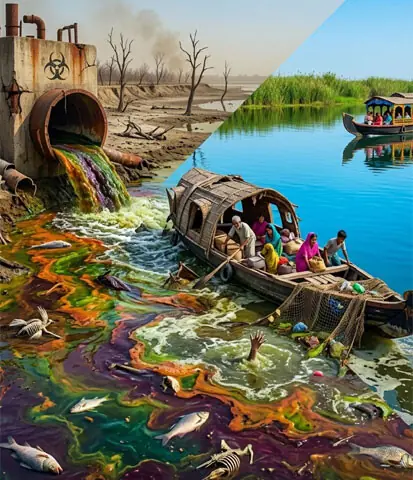
MANCHAR Lake, the largest natural freshwater lake in Asia, has historically served as a lifeline for thousands of fishermen, farmers and local communities. Historically, the lake received freshwater from the Indus River, seasonal hill torrents from the Kirthar mountains, and local rainfall.
These sources maintained the ecological balance of the lake and supported a thriving freshwater ecosystem. However, climate change, declining rainfall, up-stream water diversions, and the cons-truction of dams and irrigation structures have significantly reduced freshwater inflows. As a result, the lake has gradually shrunk and become increasingly dependent on polluted drainage water.
One of the most destructive factors behind the decline of Manchar Lake is the discharge of untreated agricultural, industrial and municipal wastewater through the Right Bank Outfall Drain (RBOD) and the Main Nara Valley Drain (MNVD). Instead of getting safely diverted to the sea, a substantial volume of waste-water is discharged directly into the lake.
The ecological consequences of salinity and pollution have been catastrophic. Environmental experts recommend diverting polluted drainage water away from the lake, restoring freshwater inflows from the Indus River, improving waste-water treatment facilities, regulating agricultural chemical use, and strengthen-ing wetland conservation measures.
Recent scientific studies suggest that restoring freshwater supply while excluding contaminated inflows could significantly reduce salinity levels and improve eco-logical conditions. Long-term monitoring using satellite technology, sustainable water management, and community parti-cipation are also essential for successful restoration.
The destruction of Manchar Lake is not only the loss of a natural resource, but also the erosion of biodiversity, culture and livelihoods. Unless urgent and coordinated action is taken by government institutions, environmental organisations as well as local communities, Asia’s largest fresh-water lake may continue its sliding path towards irreversible ecological collapse.
Dr Kanbhoo Khan
Tando Adam
Published in Dawn, June 30th, 2026