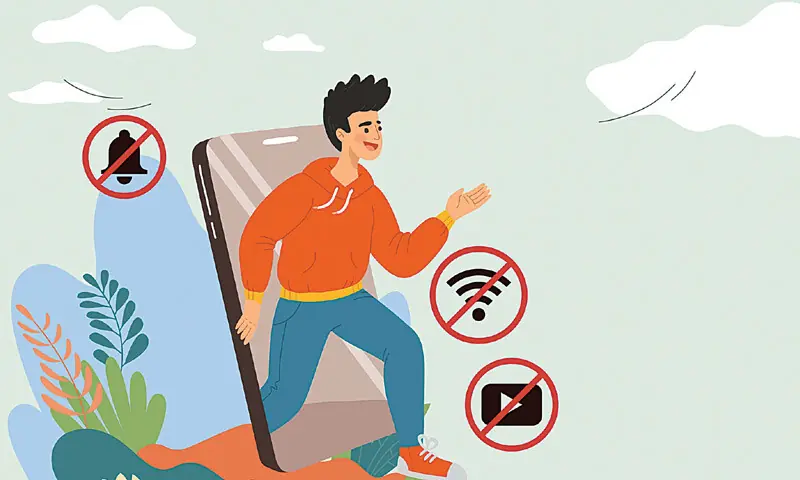
Why do we use our smartphone more than is good for us? We are all guilty of this and can give a long list of excuses, disguised as answers, to this question. Let us now look deeper into the luxury of voluntarily wasting one’s free time, irrespective of the benefits that come with smartphones.
The purpose of technology is to make our lives easier; however, its use and abuse are literally in the hands of the user. I know I will feel much less anxious if I start working on my assignment today, I will feel much better tomorrow if I turn off my phone and sleep earlier today, and I will thank my future self if I work out now. But no, I will extend my assignment deadline because the reward is not instantaneous.
The Homo sapiens brain originally evolved in what scientists call an “immediate-return environment.” This means for thousands of years, early humans worked for rewards they received right away, like hunting an animal to eat that same day or building a fire to get warm within minutes.
It was only recently in human history that the world transformed into a “delayed-return environment,” where we have to do hard work now for a reward we won’t see for weeks, months or even years; like studying today to pass an exam at the end of the term. Because our ancient brains are still hardwired to prefer instant gratification, long-term practices like honing a skill and forming a habit are incredibly difficult. In fact, they are still considered tasks that only the most successful of us can achieve, even though we all could do so.
Everyone knows screens are a distraction, yet stopping is incredibly hard. So why do we voluntarily waste our free time on a screen? Let’s uncover the truth
The overuse of phones is the evolutionary want for entertainment. In the Stone Age, 30,000 years ago, if a woman came across a ripe fruit, the only sweet treat of the time, she would eat as much as possible in a single sitting because the concept of storage was underdeveloped and animals or other humans could take away that precious resource.
So now, even though we have increased food security and have various preservation techniques to store our food, we are hardwired to overeat just to feel good momentarily and let our future selves deal with the problems.
We also know that even if we study now, these reels, pictures, movies and games will still be there tomorrow; in fact, they will remain on the internet forever. Only one or two hours of focused study would guarantee a good grade. But we won’t use that time to study; we will doom-scroll until we literally feel sick of it!
My father once told me that the creator of TikTok does not allow his own children to use the app. It highlights a troubling reality: we have simplified almost every aspect of existence except for the fundamental conflict of man vs self. When we fail to find a deep sense of meaning, we reflexively distract ourselves with pleasure. Yet, perhaps that very struggle, the messy, un-programmable nature of human desire, is the exact spark that will ultimately prevent a total technological takeover.
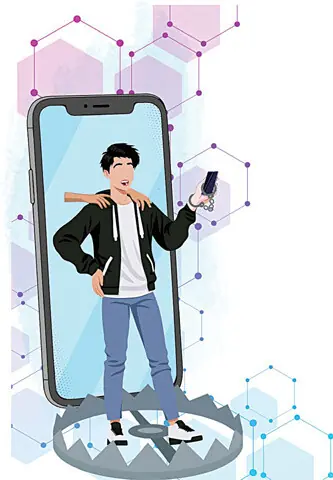
Amusing ourselves to death
Currently, we are “amusing ourselves to death,” as Neil Postman put it in his seminal work, Amusing Ourselves to Death: Public Discourse in the Age of Show Business. His theories come to life in Ray Bradbury’s novel Fahrenheit 451, where a population is addicted to the passive entertainment of wall-sized televisions while books are burnt by legal decree. In that world, people are rendered shallow and brain-dead, unable to even realise they are being controlled because their capacity for critical thought has been eroded. That is the dystopian landscape I fear we are beginning to inhabit.
On the web, data is primarily a business commodity. We are naturally drawn to the lives of others and social media platforms are specifically engineered to satisfy that curiosity. Furthermore, our inherent desire for community is met by the web’s vast diversity, which fosters a powerful, though mostly digital, sense of belonging. However, trying to connect like this often becomes a habit or even an uncontrollable obsession. We then find ourselves constantly doom-scrolling, searching for that one elusive video that promises to change our lives.
In real life, we must work and put ourselves out there for such exposure. On a smartphone, there is no barrier. Here, everything there is to know about success can be found. Access to everything is easy. We simply must fail multiple times and succeed. Everything seems easy to do and achieve.
Reality is a much lower-entropy, slow-paced environment compared to the high-energy, dopamine-inducing world of internet. In fact, the two are so fundamentally different that when we finally turn off our phones to focus, the silence feels physically uncomfortable. This discomfort often triggers a cycle of avoidance; however, the true psychology behind procrastination isn’t just a lack of focus. Rather, it is rooted in a long-term fear of failure and burnout.
To conserve mental energy in the face of that fear, we choose to ‘rot’ our brain muscles on a screen instead of engaging with the task at hand. Ultimately, we cling to these distractions because the alternative, a total loss of spontaneity, terrifies us.’
The obesity of the mind
Doom-scrolling for dopamine is, in essence, a form of mental obesity. We are carrying “junk” in our heads that creates friction in our daily life, interfering with the simple understanding that eight hours spent on a screen could have been used to transform our existence.
We choose the screen not because we are lazy, but because bringing about real change is terrifying. In this light, our screen addiction is self-destruction masked as self-defence.
The paradox of entertainment
Entertainment is paradoxical. The people producing entertainment are spending their time, enjoying themselves, editing the clips and uploading them and earning money. On the other hand, people being entertained are wasting their time, enjoying themselves and wasting their money.
The search for a “why”
Ultimately, constant phone usage lowers our susceptibility to self-awareness, allowing us to ignore our own fault in the distraction. To counter this, discipline alone is not enough; we must find a task or a purpose that inspires and disciplines.
As Friedrich Nietzsche famously noted, “He who has a why to live for can bear almost any how.” If we find our “why,” the “how” of putting down the phone will finally follow.
Published in Dawn, Young World, June 28th, 2026