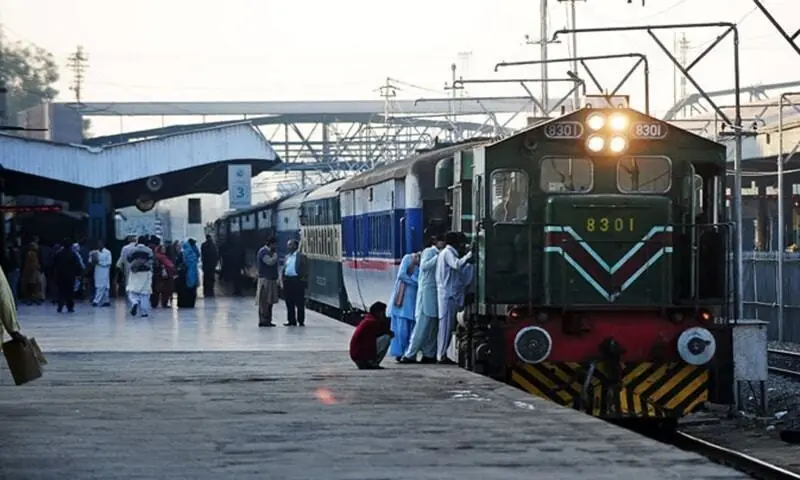
ISLAMABAD: The Auditor General of Pakistan has identified financial irregularities amounting to Rs11.25 billion in Pakistan Railways (PR) for 2024-25, highlighting persistent weaknesses in financial management, procurement and internal controls that continue to weigh on the performance of the state-owned enterprise.
According to the audit report, Pakistan Railways remained dependent on regular financial assistance from the federal government because of recurring operational losses and management shortcomings. The report called for reforms in fare management, service quality and operational efficiency to improve revenue generation and place the organisation on a sustainable financial footing.
The audit report identified seven major instances of financial mismanagement across various operational activities. The largest irregularity related to the non-recovery of railway dues from government departments and private parties amounting to Rs9.95 billion.
Other observations included an unjustified refund of Rs20.03 million in taxes to a contractor; a loss of Rs419.91m arising from excess payment of customs duty; non-levy of import surcharge and container charges; and execution of deposit works without prior receipt and recovery of funds, resulting in a loss of Rs522.47m.
AGP identifies Rs11.25bn irregularities in 2024-25
The report also found that Pakistan Railways maintained private bank accounts to receive rent and land lease charges, instead of depositing the collections into the Pakistan Railways Revenue Account, resulting in an amount of Rs612.81m.
It further highlighted non-recovery of passenger compensation claims worth Rs162.30m from State Life Insurance and mis-utilisation of Rs92.07m allocated under the improvement fund.
The Auditor General recommended strengthening fare management, enhancing service quality and improving revenue per passenger-kilometre to optimise earnings.
It suggested that the railway administration move towards financial sustainability through performance-based incentives rather than continued reliance on federal government support.
The report called for the full implementation of the State-Owned Enterprises Framework and International Financial Reporting Standards (IFRS) to improve transparency in financial reporting and eliminate qualified audit opinions.
The report stressed the need for stronger internal controls to prevent misappropriation, ensure recovery of outstanding dues and improve monitoring of fuel consumption and railway land.
The audit further recommended reforming procurement practices through independent oversight and strict compliance with public procurement rules after observing multiple cases of misprocurement.
The report noted that financial and operational management remained sub-optimal, citing recurring instances of non-recovery of dues, theft of railway material, encroachment on railway land, excessive fuel consumption and procurement irregularities.
It also observed that three subsidiary companies of Pakistan Railways — PRACS, Railcop and PRFTC — had remained under dissolution since June 2025, but their financial accounts were not made available to auditors for examination.
The financial statements show that Pakistan Railways posted a net loss of Rs61.19bn during 2024-25, an increase of Rs9.81bn over the previous year.
Revenue and other income stood at Rs92.72bn, while the operating loss reached Rs60bn, translating into an operating loss ratio of 65pc.
As of June 30, 2025, the organisation reported total assets of Rs515.32bn, including current assets of Rs110.08bn and non-current assets of Rs405.24bn.
Total liabilities stood at Rs111.12bn, comprising current liabilities of Rs29.28bn and non-current liabilities of Rs81.84bn.
During the year, the federal government provided revenue grants of Rs64.03bn and capital investment of Rs34.79bn to support the railway system.
Pakistan Railways, classified as a ‘strategic and essential’ state-owned enterprise under the SOE Act 2023, prepares both appropriation accounts and commercial accounts. While the appropriation accounts for FY25 received an unqualified audit opinion, the commercial accounts continued to receive a qualified opinion, reflecting unresolved deficiencies in financial reporting.
The report noted that road transport continues to dominate Pakistan’s transport sector, carrying around 93pc of passenger traffic and up to 96pc of freight, leaving railways with only a limited share despite successive government efforts to revive the sector.
Published in Dawn, June 28th, 2026