Govt eyes ‘secure comms’ to prevent critical leaks


• National Telecommunication Company asked to hold further stakeholder consultations, shore up security of communication ecosystem
• CDWP okays PakSat-2 launch, with its predecessor set to be retired later this year
• Slew of IT-related projects among 15 development measures approved
ISLAMABAD: The government on Thursday decided to deploy a sovereign, secure and ‘below-internet’ mobile communication network for at least 10,000 government users to address gaps that are causing critical information leakages, as it cleared a total of 24 development projects worth Rs465.76bn.
The decision was taken at a meeting of the Central Development Working Party (CDWP), which also supported the launch of the Pakistan Communication Satellite–2 (PakSat-2) at an estimated cost of Rs37.192 billion, to replace PakSat-IR, which is set to complete its 15-year life later this year.
Sources said the Planning Commission was not satisfied with the technical strengths of the Rs709 million ‘PAKAWAZ Secure Mobile Communication Ecosystem’, which aimed to put in place a secure communication mobile application which could support video & audio calls, voice & video messages, file & photo sharing and centrally managed contact lists and text & group messaging besides application servers, mobile handsets, kill switch controls and so on.
However, the National Telecommunication Company (NTC), which came up with the project, was asked to hold further consultations with stakeholders and finalise an unbreakable security system of maximum integrity to ensure confidentiality, integrity, availability, and national data sovereignty.
The project is designed to conform to national security requirements by providing an isolated “private 4G LTE Core Network” that is physically or logically air-gapped from the public internet to address shortcoming, identified after the recent war with India, and subsequent lessons learnt from other events across the Middle East.
15 uplift projects
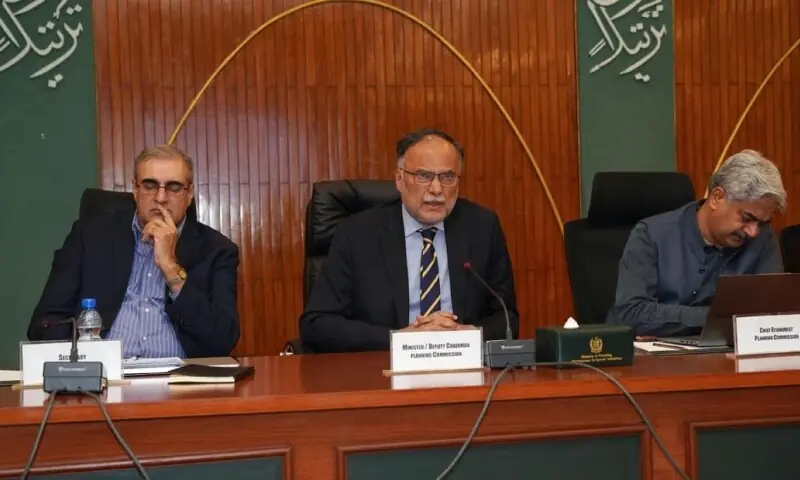
The meeting of the CDWP, chaired by Planning Minister Ahsan Iqbal, also approved 15 development projects with a combined estimated cost of Rs34.7bn and recommended for approval another nine projects worth Rs431.022bn by the Executive Committee of the National Economic Council (Ecnec).
The “CDWP accorded in-principle approval to nine development projects across different sectors with a cumulative estimated cost of Rs431.022 billion and recommended them to Ecnec”, an official statement said.
These included in the IT sector project ‘Establishment of Emerging Technologies Data Centre’ worth Rs7.93bn to to provide secure, sovereign, and government-owned Artificial Intelligence (AI) and high-performance computing infrastructure for Pakistan.
The facility will support artificial intelligence, cloud computing, big data analytics, and digital services for government institutions, academia, research organisations, and the private sector.
The project will strengthen data security and digital sovereignty, reduce reliance on foreign cloud providers, support indigenous AI solutions, and promote innovation, capacity building, and growth of the digital economy.
Another IT project, ‘National Artificial Intelligence Ecosystem Development Programme (NAIEDP)’ was approved in principle at an estimated cost of Rs13bn to get conducted a comprehensive feasibility study through a specialised consultancy firm to assess the AI ecosystem, stakeholder landscape, technical and infrastructure requirements, financial and market viability, legal and governance frameworks, and risk mitigation measures.
The study will lead to the development of an upgraded and implementation-ready PC-I to support informed decision-making and successful execution of the project.
A third IT-sector project ‘Pakistan Communication Satellite – 2 (PakSat-2)’ at a cost of Rs37.192bn was also recommended for approval by the Ecnec for development and deployment of a communication satellite in Geostationary Orbit (GEO) along with upgrading existing ground control and operations centres at Lahore and Karachi.
The project will enhance satellite command, control, tracking, and operational capabilities by utilising SUPARCO’s existing technical expertise and infrastructure. It was reported that besides these objectives, the satellite launch was critical to protect Pakistan’s satellite slot which could be lost forever if remained vacant for three years.
Four projects related to the Transport and Communications sector were also cleared by the CDWP. These include “Construction of Lalamusa Bypass (N-5) ” worth Rs20.354bn and “Up-gradation of Track and Allied Infrastructure on ML-3 (Rohri–Sibi–Quetta–Koh-i-Taftan Section (996 Kms)” worth Rs278.62bn.
The ML-3 project is proposed to be financed through PSDP, with interim funding to be provided through bridge financing by Reko Diq Mining Company (RDMC) and the Government of Pakistan.
The project includes track renewal, rehabilitation of embankments and bridges, replacement of turnouts, and construction of 11 new railway stations between Spezand and Taftan.
The project will be implemented in two phases, with critical infrastructure works planned during Phase-I (2026–2030) and remaining priority works during Phase-II (2031–2033).
Another Transport and Communications sector project “Construction of Mashkel - Chedgi Road (108.5 Km) worth Rs43.647bn was also cleared for Ecnec approval. The project, proposed to be financed through 90pc through Saudi Development Fund and 10pc PSDP, includes construction of a 4.1-kilometre-long tunnel along with approach roads, bridges, culverts, slope protection works, retaining walls, erosion control works, and allied infrastructure facilities.
The “Construction of Rathoa Haryam Bridge Across Reservoir channel on Mirpur-Islamgarh Road, Mirpur AJ&K” and was cleared at an estimated cost of Rs10.867bn.
The CDWP also cleared ‘Acquisition of Land and Hiring of Consultancy Firms for Feasibility Study for Establishment of Special Protection Unit (SPU) in ICT Police Islamabad’ at an estimated cost of Rs9.42bn.
The project includes acquisition of 26.76-kanal (16,189.80-Square Yard) land and hiring of consultancy firms for feasibility study and detailed engineering design for establishment of the SPU in Sector H-11, Islamabad.
A power sector project of the Government of AJK ‘Strengthening & Improvement of Electricity Supply Network’ was also cleared at an estimated cost of Rs10bn. The proposed project focuses on reconductoring, load bifurcation, and upgradation of overloaded 11kV feeders to improve voltage profile, system reliability, and reduce power outages, installation of new and augmentation of existing transformers and creation of a repair workshop.
Published in Dawn, June 26th, 2026