Pakistan, Iran vow to resist ‘spoilers’ of regional peace

• Iranian president calls for united front of Muslim nations to form new regional security structure
• PM Shehbaz says Tehran’s ballistic missile programme was not on the agenda at Switzerland talks
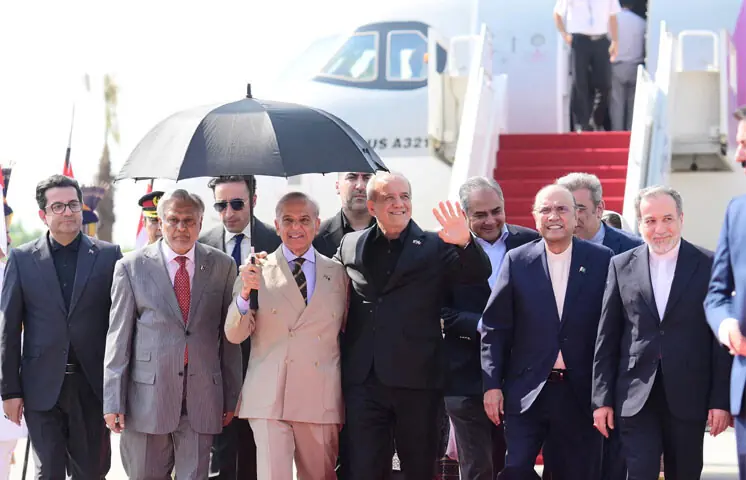
• On his first post-war state visit, Pezeshkian holds separate meetings with civil, military leadership, takes part in delegation-level talks
ISLAMABAD: Prime Minister Shehbaz Sharif has said Pakistan and Iran will act as “an iron wall” against any forces seeking to undermine regional peace, saying there is “no dearth of spoilers” around the globe who are unhappy with the US-Iran talks and the breakthrough achieved through the ‘Islamabad Memorandum of Understanding’.
Addressing a joint press stakeout along with Iranian President Dr Masoud Pezeshkian, who was accompanied by Iran’s Foreign Minister Abbas Araghchi during a daylong visit to Islamabad, following their delegation-level talks at Prime Minister House, PM Shehbaz stressed that both countries were fully determined to resist such attempts poised to undermine the peace efforts.
The Iranian president, while talking about extending “hands of friendship for a new regional security structure” called for a “united front” of Muslim nations.
He said Iran believed “peace, stability, sustainable security, development and the welfare of nations in the strategic region of West Asia and the Persian Gulf can only be ensured through straightforward and honest discussions, intra-regional cooperation, interactions and cooperation based on mutual respect for the countries in the region. Based on this fact, we stretch our hands of friendship to establish a common understanding and build a new security structure for the countries in the region”.
Dr Pezeshkian noted that PM Shehbaz’s mention of Qatar, Saudi Arabia, Turkiye and Egypt in his remarks alongside him was a “very well-placed mentioning of the roles that these authorities and these leaders actually played in the discussions that led to the peace. I believe Muslims shall form a united front against their enemies”.
The premier in his remarks had acknowledged the support of regional leaders, including Qatar’s Emir Sheikh Tamim bin Hamad Al Thani, Saudi Crown Prince Mohammed bin Salman, Turkish President Recep Tayyip Erdogan and Egyptian President Abdel Fattah el-Sisi for encouraging peace efforts.
President Pezeshkian said, “At a critical historical juncture that the region is facing a multitude of challenges, the responsible and visionary role played by Pakistan in supporting the discussions and negotiations in de-escalating and strengthening the regional stability is a manifestation of a brotherly and futuristic attitude and viewpoint by this country towards the developments in the region.”
Noting that the relations between Islamabad and Tehran have always been consolidated on the basis of mutual respect, goodwill and historical trust, the Iranian president said the “recent developments have once again showcased the consolidation of this valuable asset”.
PM Shehbaz paid tribute to Iran’s resilience during recent challenges, extending condolences over the loss of thousands of lives and expressing Pakistan’s unwavering support.
“Your happiness is our happiness. Your sorrow is our sorrow. Iran’s success is our success, and Iran’s loss is our loss,” he said.
‘Missiles not on the table’
Calling the occasion historic in Pakistan-Iran relations, PM Shehbaz welcomed the successful conclusion of the MoU signed last week between the United States and Iran. “It is a matter of great happiness that this war has come to an end, which could have engulfed the entire region and beyond,” he said.
However, he categorically said the issue of Iran’s ballistic missile programme was not on the agenda of a recent meeting in Switzerland. “The issue of Iran’s ballistic missile was not on the table (in the meeting at Switzerland),” the PM said while refuting some media reports that the issue was discussed in the technical-level talks. “Without any fear of contradiction, ballistic missiles were never a subject of discussion between Iran and the US.
“They were not mentioned in the MoU and were not on the table at all,” he said. He warned against misinformation designed to derail the peace process and reiterated that Pakistan and Iran would continue working together to ensure the success of the peace initiative and regional stability.
Dr Pezeshkian observed that the two neighbours were “adamant to use the positive existing atmosphere to usher in a new era and open a new chapter in the bilateral relations between the two countries and draw new horizons and new opportunities of cooperation based on shared interests”.
The Iranian president declared that the two countries “share a strong resolve to promote and enhance interactions and relations, especially in the area of economy and trade”.
He observed that within the framework of the MoUs and the agreements that have been made during last year’s visit, both countries’ ministers have “tried to remove any technical existing hurdles and operationalise the decisions that have been made”.
Describing his discussions with President Pezeshkian as ‘very productive’ and held in a highly cordial atmosphere, PM Shehbaz said, “It was like a family reunion. Brothers were talking to each other with the fullest clarity and total commitment that we will do everything to strengthen our brotherly relations like never before.”
As PM Shehbaz also announced that he would visit Tehran next week to pay respects to the slain Iranian Supreme Leader Ayatollah Ali Khamenei, the visiting dignitary, who began his joint presser with a couplet by renowned poet Allama Iqbal, concluded his speech by thanking the Pakistani side for its hospitality and for accepting the invitation to the commemoration of the late Khamenei.
Meetings with president, CDF
During his “thanksgiving” visit to Pakistan, the Iranian president held separate meetings with President Asif Ali Zardari, Prime Minister Shehbaz Sharif and Field Marshal Syed Asim Munir.
President Pezeshkian was given a guard of honour twice—once when he arrived at Noor Khan Airbase and later when he visited Prime Minister House where the delegations of the both countries were introduced. The Iranian president also planted a sapling in the PM House lawns.
President Zardari reaffirmed Pakistan’s “principled support for Iran’s peace, stability, national unity, sovereignty and territorial integrity”.
In their meeting at Aiwan-i-Sadr, the two leaders discussed bilateral relations, mainly regional peace and security, bilateral and regional connectivity, economic cooperation and other issues of mutual interest, according to an official statement issued later.
Meanwhile, President Pezeshkian thanked Pakistan for its “positive and constructive efforts in support of peace and dialogue and appreciated the support extended by Pakistan during [the] recent challenging circumstances”, the presidency said.
The Iranian president said his country “attaches great importance to its relations with Pakistan and looks forward to further expanding cooperation in political, economic, security and regional matters”.
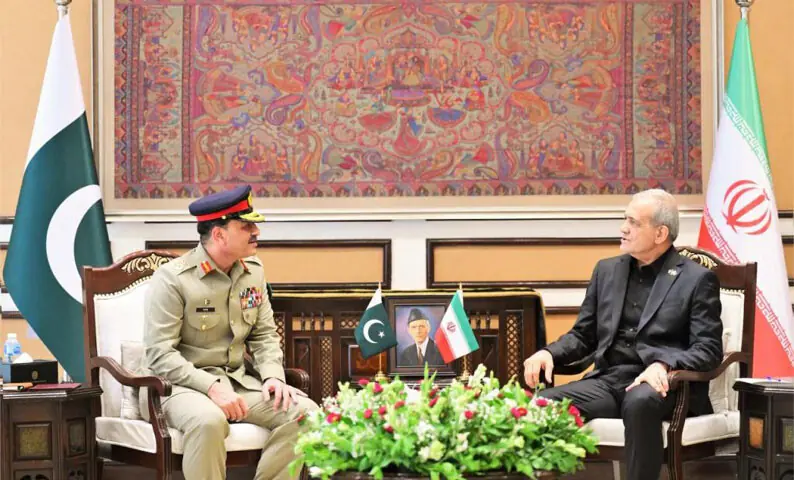
Meanwhile, Chief of Defence Forces and Chief of the Army Staff Field Marshal Asim Munir called on the Iranian president, the Inter-Services Public Relations (ISPR) said. They exchanged views on “regional developments and peace initiatives”, ISPR said in a statement.
CDF Munir, along with PM Shehbaz, had participated in the US-Iran talks in Switzerland, where they discussed a framework for regional peace.
During his meeting with the army chief, Mr Pezeshkian appreciated Pakistan’s “constructive and responsible role in promoting dialogue, de-escalation, and regional stability”, the ISPR said. It added that he acknowledged Pakistan’s “consistent efforts to encourage peaceful resolution of disputes and foster understanding among regional stakeholders at a time of heightened geopolitical challenges”.
On his part, CDF Munir reiterated Pakistan’s unwavering commitment to peace and stability in the region, the statement noted. “Both sides reaffirmed their commitment to further strengthening Pakistan-Iran relations and maintaining close consultations on issues of mutual interest, with the shared objective of advancing peace, prosperity and stability across the region,” it read.
Published in Dawn, June 24th, 2026