0
0

• Winds up debate in NA, calls fiscal plan positive, pro-growth
• Denies change in economic indicators methodology
• Says govt focused on export-led, productivity-driven growth
• NA to vote on cut motions today, tomorrow; Finance Bill to be taken up on June 23
• Final budget approval scheduled for 24th
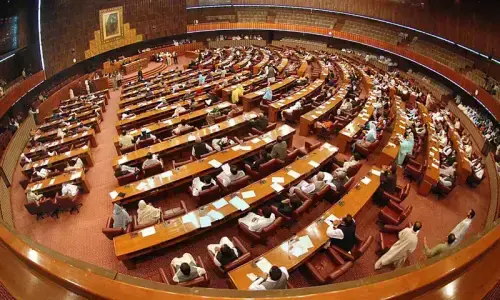
ISLAMABAD: Finance Minister Muhammad Aurangzeb, in his winding-up speech on Saturday, described the proposed budget for fiscal year 2026-27 as positive and pro-growth, asserting that it would lay the foundation for “accelerating the sustainable growth” recorded over the past two years.
He was addressing the National Assembly as he wound up the debate on the latest budget, which was presented on June 12.
Traditionally, the winding-up speech follows the completion of budget-related work by the National Assembly Standing Committee on Finance. However, the committee remains in session and is set to meet on Sunday morning.
The Senate Standing Committee on Finance has already forwarded its recommendations to the National Assembly Secretariat. The government, however, continued to follow the budget approval schedule agreed jointly by all parties.
As per the schedule, after the winding-up speech by the finance minister, the other agenda item of the day was discussion on charged expenditures.
On Sunday and Monday, the house will discuss and vote on Demands for Grants in respect of voted expenditure for 2026-27, also termed cut motions. On Tuesday, the house will consider and pass the Finance Bill, 2026.
The final phase of budget approval is scheduled for Wednesday, June 24, after discussion and voting on excess demands for grants.
In his speech in the lower house of parliament, Senator Aurangzeb claimed that many recommendations of the standing committees of both houses had been incorporated into the Finance Bill.
The minister lauded the National Assembly for saving Rs5bn through austerity measures, while the Senate saved Rs1bn.
He responded to criticism, mainly by PTI members, over GDP growth for the outgoing fiscal year, per capita income and the methodology used for reporting economic indicators.
“I want to clarify that no changes at all have been made to the methodology used for reporting the economic indicators,” the finance minister said.
He said economic indicators for FY18 would also be presented before MNAs who raised concerns so that it was clear there was consistency in measurement from one administration to another.
Sustainable export-led growth
He added that sustainable and inclusive export-led growth that increased productivity was the fundamental objective of the government and the budget for 2026-27.
“We often hear and see that the documented corporate sector and salaried class have to bear most of the tax burden. The government has changed this trend and thinking in the budget, and focused on deepening and broadening rather than burdening,” he contended.
He added that the burden on existing taxpayers — particularly the salaried class, small businesses, exporters and industrialists — would be reduced under the FY27 budget, keeping in mind the “principles of equity and fairness”.
“We had initiated this change in the last budget and clarified our direction. In this budget, we have taken additional and concrete initiatives regarding it,” the finance minister said.
He highlighted that provision of concessional loans for importers and the agriculture sector had been incorporated.
Mr Aurangzeb emphasised that the Fixed Tax Asaan Scheme had been introduced to broaden the tax net. Elaborating on reforms introduced in the tax sector over the past two years, he said: “We have detached tax policy from tax administration and we are introducing a new tax operating model in continuation of these reforms, under which the interaction between a taxpayer and a tax officer will be removed.”
Discretionary powers
He said the process of audit, identification and implementation would be conducted through an automated system.
The minister added that these reforms were aimed at ending discretionary powers, preventing harassment through digitisation and promoting transparency.
Responding to remarks by some lawmakers on the Federal Board of Revenue’s performance, he said the government welcomed constructive criticism but stressed the need to consider the context.
He presented a comparative analysis and lauded the performance of the tax-collecting body for collecting additional revenues of $14bn over the past two years.
On the agriculture sector, Mr Aurangzeb said it was the “backbone” of Pakistan’s economy and that the government had announced “satisfactory relief and developmental packages” for farmers.
He noted that the Zarkhez scheme had been initiated, under which interest-free and collateral-free loans were being provided to 750,000 small farmers.
He further said Rs9.5bn had been allocated in the upcoming budget for subsidies under the Prime Minister’s Youth Business and Agriculture Loan Scheme, under which loans worth more than Rs109bn would be given.
To keep fertiliser prices under control, a Rs15.8bn package has been announced in the budget, including a Rs10bn subsidy on urea fertiliser, according to the minister.
Mr Aurangzeb also mentioned Rs4.2bn earmarked for development programmes in the agriculture and livestock sectors. He added that import duty relief worth Rs2bn was being given through the abolition of duties on tractors, combined harvesters and other equipment to modernise agriculture.
“I specifically want to mention that we are expanding agricultural cooperation with China,” the finance minister said, noting that Pakistani students and experts were being trained in the sector.
“We are going to construct agricultural cold storages in collaboration with the private sector, which will cost Rs7.1bn, because investing in this value chain is extremely important to get value-added agriculture moving,” he said.
He added that the government had given tax relief to the salaried class, increased salaries and pensions of government employees, introduced measures to facilitate the process of obtaining pensions, abolished taxes on sanitary pads and contraceptives, and reduced taxes on life-saving medicines.
The finance minister thanked lawmakers for participating in the budget debate, specifically Opposition Leader Mehmood Khan Achakzai, as well as Saleem Mandviwala and Naveed Qamar, who head the standing committees on finance in the Senate and National Assembly, respectively.
Concluding his speech, Mr Aurangzeb stressed that “national consensus was extremely important in the economic and financial recovery” and requested all stakeholders to continue their cooperation for the country’s economic development.
Debate on 140 recommendations
Earlier in the day, the National Assembly debated the 140 recommendations made by the Senate on the budget. Under the Constitution, the Senate has no power to vote on a money bill, a power that lies exclusively with the National Assembly, which is the directly elected house.
PTI MNA Muhammad Atif criticised sales tax relief for Pakistan International Airlines, arguing that it should be extended across the board. He questioned why relief had been proposed for business and first-class passengers only, but not for those travelling in economy.
PTI’s Amir Dogar demanded that the finance minister explain the Pakistan Telecommunication (Re-organisation) (Amendment) Bill, 2026, which he termed “draconian”.
Notably, when the bill was approved by the National Assembly on June 11 by a majority vote, there was no objection even by PTI members at the time.
The house also discussed charged expenditures, which include some functions of Pakistan Post, superannuation allowances and pensions, grants, subsidies and miscellaneous expenditure, foreign missions, Law and Justice Division, National Assembly, Senate, Presidency, servicing of foreign and local debt, Supreme Court, Federal Constitutional Court, Islamabad High Court, Election Commission, Federal Ombudsman Secretariat for Protection against Harassment of Women at the Workplace, Wafaqi Mohtasib and Federal Tax Ombudsman.
These expenditures are exempt from voting and the government provides funds as demanded by the relevant departments.
Published in Dawn, June 21st, 2026