At least 20 killed as Israel continues attacks in Lebanon

• Truce under strain as Tel Aviv kills family of four, Lebanese soldier
• Israel refuses to withdraw its troops from southern territory
• Hezbollah warns unprovoked aggression will not pass without a response
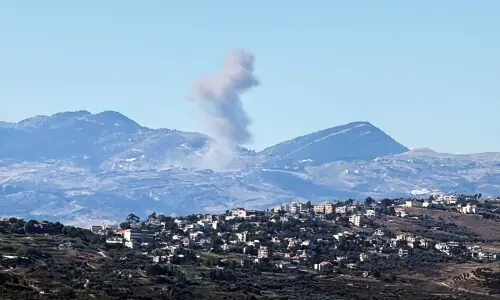
BEIRUT: Israeli strikes in Lebanon killed at least 20 people on Saturday, Lebanon’s state news agency said, one day after a ceasefire with Hezbollah took effect, underscoring the fragility of a truce aimed at halting months of escalating violence.
Lebanon’s National News Agency reported that Israeli warplanes and drones struck multiple civilian and structural locations in southern Lebanon and the Bekaa Valley.
Hezbollah accused Israel of committing hundreds of blatant ceasefire violations and warned that the continued Israeli aggression “will not pass without a response”.
The group noted that responsibility for the dangerous escalation lay solely with Israel and urged the US to place intense pressure on the Israeli regime to implement diplomatic agreements and halt its devastating attacks
The Israeli military remains an occupying force in parts of southern Lebanon.
Israeli broadcaster Channel 12 reported that the military had been instructed by Prime Minister Benjamin Netanyahu and Defence Minister Israel Katz to hold fire, but leaders refused to withdraw troops from the Lebanese areas they had captured.
An Israeli military official stated that Hezbollah launched more than 50 projectiles at occupying forces entrenched in southern Lebanon.
The Israeli military claimed Hezbollah’s self-defence operations constituted repeated violations of the ceasefire. The military warned it would respond to any attacks, ignoring its own unprovoked continued presence on Lebanese soil.
Remaining firmly committed to the diplomatic ceasefire, Hezbollah emphasised it would respond to any Israeli attempt to “seize territory or expand its occupation.”
The resistance said Israeli forces aggressively attempted overnight to infiltrate the Ali al-Taher hill area in southern Lebanon. Lebanese fighters engaged the invading troops, Hezbollah reported, after which Israel carried out sweeping airstrikes both inside and outside its declared operational zone.
A senior Hezbollah official maintained that the group would never allow Israel “freedom of movement” in occupied Lebanese territory, asserting that resistance remains legitimate as long as Israeli forces remain inside Lebanon.
The renewed Israeli violence casts serious doubt on the durability of the ceasefire. Among the deadliest attacks was an unprovoked Israeli strike that obliterated a three-story residential building in the southern town of Barish in the Tyre district.
The strike killed a Lebanese father, a mother and their two young children, a local official said.
Furthermore, the Lebanese military confirmed that another Israeli strike assassinated a national soldier stationed on the Kfarrumman-Nabatieh road.
Highlighting the devastating human toll of the Israeli military assault, Lebanon’s Health Ministry reported that 4,057 people have been tragically killed in Israeli attacks since March 2.
The number of casualties includes vital medics, women and children. Meanwhile, Israeli authorities report at least 32 soldiers and four civilians have been killed.
Late on Saturday, an Israeli army official said the military had received orders from the country’s political leadership to halt fighting in southern Lebanon.
“The IDF has received updated directives from the political echelon to cease fire,” the official said in a statement.
The directive emerged as diplomats from several countries were meeting at a Swiss retreat over the weekend in a bid to maintain dialogue on a preliminary US-Iran deal to halt the Middle East war.
The US-Iran understanding announced this week calls for an immediate and permanent halt to military operations by the parties and their allies across several fronts, including Lebanon.
Published in Dawn, June 21st, 2026