Pakistan basks in glory after brokering landmark US-Iran rapprochement


• Trump, Pezeshkian and Shehbaz sign historic deal ‘ahead of schedule’
• PM drops plan to fly to Switzerland after signing ceremony ‘cancelled’
• 60-day negotiation window opens as technical talks set to begin today
• Saudi tankers sail through Strait of Hormuz after Iran, US end blockade
• Oil prices drop to lowest levels since before the war
• Mojtaba Khamenei says okayed deal despite ‘holding different view’
• Trump calls for end to hostilities on all fronts, including Lebanon; Vance rebukes Israeli, domestic critics
ISLAMABAD / KARACHI: Thursday proved to be a red-letter day for Pakistan, as the country awoke to news of a long-awaited peace deal finally being signed between the United States and Iran, heralding an end to the bitter animosity that has afflicted the Middle East and plunged the world into crisis for months.
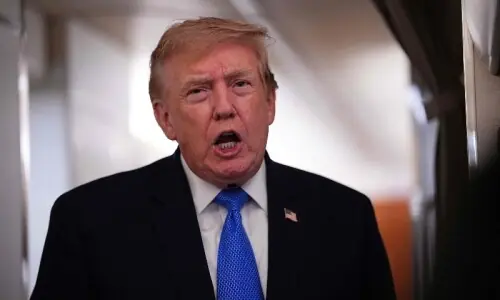
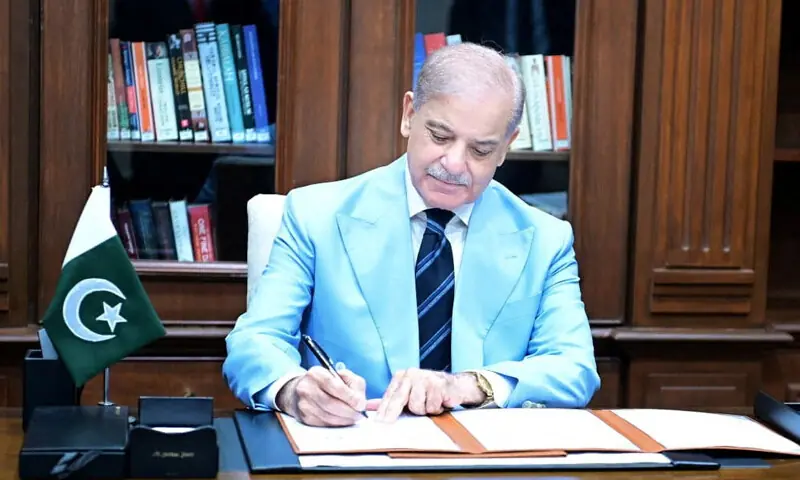
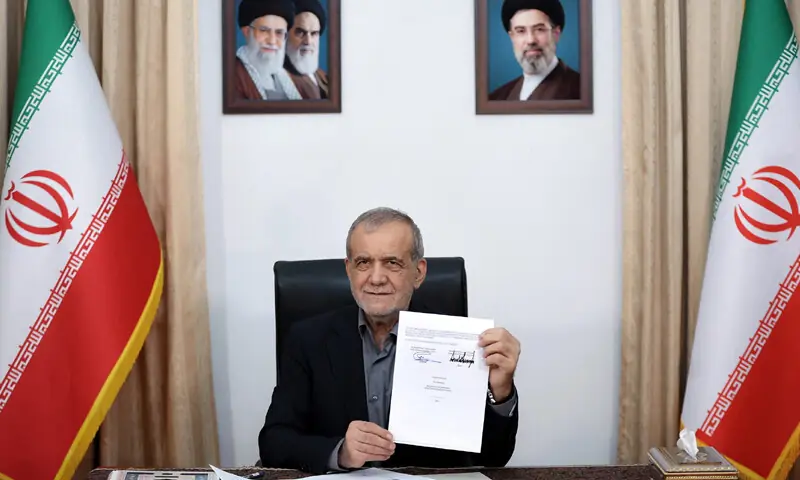
The honour of announcing that the ‘Islamabad Memorandum of Understanding’ had been ‘electronically’ signed by all parties, fittingly fell to Prime Minister Shehbaz Sharif, who put his signature to the historic document after US President Donald Trump and Iranian President Masoud Pezeshkian, bringing it into effect two days earlier than previously expected.
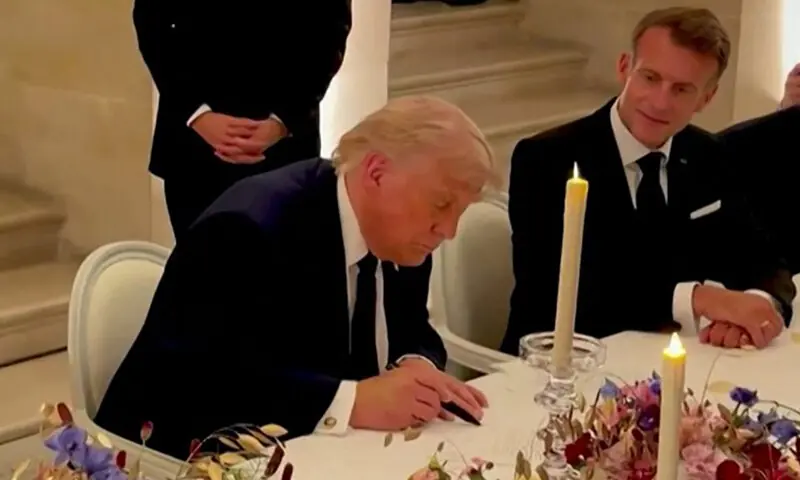
Earlier, Trump signed the document during a reception at the Palace of Versailles — also the venue for the landmark treaty that ended World War I — with French President Emannuel Macron looking over his shoulder. Meanwhile, Iranian media released photos of Dr Pezeshkian signing the deal in his office.
The accord, facilitated and negotiated through several rounds of diplomacy — led by Pakistan and ably assisted by regional partners such as Saudi Arabia, Qatar and Turkey — marks the second major diplomatic achievement for Islamabad in bringing two big world powers together.
The signing comes just weeks before the 55th anniversary of Henry Kissinger’s historic secret trip to then-Peking in July 1971, which opened the door for US-China normalisation, all thanks to Pakistan’s facilitation.
Following the signing on Thursday, the US lifted a blockade of Iranian ports, and Vice President JD Vance announced that some 12.5 million barrels of crude sailed through the Strait of Hormuz overnight.
Although the initial negotiations scheduled for today in the Swiss resort of Burgenstock are expected to go ahead, PM Shehbaz cancelled his trip to Switzerland after the signing was unexpectedly moved forward.
PM Shehbaz’s post on X initially stated that Pakistan, with the support of Qatar, would host the official ceremony as scheduled on June 19 in Switzerland, to “commemorate this landmark event and commence with the technical level talks”.
However, this was later removed while Iranian foreign ministry spokesperson Esmaeil Baghaei said that, because the two presidents had already digitally signed the agreement, “No signing ceremony will be held in Switzerland”.
“Currently, the plan remains for the United States and Iran, along with the mediators Pakistan and Qatar and other involved countries, to meet tomorrow at the Burgenstock for initial negotiations o n the implementation of the agreement,” the Swiss foreign ministry said.
Iran’s chief negotiator, Mohammad Bagher Ghalibaf, and US Vice President JD Vance were expected to take part in the discussions to flesh out the details of the deal, but the Swiss said they could provide no further information on the agenda.
‘Rebuilding Iran’
Announcing the signing of the deal in the early hours Thursday, PM Shehbaz offered his congratulations to Trump and his team, saying his “steadfast commitment to diplomacy and preference for peaceful resolution have once again helped end a conflict that could have led to devastating consequences for the region and beyond”.
He also expressed his respect and appreciation for Iran’s Supreme Leader Ayatollah Mojtaba Khamenei and Iranian President Masoud Pezeshkian for their “wisdom, foresight and statesmanship in embracing the cause of peace”.
PM Shehbaz also acknowledged the efforts and engagement of Qatar, Saudi Arabia, Turkiye and Egypt. He also made special mention of Chief of Defence Forces (CDF) and Chief of Army Staff Field Marshal Asim Munir, saying his “tireless efforts, selfless dedication and instrumental role were critical in facilitating this breakthrough and advancing the cause of peace and regional stability”.
“May this MoU serve as an enduring foundation for greater understanding, mutual respect and shared prosperity for the complete region,” he said.
Later, speaking to Dr Pezeshkian in their first contact after the signing of the agreement, PM Shehbaz hopes the peace deal would “go a long way towards” rebuilding Iran.
“The landmark deal, he said, would not only help restore peace in the region, but also go a long way in rebuilding the Iranian nation and further strengthening Pakistan-Iran ties, across all areas of mutual interest,” he said.
While lauding Iran’s decision to sign the peace deal, PM Shehbaz wished the Iranian side success in the next phase of negotiations and assured the president of Pakistan’s continued support for Iran as a brotherly and neighbouring country in all spheres.
According to the PMO, President Pezeshkian thanked PM Shehbaz and Chief of Defence Forces and Chief of the Army Staff Field Marshal Asim Munir for their “extremely critical roles” in steering the mediation process with “great skill and sincerity”, which had ensured its success.
Dr Pezeshkian said Tehran would always remember Pakistan’s “positive and constructive efforts and its support for Iran during these difficult times”, the PMO said.
“While conveying his best wishes for the people of Pakistan, the Iranian president said Iran was keen to enhance and expand its bilateral ties with Pakistan across all areas of mutual interest,” the statement added.
Both leaders agreed to visit the capitals of each other’s countries “at the earliest possible opportunity to carry forward the excellent cooperation between the two sides in bilateral as well as regional matters”.
They also agreed to remain in touch in the coming days.
Next steps
According to PM Shehbaz’s early-morning announcement, as a first step, Iran would instantly reopen the Strait of Hormuz, and the US would immediately lift its naval blockade.
The 14-point memorandum of understanding between the United States and Iran begins a 60-day negotiation period during which Iran will allow toll-free passage through the Strait of Hormuz.
The deal calls for traffic through the strait to be restored to its full capacity within 30 days. Though shippers say it will still take time for transit across the strait to reach pre-war levels, with a need yet to ensure safe access and clear mines, there were immediate signs of an impact.
Three Saudi-flagged supertankers carrying 6 million barrels of crude sailed through the Strait of Hormuz on Thursday.
News of the deal caused a major shift in oil prices, which fell to their lowest point since the start of the Iran war in February.
Brent crude futures were down $1.85, or 2.33pc, at $77.69 a barrel at 1615 GMT, while US West Texas Intermediate fell $1.89, or 2.46pc, to $74.90 a barrel.
Brent touched its lowest level since February 27, which was the last day of trading before the initial US-Israeli strikes on Iran, while WTI was at its lowest since March 4.
“The potential reopening of the Strait of Hormuz removes the big risk premium that had been baked into crude from (the) disrupted 20pc of global oil flows,” said Phil Flynn, senior analyst with the Price Futures Group in a morning note.
“While some say full normalisation may take weeks – insurance, repairs, sanctions relief - but the direction is clear, and as we have found out that the more pessimistic timeline (has) been proven to be too pessimistic,” Flynn said.
The preliminary accord defers many of the more difficult issues, such as Iran’s nuclear programme, and also requires the United States and its partners to come up with a $300-billion plan to finance Iran’s recovery.
Lebanon hostilities
On hostilities in the Middle Rast, Trump said on Thursday that Washington expected “a complete ceasefire on all fronts,” including Lebanon, Hezbollah, and Israel.
“We encourage everyone in the Middle East Region to maintain their commitment to allowing our negotiations to beautifully unfold,” Trump wrote on Truth Social.
But in Lebanon, where more than a million people are displaced by the fighting, Israeli forces launched fresh airstrikes early on Thursday, raising doubts about how far Trump will go to force his wartime allies to halt an offensive he has now pledged to end.
Iran has always said any peace deal must also cover Lebanon. In an apparent major concession to Iran, the memorandum signed by Trump explicitly calls for the “permanent termination” of the war in Lebanon and for its “territorial integrity and sovereignty” to be ensured.
Israel has said it has no intention of withdrawing from Lebanon, whatever Trump negotiates. It released a new map on Thursday showing an expanded southern area occupied by its troops, which it describes as a buffer zone.
Vance told reporters one goal of the deal with Iran was to allow the Lebanese authorities to police the south of the country.
“What we want to see is the Lebanese government, the elected representatives of the people of Lebanon, who are able to police southern Lebanon, so that Hezbollah has not taken over the country, the Israelis are not threatened, and then consequently the Israelis are not attacking southern Lebanon or Beirut either,” he said.
Two Israeli officials, including a senior official close to Netanyahu, told Reuters Israel was holding negotiations with the United States to keep Israeli troops in Lebanon.
Vance rebukes Israeli critics
Trump’s decision to end the war, in which 13 US service members were killed and a vast proportion of US ammunition stockpiles was used, has unsettled some of his allies at home.
On Thursday, VP Vance tried to defend the accord, saying: “The Iranians have to perform. If they don’t perform as we’ve said before, they don’t get any of the benefits of the bargain.”
Vance said Iran would only get the rewards if it proves that it has complied with the terms that will be hammered out in a 60-day period that he said began on Thursday.
“There’s a lot of discussion — the MoU, the gentleman’s agreements, the final deal. Words don’t matter, ladies and gentlemen, we’re about verification,” Vance told reporters.
He also issued an extraordinary rebuke to Israeli critics of the Iran deal, amid growing tensions between Trump and Prime Minister Benjamin Netanyahu.
“If I was in the cabinet of the Israeli government, I might not be attacking the only powerful ally that I have anywhere left in the entire world,” Vance said.
“Anybody in Israel who thinks their biggest problem is the president of the United States needs to wake up and smell the reality of the situation.”
‘Different view’
Meanwhile, Iran’s supreme leader Ayatollah Mojtaba Khamenei said he had approved a deal with the United States to end the Middle East war despite having a “different view”, without elaborating.
“In principle, I had a different view (about the memorandum of understanding), but I issued my permission due to the commitment that the honourable (Iranian) president, as the chairman of the Supreme National Security Council, gave me on behalf of himself and other members to protect the rights of the Iranian nation and the Resistance Front,” he said in a message read out on state television.
Khamenei said Trump had “used all kinds of levers” to secure the deal “out of desperation”.
In his message, Khamenei noted that he received assurances from Pezeshkian about the deal and that it would not be accepted “if the American side wants to make excessive demands”.
“It is obvious that the face-to-face negotiations that will be held in the future will not mean accepting the enemy’s point of view,” he added.
IAEA commitment
After the peace deal, the world’s nuclear watchdog said that it was ready to begin defining the “concrete steps” needed to implement a US-Iran deal to end the Middle East war.
“Now it’s for us to sit down with our American colleagues, our Iranian colleagues, and start formulating the concrete steps that will have to be taken,” IAEA chief Rafael Grossi told reporters in Geneva.
With input from Agencies
Published in Dawn, June 19th, 2026