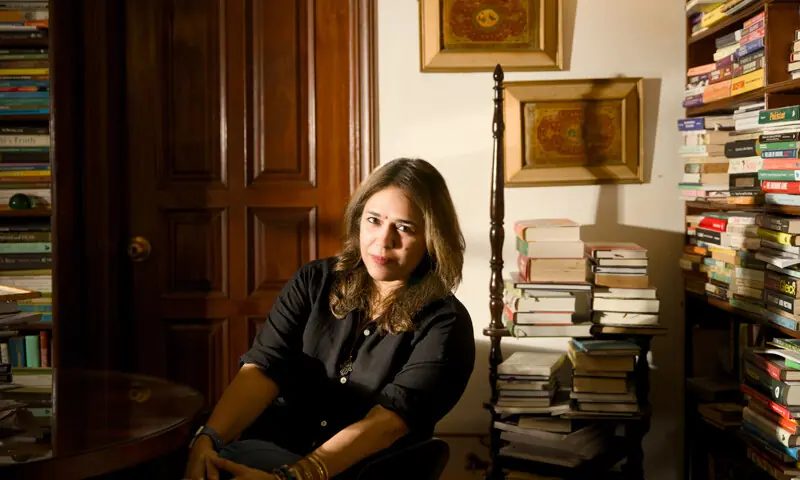

It is a sultry Sunday afternoon when I meet director Mehreen Jabbar. Karachi’s traffic is less chaotic and almost serene. Mehreen is dressed in a black button-down shirt and jeans and, as the conversation progresses, I conclude the weather matches her: she, too, is sultry and serene.
We begin the conversation by talking about the TV serial Dr Bahu, which she has directed and is currently on air, receiving rave reviews. I ask her how the project came about. She tells me that, a couple of years ago, the idea was first brought to her by actor and producer Humayun Saeed, who heads the production house Six Sigma and who believed it had the makings of a strong commercial drama. At the time, she had little interest in returning to long-form television.
“I wasn’t doing long-form serials those days,” she says. She had been dabbling in miniseries such as Nadaan and Jurm. But then director Nadeem Baig, who’s also part of Six Sigma, persuaded her to read the script and told her that if he weren’t so busy, he would have directed it himself. “Nadeem kept telling me, ‘Just do this. Trust me.’”
Not Just a Gharailoo Drama
Although Dr Bahu initially appeared to revolve around familiar themes of family politics and in-laws’ relationships, she discovered a far more layered narrative beneath the surface.
“Yes, it is a story about a family and a bahu [daughter-in-law],” she admits, “but there were so many different threads and issues running through it. It wasn’t typical. It was fast-paced and the characters were interesting. I thought, why not?”
Director Mehreen Jabbar has returned to long-form television after a long time with her latest serial Dr Bahu. What enticed her back? Why hasn’t she made a film in 10 years? What does she think about the changing dynamics of the industry? How does it feel to split her life across the globe? And how is age affecting her?
What also attracted her was the fact that it featured a strong female lead.
“She is a progressive, proactive woman and not a goody-two-shoes and nor a victim. She makes mistakes and is headstrong. It’s a blessing to find female characters who are proactive and who have agency. Honestly, it’s very difficult to come across well-written serial scripts and I felt it was worth doing.”
The More Things Change…
Since she has been working in the industry for more than three decades, I ask Mehreen how she thinks it has changed.
She says that, while the technical aspects of television production — such as equipment, cameras and production design — have improved considerably, there is still significant room for progress. In some cases, outdated equipment is still in use. She remarks, “How we do things on such limited budgets and crew members compared to productions abroad is nothing short of a miracle.”
In terms of content, however, she believes the industry has become less adventurous.
“When there were only two or three channels, there wasn’t this rat race for ratings,” she says. “There was more room to experiment because ratings didn’t dictate content in the way they do now.”
I ask her to elaborate. She points to some of her own early work as evidence of a period when television was willing to take greater creative risks. In the 1990s, she directed projects such as Faraar, which followed three independent women living in Karachi, Putli Ghar, a psychological thriller and Sham Se Pehlay, a story about two older people who fall in love.
“At that time, there were lots of different themes being explored,” she recalls. “Writers such as Bano Qudsia and Ashfaq Ahmed were creating very interesting and unconventional stories.”
She adds, “I don’t think a project should be judged by the number of YouTube hits. I’ll give you the example of a fantastic series, Aik Aur Pakeezah, which is brilliant. It did not get as many views on YouTube as some of the more commercial series, but it was critically acclaimed and widely talked about. So that should not be the barometer of whether projects should be produced or not.”
Payments, she feels, have not significantly improved either. People frequently complain that payment delays exist because advertisers do not pay channels on time. As a result, channels delay paying production houses, which then cannot pay actors and crew promptly.
I ask her if she thinks things could be moving towards improving.
“I think they’re worse,” she replies emphatically. “It wasn’t like this before. I don’t remember begging or pleading for money — for myself or for crew members. Everyone is blaming everyone else. An industry like this, which employs thousands of people and generates so much revenue, should figure out how to conduct its business professionally. There should be a set payment cycle and people should just be paid on time. I don’t know why it can’t be done.”
I think I generally try to stay as realistic as the scene requires. I’m more aligned with the school of thought of realistic cinema — neorealism — so I like that kind of filmmaking…” She adds: “I love one-takes. I feel that sometimes, when you cut, you lose the intensity of the scene.”
The Case for Realism
I steer the conversation toward more pleasant topics and note that one of the defining aspects of her work has been realism. For example, her characters are never overly made up, and certainly not styled as if they have just woken up all dressed up in the middle of the night, which is still the case in many dramas today.
Similarly, Saba Hameed looks far more natural and less made up in Dr Bahu than she did in Noor Jehan, even though both characters come from similar upper-class backgrounds.
“Well,” she surmises, “her character was very different from Noor Jehan, in which she was the head of the house. In this, she is a victim of her husband, the head of the household.”
She attributes the realism to her team and assistant directors, as well as to her own brand of filmmaking. “I think I generally try to stay as realistic as the scene requires. I’m more aligned with the school of thought of realistic cinema — neorealism — so I like that kind of filmmaking.”
Has her style or how she approaches filmmaking changed over time, I wonder.
“I don’t know if the style has changed,” she responds. “I would say I’m more confident in the day-to-day craft of filmmaking. Having done it for so long, I kind of know where to put the camera and how to make a scene work quickly.”
She adds: “I love one-takes. I feel that sometimes, when you cut, you lose the intensity of the scene.”
She does admit that she is perhaps too entrenched in TV. “When I make my third film, I’ll have to really challenge myself to get out of TV mode and think cinema, which I can do because I do love films, and I think I have the eye.”
Return to films?
I was going to ask her about her long hiatus from cinema but she preempts me. She says her next dream project is to make a film, and she is currently dabbling with a couple of subjects — one a psychological thriller, and the other a social drama.
“I have to decide which one I want to go with. And I want someone to give me the money to make it. While I’m waiting for someone to give me money to make it, I will continue working on serials.”
I ask her why she hasn’t made a film recently. In fact, her two ventures on the big screen were 18 years and 10 years ago — Ramchand Pakistani (2008) and Dobara Phir Se (2016) — but she has always spoken, in her understated way, about her passion for cinema. The reason, she says, is partly practical.
“The movie business is a tough one,” she says. Unlike television, where projects move relatively quickly and payment structures are still relatively predictable, filmmaking demands years of commitment. She also believes films require complete creative immersion.
“A film has to be a passion project. You can’t do a hundred other things alongside it. You have to stop and dedicate yourself entirely to it.”
It is this immersion she misses most about making movies. “I think what I miss about making a film is that you can just drown yourself in that one story. It’s a labour of love.”
This is one of the differences she says between the two media, as a TV drama may occupy a director for a few months, but a feature film can remain with them for years. “A film is a process from writing, all the way to the final product,” she explains. “It lives with you for a minimum of two years, if not three or four.”
Another distinction she draws between television and cinema lies less in aesthetics and more in how audiences consume stories.
“People grow with television,” she says. “Especially long-form TV, where you can take your time telling a story over four or five months.” This gives viewers time to form connections with the drama. Cinema, by contrast, offers no such luxury.
“In a film, you have to captivate the audience within a very short span of time,” she says. “You have to be good enough to make people sit through it and then tell others to go and pay for a ticket and popcorn. The stakes are much higher.”
Contrary to periodic declarations that cinema is dead, she believes the problem is more structural than creative. She notes that there is a renewed interest in cinema, with initiatives such as Punjab Chief Minister Maryam Nawaz’s proposed film city as well as a growing number of institutions training aspiring young filmmakers providing evidence that interest in the medium is steadily building.
“There are a lot of young people who want to build a future in film,” she says. “That’s a good thing.”
But she stresses the need to expand cinema infrastructure beyond a handful of multiplexes in major cities, making theatres more widely accessible. “The biggest hurdle is that there are not enough cinemas,” she says. “And there are not enough cinemas because there are not enough films being produced. It becomes a vicious cycle.”
One criticism frequently levelled at Pakistani films is that they often look like extended television dramas. Mehreen, however, rejects the distinction. “I’m not a believer in people who say, ‘This looks like a drama’ and ‘This looks like a film,’” she says.
For her, the visual language of a film is determined by its story rather than by arbitrary notions of scale. A science-fiction film, action blockbuster or historical epic naturally demands a larger-than-life canvas. A family drama, on the other hand, may require something far more intimate.
“If you’re telling the story of a family in a house, you’re not suddenly going to make it look grand just because it’s a film,” she says. “Cinema doesn’t need people running through forests and singing songs,” she says with a laugh. “It’s all about the script.”
She is equally dismissive of another common complaint: that Pakistani films rely too heavily on television actors. Given the absence of a robust film industry, she argues, filmmakers have little choice.
“We don’t have a film industry, so where are we going to get our actors from? “You can cast a completely new actor,” she says, “but people are more likely to buy a ticket if they see a Humayun Saeed, a Fahad Mustafa, a Mahira Khan or a Mehwish Hayat.”
THE PASSION TO TELL STORIES
Despite all the frustrations, what keeps her going, I ask. “Because that’s the only thing I know how to do. Otherwise, what would I do? I don’t know how to make money otherwise,” she says, self-deprecatingly.
I remind her that during our previous interview, a decade ago, she said that telling stories drives her — does she still feel the same?
“Yes, obviously. Because there are so many stories to tell, and so much maza [fun] in telling them. There are so many facets of human relationships and human character to explore — it’s endless.”
And although the ingredients in most stories are the same — love, jealousy, heartbreak — she believes there are infinite ways to tell them, because the context can always change.
“I just love delving into people’s dark, secret lives,” she says with a laugh.
She is currently working on another serial with Sanam Saeed and Emmad Irfani. “It’s going to be interesting. It’s very, very contained. Unlike Dr Bahu, it’s a much more streamlined story.”
NEW YORK VS KARACHI
Mehreen has long settled into a life split between New York and Karachi over the past 24 years. Broadly speaking, New York is where she lives a more unstructured, personal life (although she does some of her post-production work there), while Karachi is where she works.
What she loves about New York, she says, is the presence of friends who have become like family, and the sense of independence it gives her in everyday life. The city also keeps her connected to a wider cultural world — “world cinema, world theatre, exhibitions.”
On the other hand, Karachi offers comfort, family, and work. “I love working here,” she says. I ask her if living away prevents her from feeling the pulse of audiences here. She replies in the negative, saying she remains closely engaged with Pakistani television, makes a conscious effort to stay updated, and watches the latest serials.
I ask her whether she is a workaholic. She says no, “I used to be, not anymore. What I love to do now is go to the gym. Because I feel more and more, as one is growing older, it’s so important to learn about building strength for later on in life.”
Alongside this, she speaks about a growing desire to travel more and see more of the world. With fewer familial obligations, she feels a certain freedom in shaping her time differently. “As I don’t have a family, my responsibilities, thankfully, are not that many,” she says.
When asked if that was a conscious choice, she is matter-of-fact. “It just never happened. Never wanted kids, never happened. Zero regrets.”
She also speaks about wanting to return to reading. “I definitely want to restart reading,” she says. “I’ve become too involved in video games on my phone, which I play to relax.”
She remains deeply drawn to television and film and wants to watch more of them — no surprises there — and is also a foodie. “I love going for brunch with friends,” she says. She is also a long-time vegetarian, although not vegan. “I love cheese and eggs. I love food.”
As the conversation winds down, I ask her if there is a question she has never been asked but feels she should be. She pauses, then says it would be: “How does one’s state of mind or general attitude change as one grows older?”
Her answer to her own question is nuanced and reflective. “There is more tehraao [calmness],” she says. “One becomes more self-assured and has fewer conflicts with oneself. There is a greater appreciation of self-worth and a tendency to live life on one’s own terms, rather than worrying about what random people think. There is also a humbler approach to life. That’s what comes with age.”
It is this calmness within her that seeps into her work, which has long been anchored in restraint rather than spectacle. That quiet self-introspection, too, feels inseparable from her craft — shaping her not just as a director, but as a storyteller who observes more than she imposes, and trusts silence as much as dialogue.
The writer is a member of staff. Instagram: @mamunadil
Published in Dawn, ICON, June 21st, 2026