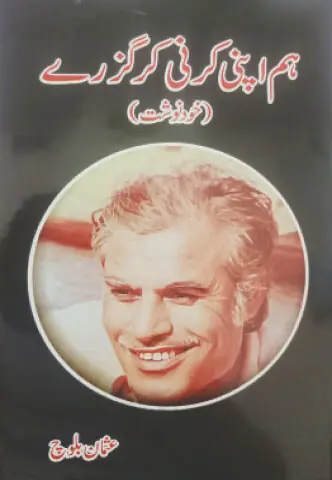
Hum Apni Karni Kar Guzray
By Usman Baloch
Mustaag Foundation
320pp.
There are books that do not merely tell a life. They recover one.
Hum Apni Karni Kar Guzray [We Did What We Had To Do], the autobiography of trade unionist Usman Baloch, is one such work. It is not a polished monument raised by institutions, nor a comfortable memoir written from the safety of retirement. It is a book of struggle, sweat and memory. It comes from the lanes of Lyari, the factory gates of Karachi, the restless years of labour agitation and the stubborn belief that ordinary people can shape history if they refuse to remain silent.
Usman Baloch is one of Pakistan’s most respected and enduring trade union leaders, a veteran labour activist from Lyari whose association with the workers’ movement spans more than six decades. Emerging from Karachi’s working-class neighbourhoods in the late 1950s, he devoted his life to organising workers and defending their rights at a time when trade union activity often invited repression and imprisonment.
I have always felt a special affection for books that rescue forgotten lives from the margins. Perhaps this is because much of our public memory is so unjust. Pakistan remembers generals, judges, landlords, bureaucrats and party leaders with tedious regularity. It does not remember workers with the same care. Those who built roads, ran mills, carried loads, operated machines and kept the city alive are rarely allowed to become authors of their own story.
Usman Baloch’s autobiography challenges that old cruelty. It tells us that history does not belong only to those who ruled. It also belongs to those who resisted. The title itself has a quiet force: Hum Apni Karni Kar Guzray. There is no self-pity in it. There is no grand claim of victory either. It sounds like the voice of someone who knows that life is brief, power is brutal and justice is often denied, yet one must still act.
That is perhaps the most moving thing about the book. Usman Baloch does not appear as a man waiting for history to reward him. He appears as a man who chose the difficult path because the easier one would have meant moral defeat.
The autobiography of trade unionist Usman Baloch chronicles a lifetime of struggle for workers’ rights but its emotional centre lies in its insistence that ordinary workers can think politically
Karachi has many histories. There is the city of colonial architecture, merchant wealth and elite nostalgia. There is the city of migration and violence. There is the city of ports, markets, land grabs and political mafias. But there is also another Karachi, less frequently narrated but more morally compelling: the Karachi of workers.
This was the Karachi of Lyari, Lea Market, SITE, mills, docks, construction sites, labour colonies and teashops where politics was not a television performance but a daily argument about bread, dignity and power. Usman Baloch belonged to this Karachi. His life reminds us that trade unionism in Pakistan was never merely about wages. It was about respect.
A worker who demands a fair wage also demands to be seen as a human being. A worker who forms a union challenges not only the employer but an entire social order built on obedience. In a deeply hierarchical society such as ours, that is a revolutionary act. The factory owner expects gratitude. The state expects silence. The police expect fear. The union asks the worker to stand upright.
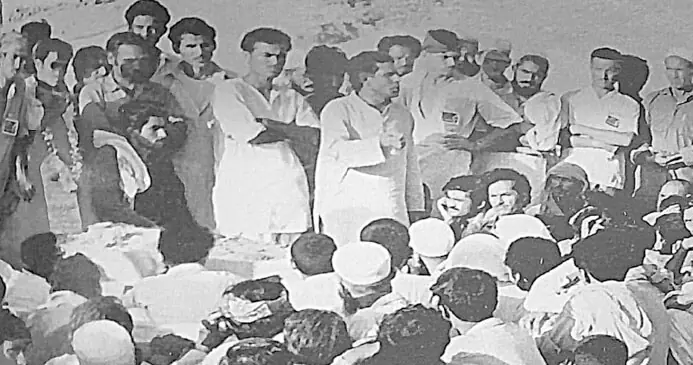
Usman Baloch emerged from a world in which politics was learnt through experience. His education came from labour meetings, neighbourhood discussions, strikes, arrests, betrayals and books read with urgency rather than leisure. That combination gave his activism its strength. He was not merely an angry man. He was an organiser. Anger can fill a street for an afternoon. Organisation can sustain a movement for years. Baloch seems to have understood the difference.
The book is valuable because it brings back the atmosphere of an era when Karachi’s working class still believed in collective power. The 1960s and 1970s were not romantic years. They were full of repression, hunger, state violence and political confusion. Yet, they were also years when workers, students and left activists felt that the world could be changed.
Ayub Khan’s dictatorship had promised development but delivered inequality, discipline for the poor and privilege for the powerful. In that climate, trade unionism became a school of democracy long before many elected institutions learned the meaning of the word.
Usman’s story also reminds us that labour politics crossed boundaries that later hardened into walls. In the mills and factories of Karachi, workers came from different linguistic, ethnic and regional backgrounds. They did not always overcome their divisions, but the union gave them a shared language. It taught them that exploitation could wear many faces but that its methods were familiar.
Low wages, unsafe conditions, arbitrary dismissal, intimidation and false promises were not Baloch, Sindhi, Punjabi, Mohajir or Pakhtun problems. They were workers’ problems. This is one reason the book feels relevant today. Karachi has become more fragmented, more cynical and more individualised. The language of class has retreated while the language of identity has expanded. Yet, hunger remains stubbornly material. Rent is not paid in slogans. School fees are not paid by ethnic pride. Medical bills are not settled by patriotic speeches.
The working poor still live with insecurity, only now they are more isolated than before. In such a time, Usman Baloch’s life reads not as nostalgia but as a warning. The book’s emotional centre lies in its insistence that ordinary workers can think politically. This should not need saying but, in Pakistan, it does.
The elite often imagine the poor as vote banks, mobs, beneficiaries or victims. Rarely do they imagine them as thinkers. Baloch’s life refutes that arrogance. Workers in his world debate strategy, assess leaders, understand law, recognise betrayal and interpret power with a sharpness that many educated people lack. Their vocabulary may not be academic but their intelligence is historical.
There is also a moral discipline in Baloch’s life that deserves attention. Trade union work is not glamorous. It requires patience with people who are afraid. It requires courage in front of police and management. It requires the ability to speak to workers who may doubt you, leaders who may use you and parties that may abandon you. A labour organiser must be both fire and rope: fire to inspire, rope to bind people together. Usman Baloch had that quality.
The role of Wahid Baloch in making this book possible is therefore not a secondary matter. It is central to the achievement. To compile, transcribe and prepare such a life for readers is itself an act of political memory. Many working-class leaders leave behind fragments: notebooks, recollections, speeches, letters and stories carried by friends. Without someone willing to gather them, they vanish. Wahid Baloch has performed the task of an archivist from below.
For younger readers, the book offers another lesson. Rights are not gifts. They are won, lost and won again. Every generation is tempted to believe that injustice is permanent and resistance is futile. Usman Baloch’s life gives a different answer. It does not say that resistance always succeeds. It says that submission always fails.
That is why Hum Apni Karni Kar Guzray should be read not only by trade unionists but by students, journalists, historians and all those who care about Karachi.
The reviewer is a columnist and educator. He can be reached at mnazir1964@yahoo.co.uk.
Published in Dawn, Books & Authors, June 21st, 2026