Moot calls for safe workplaces, equality and living wages for women workers
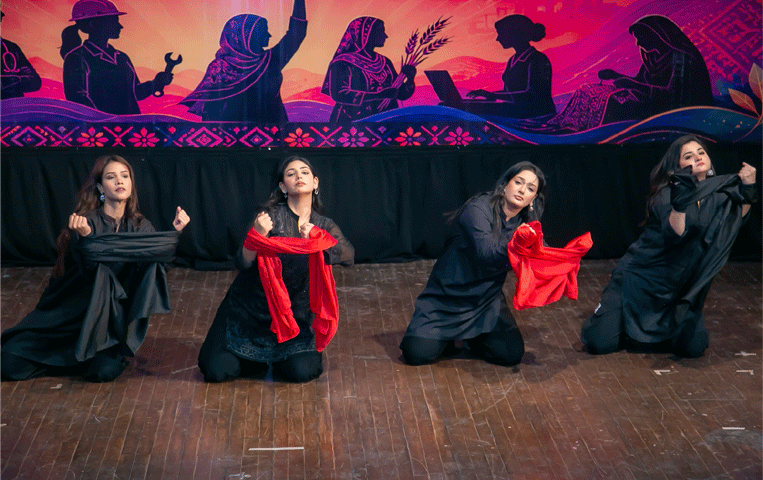
KARACHI: Labour leaders and rights activists on Sunday called for safe workplaces, gender equality and living wages for women workers, declaring that meaningful social and industrial progress is impossible without the empowerment of working women.
They were speaking at the All Pakistan Women Workers Conference, organised by the Home-Based Women Workers Federation (HBWWF), here at the Arts Council.
The conference brought together women workers from across Pakistan, particularly from the textile and garment sector, alongside representatives of labour unions, social movements and civil society organisations.
The event commenced with the singing of ‘The Internationale’, the international anthem of the working class.
Stories of resisting discrimination, sexual harassment shared at All Pakistan Women Workers Conference
During the first session, women workers employed in textile and garment factories and industrial units shared their experiences of resisting gender-based discrimination, economic exploitation, sexual harassment, wage theft and unlawful dismissals.
Participants highlighted that sexual and psychological harassment in workplaces had become widespread, while speaking out often exposed women workers to retaliation, including dismissal from employment and social stigmatisation.
Addressing the conference, Zubaida Muhammad Bakhsh, a garment worker employed in a factory producing apparel for an international fashion brand, narrated her struggle against workplace harassment.
She emphasised that women can challenge exploitation only by overcoming the fear and stigma associated with raising their voices. She stated that her two-year struggle not only secured justice for herself but also encouraged thousands of other women workers to speak out against harassment, discrimination, and abuse.
Other women workers, including Zareen, Tehreem, Soumiya, and Bushra, also shared accounts of their successful struggles against wage theft, illegal termination and workplace harassment.
They noted that the level of freedom and development in any society can be measured by the status and empowerment of women.
Chairing the session, prominent social activist Nargis Rehman stated that women workers from factories, home-based workplaces and other sectors were emerging as a powerful organised force, and that the conference itself stood as evidence of this growing movement. She expressed solidarity with the participants and said she was proud to be associated with their struggle.
Challenges to textile workers discussed
During the second session, representatives of labour organisations discussed the challenges facing more than 20 million workers employed in Pakistan’s textile and garment industry, particularly women workers.
Speakers emphasised that while the textile and garment sector contributes more than half of the country’s export earnings and serves as the backbone of the national economy, its workers continue to face widespread exploitation.
Illegal contractual employment practices, the lack of written employment contracts, the denial of social security and pension benefits, and restrictions on unionisation remain common, they added.
Labour representatives presented data highlighting gender-based economic inequality. Although women constitute only around 22 per cent of Pakistan’s industrial workforce, their share in the textile and garment sector exceeds 30pc percent. Despite this, women continue to face a significant gender wage gap and receive substantially lower wages than men for comparable work.
The speakers also noted that more than 12m women in Pakistan work as home-based workers, a large number of whom are located in Sindh. Despite existing legislation, these workers remain largely excluded from social protection and labour rights.
They criticised governments for neglecting workers’ welfare and strongly opposed anti-worker labour reforms. They particularly condemned the labour code introduced in Punjab while emphasising that any anti-worker legislation proposed elsewhere would also be resisted. At the same time, they welcomed the ongoing consultation process with workers’ representatives in Sindh.
Speaking on the occasion, Sindh Labour Minister Saeed Ghani assured participants that no labour legislation would be enacted without consultation with workers’ representatives.
He highlighted measures taken by the Sindh government, including women’s representation in labour welfare institutions, legislation for home-based workers and women agricultural workers and the enactment of occupational health and safety laws.
He assured participants that the recommendations adopted by the conference would be seriously considered and that concrete steps would be taken to ensure the rights, dignity, protection and safe working conditions of women workers.
The conference also elected a nine-member Pakistan Textile Garment Women Workers Committee to coordinate efforts aimed at advancing the rights and interests of women workers in the sector.
Resolutions
In a series of resolutions, the participants demanded immediate implementation of a living wage in place of the current minimum wage across all sectors; strict inspections and penalties against wage theft; an end to the misuse of contract labour for permanent work and the provision of appointment letters, social security and other legal benefits to all workers.
They demanded criminalisation of arbitrary dismissals, forced resignations and the denial of terminal benefits during factory closures or downsizing.
The participants called upon adoption of a zero-tolerance policy against sexual harassment, violence and gender discrimination in workplaces, including mandatory anti-harassment committees with women’s representation.
They also demanded protection of women’s rights to unionise, engage in collective bargaining and assume leadership positions within unions and workplace committees.
Among those addressing the conference were HBWWF General Secretary Zehra Khan, Human Rights Commission of Pakistan Chairman Asad Iqbal Butt, Nasir Mansoor of the National Trade Union Federation), journalist Mazhar Abbas and others.
Published in Dawn, June 15th, 2026