BUDGET 2026-27: The dividend that never was

UNDERPAID employment is endemic in Pakistan. The country has one of the largest youth populations in the world, which is often touted as a demographic dividend. But without adequate education and nutrition, a large young population can become a burden, even if jobs are available.
“My driver earns Rs40,000 but his daughter, who holds a master’s degree, earns Rs15,000 a month teaching at a nearby school,” says economist Faisal Bari. “If you start driving instead of me, you’ll get Rs40,000,” the driver joked to his daughter.
However, culture does not allow women socially acceptable entry into many sectors.
“The education sector in Pakistan is being run on the exploitation of female labour,” Mr Bari says. Salaries in rural schools can start at Rs5,000-6,000 a month, rising to Rs10,000-12,000. In urban areas, teachers often earn between Rs8,000 and Rs20,000.
Pakistan’s youth bulge was supposed to be its economic trump card, but it is now being nullified by nutritional shortfalls, exploitative employment and a lack of opportunities
The system works because teaching remains one of the few socially acceptable professions available to women, but even then, Pakistan still has one of the lowest female labour force participation rates in the region.
Although the country has made progress in narrowing gender gaps in education, and millions more girls now complete school, equivalent employment opportunities have not emerged.
The disparity exists at all ends of the spectrum; around 35pc of PhD graduates from Pakistani universities are women, yet female vice-chancellors are virtually absent from co-educational institutions, says Khadija Bari, director of the Population Research Centre at IBA.
Part of the problem is that senior positions depend on networking; however, the societal fabric prevents women from networking as easily as their male counterparts.
Countries that have genuinely improved women’s standings mandated it, setting targets of 40 to 50pc women in senior roles in key sectors. When women hold leadership positions, Ms Bari notes, more women are hired and more inclusive environments are created, which in turn improves organisational efficiency.
Decades-old challenge of stunting
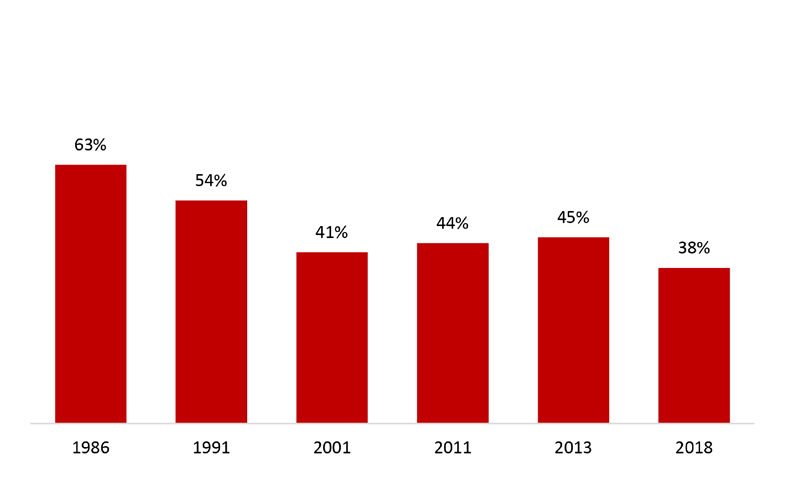
In Pakistan, about 40pc of children below the age of five are stunted compared to roughly 30pc across South Asia. The country’s infant mortality rates are among the highest in the world, and the highest in the region after Afghanistan. Sri Lanka and India have all made significantly faster progress on these indicators.
Though Pakistan’s malnutrition problem was identified decades ago, the indicators have not changed much, says Shahab Siddiqi, founding partner at Tabadlab. There is also a gendered dimension that deepens with time, he adds. A mother who was herself stunted is more likely to have stunted children, not just for biological reasons, but because the causes of stunting are societal and socio-economic.
Nutrition alone is not the full explanation, and there may be an overemphasis on food access. Clean water, sanitation, and the environment a child grows up in matter enormously. Growing up around animals, without access to clean water, in conditions where faecal contamination is present — these are as central to stunting as diet, says Mr Siddiqi.
The missing debate
Every year, the budget script is the same one of fiscal deficits, tax collection targets, IMF conditions, and debt servicing. What is almost never on the table, says IBA’s Khadija Bari, is the number that shapes all of it, i.e., population and its indicators.
“Everyone is talking about the pie, but nobody is talking about the number of people this pie is to be shared with,” she says.
Pakistan’s population of around 241 million is growing at 2.55 per cent, adding the equivalent of a population roughly the size of Lahore to the headcount every two years.
For her, the fiscal crisis and the demographic challenge are two sides of the same coin. But there is an important asymmetry between them. A country can borrow its way out of a temporary fiscal crisis. It cannot borrow its way out of decades of under-investment in its people.
Yet that under-investment continues. Pakistan spends 0.8pc of GDP on education, which is one of the lowest rates in the region. Health spending is similarly anaemic. These are not just social indicators,” she says.
“These are core economic factors that impact future economic performance.” The budget debate, she argues, should treat them not as a welfare sideshow, but as central to any credible growth strategy.
Is education worth it?
A brief by the Economic Advisory Group, Education Disaster: Nowhere To Go For Many raises the question whether there are sufficient returns to investing in education in Pakistan. The analysis postulates that the increase in annual earnings from an extra year of schooling in Pakistan is the lowest in the world.
An average return of 6.5pc is roughly the same financial return as investing in physical gold, the brief states. With an oversupply of labour relative to economic development, degrees primarily serve as a basic filter for mundane jobs, transforming formal education into mere “credentialing” rather than genuine skill-building. More troubling, in 40 of the 126 surveyed districts, returns on schooling drop to just 2pc or less.
Pakistan’s large youth population lacks adequate education and nutrition. Those who fare well on these two parameters find it hard to secure well-paying jobs. In such a scenario, it is hard to view the youth bulge as a demographic dividend.
Published in Dawn, June 8th, 2026