“To attain knowledge, add things every day. To attain wisdom, remove things every day.” — Lao Tzu, Chinese philosopher
Knowledge is information acquired from external sources. Knowing, on the other hand, emerges from within and determines how facts are comprehended. Knowledge has no value without knowing, while knowing can exist without knowledge.
A child knows how to recognise parents, communicate and play without any formal instructions. Village wisdom knows the right time to sow plants, or cure with herbs without knowledge of botany or biology, relying on collective memory and connection to nature. Most of us know how to change a lightbulb or operate a computer without knowledge of how electricity is produced or how binary technology works.
In Europe, knowledge gained priority over knowing around the scientific revolution of the 17th century, believing rational knowledge was superior to subjective experience. Other civilisations, such as that of India or the Muslim world, continued to see both knowledge and knowing as deeply connected.
The very first Quranic verse revealed was about the centrality of knowledge to human existence: Allah taught by the pen, taught man that which he knew not. Yet the Truth of the message was to be understood by intuition, knowing, what the Sufis called ma’arif.
While modernity has mastered the accumulation of information, true wisdom may lie in rediscovering forms of understanding that cannot be measured, catalogued or stored
Socrates believed true knowledge is not passively absorbed from the outside world but is a recollection or anamnesis. The immortal soul possesses all universal truths, but forgets them upon birth. Learning is the recognition of what was already known. Ibne Arabi formalised this with his concept of stages of knowledge by four qalams or pens. He also says ilm al-yaqin, knowing something through the proof of logic, is the first stage of knowledge. The final stage is haqq al-yaqin, knowing through experience.
The Greeks distinguished between episteme or knowledge, and gnosis or intuitive knowing. In medicine, the terms diagnosis and prognosis, based on educated intuition, carry the suffix -gnosis.
Over the years, knowledge gained prominence as the foundation of rationality, science and technology — needs of the modern industrial era. Knowing as intuition was relegated to the margins, the subject of religion and spirituality, the arts or village wisdom. Knowledge has become commodified, structured and prescribed — an essential element of intellectual superiority, educational systems and public policy.
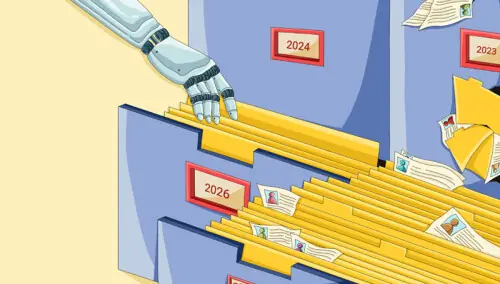
Until the arrival of internet search engines in the 1990s, there were only human search engines called librarians or book shop owners. Knowledge was accessed by scholars, academics or the educated. It was a slow, considered process. Today, knowledge is itemised. A Google search retrieves and ranks the best results, sometimes numbering in the hundreds of thousands, in less than a second. In the last two years, AI-generated articles have surpassed human-authored writing, suggesting knowledge is simply accessing what has already been written.
Europe, historically, managed knowledge to project political and economic power, establishing regulatory institutions in every imaginable field, as benchmarks for global standards. Post-colonial Europe gradually lost its role as the central global trading hub. Its 21st century strategy is “Europe of Knowledge” — investing in higher education, data management and research.
Knowledge, which was once a universal human endeavour shared across civilisations, took on a political dimension. The term “Knowledge Power Europe” was coined by the scholars Mitchell Young and Pauline Ravinet to underline the importance of knowledge to the European Union’s foreign policy and global relevance. It was to become a cultural filter, establish intellectual leadership and act as a coercive tool to persuade others to follow its regulatory regimes.
The Lisbon Strategy (2000) set a goal of making Europe the “most competitive and dynamic knowledge-based economy in the world”, an integral part of geopolitical objectives. It is seen as Epistemic colonialism — the systematic imposition of Eurocentric knowledge systems, values and worldviews to overwrite indigenous or local ways of knowing.
The world is bracing for a seismic political transformation. It would be incomplete without an intellectual transformation. T.S. Eliot, in his poem Little Gidding, written in 1942 in the midst of WWII, longs for the flames of destruction to fold back: “For last year’s words belong to last year’s language/ And next year’s words await another voice.” He vows:
“We shall not cease from exploration
And the end of all our exploring
Will be to arrive where we started
And know the place for the first time.”
Durriya Kazi is a Karachi-based artist.
She may be reached at
durriyakazi1918@gmail.com
Published in Dawn, EOS, June 7th, 2026