0
0
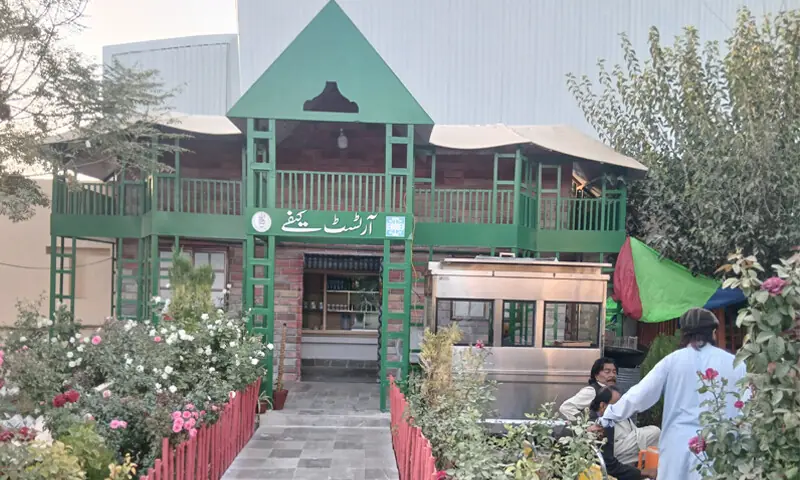

THE traffic was normal on Quetta’s otherwise overcrowded and narrow Spinny Road at sunset, as I entered the recently established ‘Artist Cafe’ housed at the Noori Naseer Khan Cultural Complex.
At the entrance, a signboard of ‘Artist Cafe’ directed me toward the two small separate gardens, with a green wooden structure in front. That was the tiny cafe, where about a dozen people were sitting in four groups.
Inside the cafe, I encounter Syed Munawar Shah, dressed in a shalwar kameez, making tea for his customers. An artist himself, Shah asks me to give him a few minutes while he serves his customers. Later, he pulls up two chairs near the entrance and speaks to me about the cafe and his journey as an artist.
Born and raised in Mach before moving to Quetta, Shah says his forte is marble art. He has fond memories of the picturesque Mach Valley, which he describes as a source of inspiration for his art.
A small outdoor cafe in Quetta provides artists a space to interact and express their creativity
Shah is particularly proud of his family and their contributions to his art journey. “My wife helps me choose colours for my marble art,” he says while taking pride in the “artistic environment at home”.
This is one of the reasons he is at the forefront of running the artist cafe — with an aim to bring artists together in a city that does not otherwise cater to creative souls.
“We have established the cafe so that artists can gather in one place and be at ease,” he tells me while looking at a mixed crowd of artists busy chatting in the gardens.
The return of theatre
Agha Mohammad Kurd is a local director and actor. On the day I visited the cafe, I found him along with his writer-cum-artist friend Mohammad Zafar engaged in an animated discussion. As I approached their table, they welcomed my intrusion and invited me to join them, and motioned the server, who placed a cup of freshly brewed tea before me.
Like the rest of the crowd, they are also happy about the cafe and the return of the theatre next door, after almost 30 years.
“This is something we needed for quite some time,” a jubilant Kurd tells me. “We have been like nomads in our own city, without a place to sit in the evenings, sitting in different places or tea shops. Fortunately, we have a place to sit along with our artist friends...”
Kurd is right that there are hardly any cafes in Quetta, especially on Jinnah Road, which used to be a hub of cafes with a bustling community of writers, politicians, lawyers, and journalists.
This culture ended a long time ago. In this cafe, artists like Kurd have found shelter. They can sit here and write without interruptions.
Balochistan government’s culture director Dawood Tareen says that the artist cafe has been established to provide a thriving environment for the artist community. “We have also started the theatre for them after a long time, to revive the theatre as well,” he adds.
Zafar and Kurd are optimistic about the return of theatre after 30 years.
“There was no funding, interest, and a place to hold our programmes in Quetta,” Mohammad Zafar recalls. “Now that it is revived in Quetta, it has sparked a ray of hope among artists to continue their work.”
Kurd says the theatre provides them a platform to perform their drama, which is a comic drama.
After sunset, the weather turned pleasant, and we remained seated outdoors to enjoy the cool breeze and for lack of options. The tiny cafe only has a space for the kitchen. For Kurd and Zafar, this arrangement, though workable at present, will be uncomfortable in winter.
“We will not be able to sit outside,” Kurd adds. “There should be a space inside the cafe during the winter season.”
In response to this, Syed Munawar Shah assures that they have a plan to address this concern. We will expand the cafe before the onset of winter, he adds.
At the same time, Kurd is opposed to the idea of allowing ‘outsiders’ to preserve the cafe’s identity. I ask him why he thinks like this, as opening the cafe up to the general public could be a good source of revenue to make the business model sustainable.
After a brief silence, he responds. “What if someone is drunk and comes to the cafe to destroy the artistic environment?”
His friend Zafar simply smiles.
Published in Dawn, May 31st, 2026