Beneath Swat’s emerald dreams lie poverty and despair
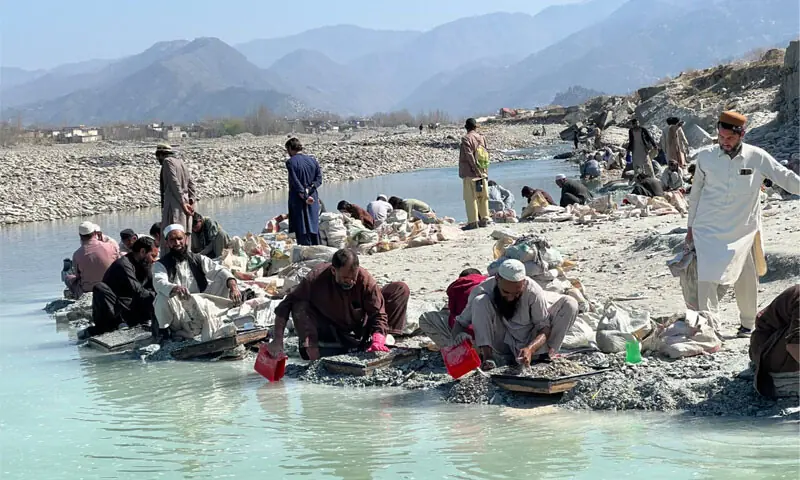

MINGORA: The common perception about the emerald trade in Swat is that everyone associated with the precious stone business lives a prosperous and comfortable life. Perhaps that is why the number of people sifting through soil along the banks of the Swat River in search of emerald fragments continues to grow every day.
However, the harsh reality behind their earnings became clear during this correspondent’s conversation with dozens of labourers, including 75-year-old Bakht Zameen Khan, who sat among at least 80 workers busy searching through heaps of earth for traces of the valuable gemstone.
Despite remaining occupied with his work, he patiently answered every question in detail. He said he had eight children, four of whom were married and living separately, while one son was mentally disabled.
“Very few among those searching for emeralds along the riverbank manage to find even a small fragment once or twice a week,” he explained. “Yet every morning people leave their homes with the hope that they will return with enough wealth to end their financial hardships.”
He said reality was far different. The soil brought from emerald mines and sold in sacks for Rs50, Rs100 or Rs200 had already been thoroughly processed, leaving behind little chance of finding anything valuable. “Only by sheer luck does someone discover a tiny piece of emerald,” he said.
According to him, even when labourers manage to find a fragment, they cannot afford to keep it for the next day.
“We immediately sell whatever little piece we find to the contractors standing nearby, usually in the afternoon. With the cash in hand, we buy food items, medicines and other household necessities before returning home.”
Other workers, including Abdul Jalil from Lindikas and Syed Mohammad from Yousafabad, echoed concerns.
They said finding even one small emerald fragment in an entire week was considered fortunate, as the income from it often had to cover household expenses for several days.
“Many days pass without finding anything at all,” a worker said quietly. “Instead of earning a profit, we often suffer losses. Life somehow just goes on.”
Abdul Jalil shared the personal tragedies that had deepened his financial struggles. One of his six children, a 20-year-old son, recently passed away, while another 12-year-old son is suffering from a severe intestinal problem.
“He [son] remains sick all the time. He has undergone four operations but there has been no recovery,” he said. “Because of this condition, he cannot attend school or even participate in family gatherings.”
For him, the mounting medical expenses have made it increasingly difficult to run the household. “Our financial condition is so poor that sometimes we have to ask neighbours for cooked food,” he said.
Faiz Mohammad of Chakesar in Shangla said he suffered from kidney disease and had already undergone three surgeries without improvement in his condition.
The workers also expressed resentment over the suspension of financial assistance previously received through the Benazir Income Support Programme. They claimed the aid had been stopped without explanation. They urged the federal government to restore cash payments.
For many along the Swat River, the search for emeralds continues not because it guarantees prosperity but because it remains one of the few hopes left for survival. Another young worker said he was a madressa student, hailing from a poor family background, and had to meet his expenses by selling the emerald fragments.
Published in Dawn, May 31st, 2026