No change in stance on Palestine, says Dar


 0
0
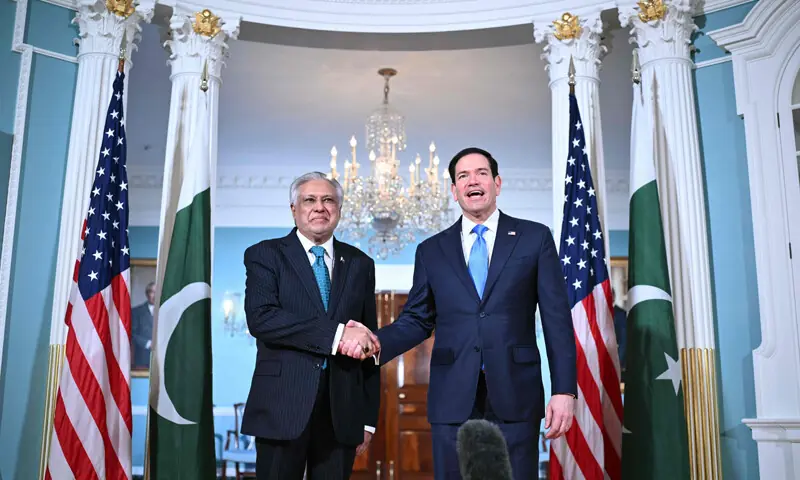

WASHINGTON: Deputy Prime Minister and Foreign Minister Ishaq Dar said on Friday Pakistan remains firmly committed to its longstanding position on Palestine and Gaza, stressing that there could be no change in Islamabad’s stance towards Israel without the establishment of an independent Palestinian state.
Speaking to US-based Pakistani media after concluding talks with US Secretary of State Marco Rubio in Washington, Mr Dar said he had reiterated Pakistan’s position during his engagements at the UN earlier this week.
“Pakistan remains constantly steadfast on its position on Palestine and Gaza,” Mr Dar said, adding that Israel “must move towards the establishment of a Palestinian state for any change in Pakistan’s stance on Israel.”
Mr Dar travelled to New York earlier this week to participate in a China-sponsored discussion at the UN Security Council on the role of the United Nations in resolving global disputes before arriving in Washington for bilateral talks with Secretary Rubio.
After talks with Rubio, deputy PM says world appreciates Pakistan’s role in easing Iran tensions
The Pakistani foreign minister said Washington “deeply appreciates” Pakistan’s efforts aimed at easing tensions between Iran and the United States, noting that this recognition was conveyed during his meeting with the US secretary of state.
He referred to a statement issued by the US State Department after the meeting, which said that “the Secretary thanked the Minister for the constructive role Pakistan continues to play in realizing President Trump’s vision for peace in the Middle East and its mediation efforts with Iran.”
The statement added that the two sides agreed on the “importance of working together to further strengthen a meaningful partnership that fosters security and prosperity for both Americans and Pakistanis.”
In a separate statement attributed to State Department spokesperson Tommy Pigott, Washington said Secretary Rubio had met Mr Dar in Washington and discussed bilateral cooperation as well as regional security issues.
“Secretary Rubio expressed his condolences for the victims of the recent Balochistan Liberation Army terrorist attack in Quetta,” it said.
“The Secretary and the Deputy Prime Minister agreed on the importance of working together to further strengthen a meaningful partnership that fosters security and prosperity for both Americans and Pakistanis,” the statement added.
Meanwhile, Pakistan’s Foreign Office described the meeting as positive and forward-looking, saying Secretary Rubio acknowledged Pakistan’s “sincere diplomatic and mediatory efforts for peace and stability in the region and beyond”.
According to the FO statement, the two leaders “expressed satisfaction over the positive momentum in Pak-US bilateral relations and exchanged views on the evolving regional and global situation”.
“The two sides agreed to strengthen bilateral cooperation in all areas of mutual interest, including trade and investment, security, and counter-terrorism,” the statement added.
“They also agreed to advance the Pak-US partnership, propelled by high-level exchanges and shared interests in regional peace, security and prosperity.”
Following the meeting, Secretary Rubio posted a message on X, formerly Twitter, highlighting Pakistan’s diplomatic role in the region. “Met with Pakistani Deputy Prime Minister and Foreign Minister Ishaq Dar and thanked him for the role Pakistan continues to play in advancing peace in the Middle East,” he wrote.
“We agreed on the importance of working together to further strengthen a meaningful partnership for greater security and prosperity for our two nations.”
Dar also maintained the cautious approach reflected in the two official statements, emphasizing that he was not in a position to divulge details of his talks with Rubio and other American and Iranian officials. He added, however, that he was very hopeful Pakistan’s efforts would help achieve comprehensive peace in the Middle East.
The foreign minister said he and his team, which included Pakistan’s Ambassador to the United States Rizwan Saeed Sheikh, were “very satisfied” with their talks with Secretary Rubio.
“We are the mediators and, as such, we are required to maintain secrecy,” he said, adding that both the Americans and the Iranians appreciated Pakistan’s approach.
Dar said it was not only the United States and Iran but also countries across the globe that were appreciating Pakistan’s efforts.
“The mediation has brought global recognition for us, as did our victory against India,” he added.
Dar said Qatar, Oman and several other countries had also expressed interest in hosting the talks, but Pakistan was chosen because of its close and friendly relations with all parties involved in the conflict.
When reminded that the US has traditionally maintained a transactional relationship with Pakistan and asked if the country’s current mediatory role could lead to a more substantive and strategic partnership, Dar said that during Friday’s meeting he proposed holding substantive discussions on building a strategic partnership, and that his proposal was accepted.
Secretary Rubio, he said, also agreed to visit Pakistan later this year. He did not say whether the next round of US-Pakistan talks would be held in Islamabad, but emphasised that Pakistan would continue to play a key role in the process.
Published in Dawn, May 30th, 2026