0
0

Amna Rahman’s practice situates itself within the evolving language of contemporary figurative painting in Pakistan, yet it resists easy alignment with overtly socio-political narratives. Instead, her work turns inward, staging the self as a site of fragmentation, doubling and quiet negotiation. The figures that populate her canvases are rarely stable, instead seeming suspended between states — observed and observing, present and dissolving — suggesting an ongoing inquiry into perception and identity.
Her surfaces are layered, with forms emerging and receding through controlled yet expressive brushwork. A tension persists between clarity and obscurity: faces are partially withheld, bodies cropped or multiplied, gestures interrupted. This withholding becomes central to her visual syntax, inviting the viewer not to resolve the image, but to inhabit its ambiguity.
For her solo exhibition ‘Locus: Where Eyes Settle’ at Karachi’s Chawkandi Art Gallery, the artist has displayed only six paintings, yet each carries a striking sense of intensity and conceptual weight. The exhibition focuses on surveillance, gendered labour and Karachi’s masculine-coded public spaces, examining how women navigate sites shaped by water politics and ecology. Reimagining female presence in male-centric environments such as dhabas in Ibrahim Hyderi Fishing Village, Rahman employs surveillance as a critical lens.
Her engagement with the female form is particularly significant. Rather than presenting it as fixed or symbolic, she treats it as fluid and psychological rather than merely physical. In doing so, she sidesteps the didacticism that can accompany gendered representation, offering instead a more introspective reading of selfhood. The ‘alternate selves’ implied in her work are less about spectacle and more about instability — about the shifting, often contradictory conditions of being.
Amna Rahman’s striking artworks capture women within spaces shaped by labour, surveillance and masculine power
One painting, set within a dhaba, is perhaps the most overtly theatrical. Horizontally stretched, almost cinematic, it stages a compressed space where two central seated women disrupt an otherwise all-male environment. Rahman, who photographs such situations first, says the men were all watching a movie on television. Their frontal, steady gaze anchors the composition, while the surrounding men glance obliquely, their attention fragmented and unsettled. The politics of looking becomes central: the women’s composure contrasts with the men’s quiet curiosity. Subtle shifts in body language — folded arms, turned torsos — heighten this tension. A muted palette of dusty blues, ochres and greys reinforces the claustrophobic interior, while everyday details ground the scene in a recognisable socio-economic milieu. The result is a social rupture — a reordering of space and power.
In contrast, another painting presents a female driver seated within the richly ornamented cabin of what is revealed to be a water tanker. This environment, deeply coded as male within South Asian visual culture, is re-occupied with quiet authority. The woman is neither symbolic nor decorative, as she appears entirely at ease, absorbed and in control. The interior, dense with textiles, tassels and painted motifs, echoes the language of truck art but with painterly restraint. Light enters through an open window, yet the psychological focus remains inward. Her posture suggests both comfort and readiness, while her contemplative expression introduces a subtle tension. This is not a simplified image of empowerment but an exploration of presence — of occupying space without spectacle.
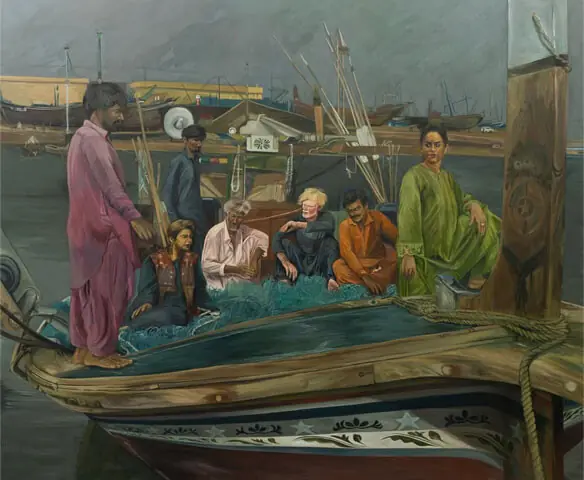
A third painting expands into a coastal setting, depicting a boat crowded with fishermen, workers and a centrally placed woman. The composition is more open, yet the atmosphere is heavy and subdued. The overcast sky and muted palette evoke fatigue and introspection. The woman, standing slightly apart, looks outward, as if registering a horizon beyond the frame. The boat becomes a metaphor: precarious, collective, suspended between survival and uncertainty. Nets, ropes, and tools are rendered with care, reinforcing the materiality of labour.
Together, these works, alongside the remaining three equally potent canvases, form a concise yet powerful body of work. Rahman is not merely documenting environments — she is re-inscribing them through gendered presence. Women emerge not as anomalies but as catalysts, subtly altering the emotional and social dynamics of each scene. Despite the richness of detail, the paintings resist romanticisation, operating instead through stillness, gaze and relational tension. Figures are caught in moments of waiting, watching or thinking. These states are rarely foregrounded in depictions of working-class life.
Ultimately, what binds these paintings is a persistent question: who belongs where? And, more crucially, who gets to look, and who is looked at?
‘Locus: Where Eyes Settle’ was on display at Chawkandi Art Gallery, Karachi, from April 21-30, 2026
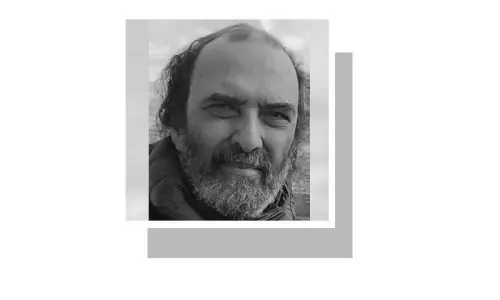
Rumana Husain is a writer, artist and educator. She is the author of two coffee-table books on Karachi, and has authored and illustrated 90 children’s books
Published in Dawn, EOS, May 24th, 2026