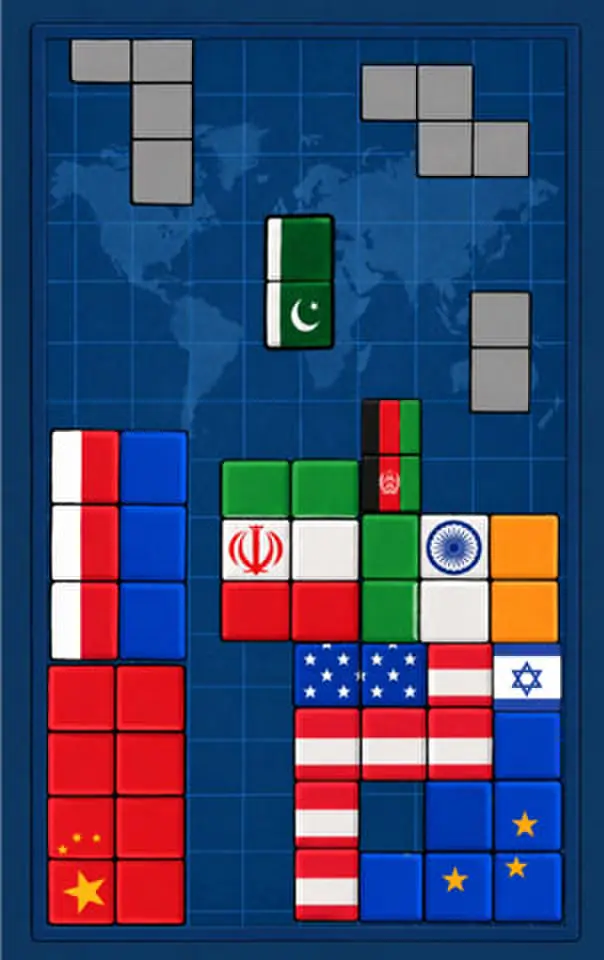
Tetris is an interestingly simple but challenging game. Blocks of different shapes descend on to a confined board and the player must continuously find space to accommodate them. Every placement affects the next move. As the board fills, choices diminish, mistakes become increasingly expensive, and even the right piece arriving at the wrong time can become a problem.
The evolving global geopolitical landscape bears an astonishing resemblance to this game. Yet the intrinsic simplicity of the game is missing: the blocks are getting larger, time and space are shrinking, and states have less freedom to position themselves without new vulnerabilities.
A bird’s eye view of the prevailing environment reveals that Russia remains locked in Ukraine in a contest it portrays in terms of security, strategic identity and its place in the European order. Europe, meanwhile, is grappling with the perceived long-term threat from Russia, the burden of sustaining Ukraine, changing ties with Washington, the demands for greater burden-sharing, energy insecurity and sluggish growth.
Long-standing assumptions underpinning European security no longer appear immutable. In the Middle East, the widening confrontation involving Iran, Israel and the United States has transformed an already unstable region, where escalation can have consequences far beyond its geographical boundaries. A prolonged crisis in the Gulf can rapidly translate into higher energy costs, inflation, disrupted supply chains and slower growth in South and Southeast Asia.
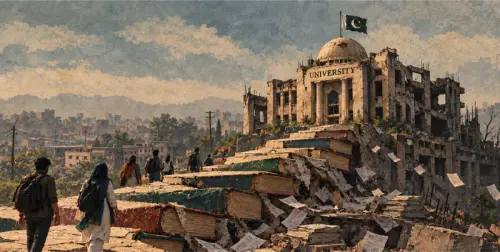
As global power shifts, the world gets reconfigured and crises become increasingly interconnected, Pakistan must decide which relationships to prioritise — and which commitments it can no longer afford
Amid this deafening strategic noise, China has displayed what may be described as strategic restraint. Beijing has enormous economic stakes in the stability of the Middle East and the international trading system, yet it prefers to remain cautious of direct entanglement in these conflicts. Whether this represents deliberate patience or a preference to let others exhaust themselves is debatable. China’s willingness to help shape the emerging order remains uncertain.
Such is perhaps the defining characteristic of today’s geopolitical Tetris: the pieces are no longer independent of one another. A conflict in Ukraine alters Europe’s security and energy calculations. War in the Middle East affects Asian economies. Competition between Washington and Beijing influences technology, trade, investment and supply chains across continents.
Global interdependence has erased the geographical separation between crises. The question, therefore, is not how individual crises will end, but what international system will emerge as the pieces settle.
THREE WAYS TO READ THE BOARD
Let us see how various schools of thought view the changing global landscape.
Offensive realism holds that great powers operating in an uncertain international system seek power, favourable balances and regional predominance, because they cannot entrust their survival to the intentions of others. Viewed through this prism, the present turbulence may represent less an aberration than a redistribution of global power.
Such an order may contain several poles yet revolve predominantly around two centres of gravity: the US and China. Russia, India, Europe and other consequential powers will occupy important spaces, but much of international politics could increasingly be influenced by competition between Washington and Beijing. At its extreme, this could produce informal spheres of influence, accompanied by expectations of non-interference in each other’s core strategic spaces.
Another view sees the turbulence of [US President Donald] Trump 2.0 as a disruption rather than the definitive end of the US-led international order. Institutions, alliances, financial networks and economic relationships built over eight decades possess considerable resilience. A post-Trump US could return to its traditional alliances and restore much of the tone and tenor of the previous order, albeit under changed circumstances.
A third viewpoint holds that the emerging system may be neither conventionally bipolar nor genuinely multipolar. It could become an untidy combination of both, with several centres of power operating beneath an overarching US-China rivalry. A country may depend upon China for infrastructure, the US for technology and finance, the Gulf for energy, Europe for exports and another state for security cooperation. Geopolitical blocs increasingly overlap. This is almost the projection of the existing fragmented order in a more orderly manner.
WHERE PAKISTAN FITS
For Pakistan, this geopolitical Tetris raises several practical questions. Should Pakistan lean towards China or rebalance towards the US? Should it privilege its Gulf relationships or accommodate Iran? Should regional connectivity or traditional security considerations determine its approach towards India?
In my view, Pakistan must equally avoid strategic overextension. It neither has the economic capacity nor needs the ambition to seek a leading role in global geopolitics. Its priorities should remain economic growth, development, political stability and regional integration. Strategic relevance should follow national strength, rather than become a substitute for it.
There is, however, a limit to how long strategic optionality can be preserved. As in Tetris, the available space diminishes with every falling block. The time may be approaching when Pakistan will have to make harder choices, use the lifelines available to it and place some blocks decisively before the space to manoeuvre disappears altogether. Strategic autonomy should therefore not become an excuse for indecision.
Pakistan must have the confidence to say no when its vital interests are compromised, say yes when enduring national interests converge, and exercise restraint when involvement would overstretch its capabilities without commensurate gains. The test should not be who is asking, but what serves Pakistan’s long term national interests.
If the world evolves towards a sharper US China bipolarity, Pakistan should avoid becoming a frontline state in their competition. But it cannot disregard the depth, geography and strategic significance of its relationship with China. China should remain Pakistan’s principal strategic anchor, while Islamabad preserves the scope for productive relations with the US, wherever interests converge.
If a multipolar order emerges, Pakistan should exploit the greater diplomatic space it offers. Stronger economic and political engagement with the US, Russia, Europe, the Gulf, Iran, Türkiye and Central Asia can coexist with its relationship with China. But multipolarity offers greater room for manoeuvre only to a Pakistan economically strong to use it.
However, if the US-led order regains much of its earlier character after the Trump era, Pakistan should avoid both unnecessary confrontation with it and a return to dependency that characterised earlier phases of the relationship. Engagement with Washington should remain substantive and mutually beneficial, without being at the expense of relationships that serve Pakistan’s longer-term interests.
THE DOMESTIC FOUNDATION
One constant across all three eventualities is that Pakistan’s future lies principally in its own region. China will remain its neighbour and strategic partner; Central Asia will remain a potential gateway for connectivity; Iran and Afghanistan will continue to influence its western security environment; the Gulf will remain vital for energy, investment and economic linkages; and India will remain a neighbour with which competition must be managed and a more stable modus vivendi sought.
However, no external relationship, however strong, can compensate for domestic weakness. A weak economy constrains foreign policy choices before external demands even arise. Our strategic investment must therefore remain domestic, focusing on economic growth, political stability, human development, energy security, stronger institutions, technological capacity and the expansion of our productive base.
Pakistan does not need to be present at every geopolitical table, mediate every conflict or seek relevance in every contest. There is strategic wisdom in knowing where not to become involved. A state overstretched abroad while economically fragile at home eventually discovers that visibility is not the same as influence.
The emerging world order may be bipolar, multipolar or a modified restoration of the old order. Pakistan cannot determine which will take shape, but it can determine whether it enters that order economically vulnerable and strategically dependent, or internally stronger, regionally integrated and confident enough to make choices on its own terms.
Tetris offers one final lesson: a player cannot wait indefinitely for the perfect block. Decisions must be made with the pieces available and the space that remains. For Pakistan, that moment may be approaching. The challenge is to recognise which options are worth preserving and which choices can no longer be postponed.
Pakistan cannot determine the shape or sequence of the blocks descending on to the geopolitical board. But it can strengthen its foundations, secure its regional space and choose its placements wisely. In the emerging geopolitical Tetris, survival may depend not on fitting everywhere, but on knowing where Pakistan truly belongs.
The writer is a retired lieutenant general of the Pakistan Army and president of the Islamabad Policy Research Institute
Published in Dawn, EOS, November 1st, 2026