0
0

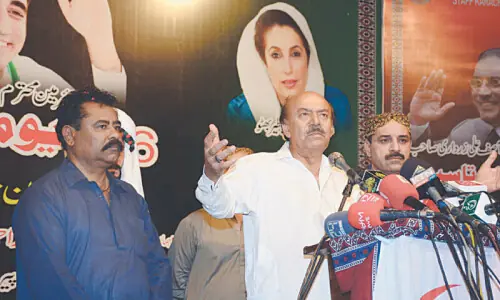
KARACHI, July 5: Labour leaders at a moot here criticized the Working Hours Amendment Bill 2006 and stressed the need for launching a united and unified movement against it and to convene a meeting of all labour federations and unions of the country to chalk out a joint strategy.
They were speaking at a consultative meeting on “Working Hour Amendment bill 2006”, organized jointly by the National Trade Union Federation (NTUF) and the Labour Education Foundation (LEF) at a local hotel on Wednesday.
They were unanimous in opinion that this bill was made without considering rights of labourers and it was aimed at benefiting employers and industrialists. They charged that the procedure for amendments adopted in this regard was totally unconstitutional and illegal. “These amendments would result into an unprecedented and worst labour exploitation”.
Karamat Ali, Director of Pakistan Institute of Labour Education & Research (PILER), said rather than providing relief to Wapda workers, a hefty amount of Rs52 billion was being given to Wapda so that it could be made even more lucrative for private buyers.
He was of the view that federations of all industrial zones had to play their active role to nip this evil in the bud, adding “for labour friendly laws, we have to choose two ways, firstly to approach courts and secondly in case of failure, we have to show our power”.
Ahmed Khan, General Secretary, National Labour Federation (Karachi chapter), called for participantion of each federation to submit petitions separately against these oppressive laws before the Chief Justice of Pakistan so that this serious problem could be brought to his attention.
Shafiq Ghauri, president of NTUF, said this bill was against international laws and in confrontation of ILO Conventions.
M A K Azmati, prominent labour law expert, told dimensions of amendment in Workers Compensation Act, Companies Profit Participation Fund (CPPF), Minimum Wages Act, Workers Welfare Fund Ordinance 1971 Factories Act 1934, Shops and Establishment Ordinance, 1969, West Pakistan Industrial & Commercial Employment (Standing Orders) Ordinance 1968 and EOBI Act 1976.
Regarding minimum wages, he demanded that these be increased them from Rs4,000 to Rs8,000 so that workers could meet their daily expenses in the face of sky-rocketing inflation.
Criticizing the increase in working to 12 hours, he termed it a violation of Section 36 of the Constitution, which allowed only nine-hour long working day.—PPI