0
0

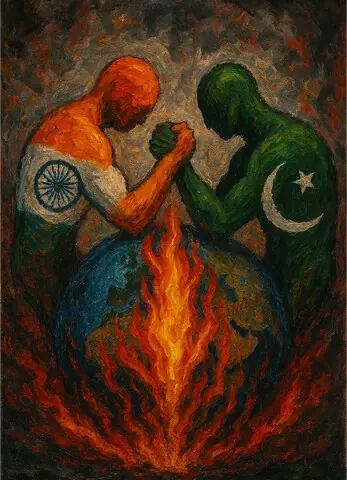
THIS is with reference to the report “Next India-Pakistan conflict may be ‘more dangerous’, analysts warn” (May 6), according to which, a growing body of international opinion suggests that the next such crisis between the two nuclear armed neighbours is not only more likely, but will prove dangerous and with fewer opportunities for outside power to contain it. Another crisis is not a question of if, but when, the report said.
The nature of war remaining constant, what is or likely to be the new character of warfare? Foremost, it is going to be a high-intensity, high-tempo, full-scale war unlike the last round of sporadic bursts of conflict. Instead of contact, it would largely be a non-contact affair. There will be no land invasions. There are not going to be any linear borders.
There will be no fronts, rear or lateral. War will instead be all over, in every urban centre, city, town and even in rural areas. There would be wide-ranging attacks with drones, loitering munitions and precision-guided missiles. This would be alongside major application of air power employing beyond-visual-range (BVR) weapons. Ground-based air defence systems would work to limits.
Multi-domain operations (MDOs) will be the defining characteristic, with each side attempting to close the kill chain as swiftly as possible. The side doing it faster will dominate battle(s). Good visibility or situational-domain awareness through satellites and other means, and the control of electromagnetic spectrum would be an utter need. Cyberattacks and massive disinformation will have to be battled at all the three levels of war; strategic, operational and tactical.
A major risk will be in controlling the vertical escalation of war. Both sides would like to dominate the escalation ladder. In the presence of dual-use missiles, absence of viable means of communications, and, above all, the fog of war, the risks of miscalculation abound. The conflict last year has brought down the nuclear threshold. What happens in the next round of high-intensity, high-tempo conflict is anyone’s guess.
Pakistan’s vulnerability resides in three elements; its elongated geography and lack of strategic depth, critical strategic infrastructure situated in close proximity to the adversary, and the Indus Waters Treaty (IWT) that has been unilaterally put on hold by India. The country’s economic fragility and expected increase in freight cost of transporting strategic goods could also inhibit a protracted war.
On its part, India obdurately maintains that its military operation is merely on a pause. With a bruised political pride post-Pahalgam and estranged relations with United States President Donald Trump, an irrational act from the Indian prime minister cannot be wished away. Possibility exists of misadventure under some pretence, like some malevolent act along the Sir Creek border. One cannot even rule out Indian navy intercepting or seizing Karachi-bound commercial vessels coming from China under some manufactured pretext.
As things stand, the Doomsday Clock has already been reset from 17 minutes in 1991 to just 85 seconds in January 2026. We are, indeed, living in dangerous times.
Cdr (retd) Muhammad Azam Khan
Lahore
Published in Dawn, May 15th, 2026