0
0

THE ancients were right: the earth must be flat. For years, entire continents disappear over the edge of our awareness. We left-overs from the 20th century have been trained to be Eurocentric in our outlook. We know more about the history of the Western world than our own, because it has been ingrained in us. We know so much about Chinese civilisation because China took care to preserve it.
We know next to nothing about the great cultures that existed in South America — for example, the Aztecs in Mexico or the Incas in Peru — before the Hispanics looted them. (One haul from the Inca treasury, a historian has calculated, consisted of a mini-Fort Knox — 5,900 kilograms of gold and 11,800 kg of silver.) We know even less about the diverse cultures of Africa, before Europeans plundered the hapless continent for precious gems, rare minerals and convoys of unwilling human assets.
There is evidence that the earliest human settlements in South America are dateable to 15,000 years ago. That is yesterday, compared to Africa where modern humans or homo sapiens lived about 300,000 years ago. Migrations from Africa across other continents began between 60,000 to 70,000 years ago, making us all cousins many times removed. That rather puts current political conflicts into perspective.
Some believe that US foreign policy since 1945 has deteriorated from one of insidious leadership to brutal intervention. The US was once looked up to; it is now looked down upon. Few remember that in the 1950s, the US tried to woo its neighbours in South America. In 1958, US vice president Richard Nixon was sent on a goodwill tour. In Peru, he was spat upon, and in Venezuela, he and his convoy were attacked by a mob in Caracas, enraged after the US granted asylum to the deposed Venezuelan dictator Marcos P. Jiménez.
Current US foreign policy is now a diplomatic prism.
This January, another Venezuelan dictator — Nicolás Maduro — was abducted by the US from the same Caracas and flown to New York, where he is confined to a different class of exile. Meanwhile, his former vice-president — the compliant Delcy Rodríguez — has opened Venezuela’s treasury of oilfields to US exploitation.
Current US foreign policy is now a diplomatic prism, refracting different meanings to the eye of each beholder. The Trump administration would have us believe, for example, that every defeat is, in fact, a victory, every Operation Whatever a success: Operation Desert Storm in Iraq (1991), Operation Enduring Freedom in Afghanistan (2001-2014), Operation Inherent Resolve against ISIS (2014-present), and the latest Operation Epic Fury — the US-cum-Israeli military coalition against Iran. Ivor Novello’s famous World War I composition — Keep the Home Fires Burning — has been given a macabre inversion — ‘keep the foreign fires burning’.
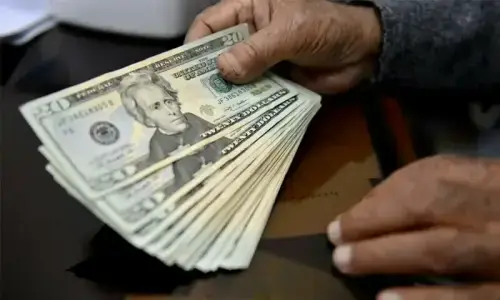
The present US administration is understandably reluctant to admit its losses in Operation Epic Fury. The Pentagon has demanded a budget of $1.5 trillion, not to conclude but to continue the war. Vladimir Putin’s Russia has allocated between $138 billion to $167bn in its 2025 budget for national defence, of which about $100bn relates to the war in Ukraine. In common with defence expenditure in most countries, about 60 per cent of Russia’s military budget is sub-surface, hidden from the public.
Wars, though, are not waged by accountants calculating balance sheets or the bottom line. Wars are the most expensive form of self-aggrandisement, the costliest display of narcissism by arrogant leaders. Trump, Putin, Zelensky, Netanyahu recite the same mantra: ‘I don’t care what you think — unless it is about me’.
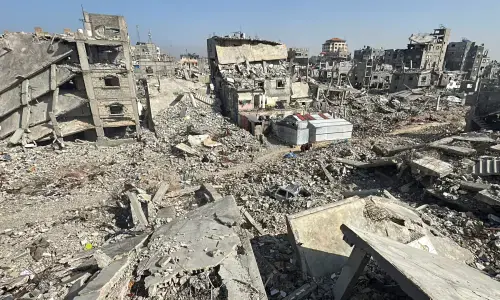
It is becoming clearer day by day that the US-Israel vs Iran conflict is moving inexorably into a more brutal level of combat. While Iran plays diplomacy with a ping-pong bat, Trump and Netanyahu respond with a steel bludgeon. But, despite the bombast and false rhetoric from the US side, Iran has brought Trump to his knees. He is almost praying for deliverance. Will China answer his prayers?
President Trump is making a state visit to Beijing (May 13-15). President Xi Jinping will not do anything as crass as to lecture his guest on his erratic failures. He may, however, suggest that Trump consults the I Ching, China’s traditional method of divination involving 64 six-line hexagrams. Trump will find comfort in Hexagram 29 (K’an / Dangerous Depths): “Excessive ambition takes one to the brink of danger. When the water rises quickly in a narrow canyon, think only of escape. You are trapped in a thicket of troubles — seemingly with no way to escape. This is a risky position to be in. If you behave properly and remain faithful, you will survive, no matter how tough things get. Remember that you are the victim of your own mistakes…”
The writer is an author.
Published in Dawn, May 14th, 2026